
When homeowners look at their roof, they often see only the surface.
Shingles.
Maybe gutters.
Perhaps a chimney or skylight.
But beneath and around those visible elements lies an intricate system of components designed to protect the home from rain, heat, wind, and moisture.
Every ridge.
Every valley.
Every vent.
Every flashing detail.
Each has a specific purpose.
And if one component fails, the performance of the entire roofing system may be affected.
Let’s take a closer look at the anatomy of a modern roof.
PART 1
The Main Structural Components of a Roof
The first group includes the structural elements that define the roof’s shape and help direct water safely away from the home.
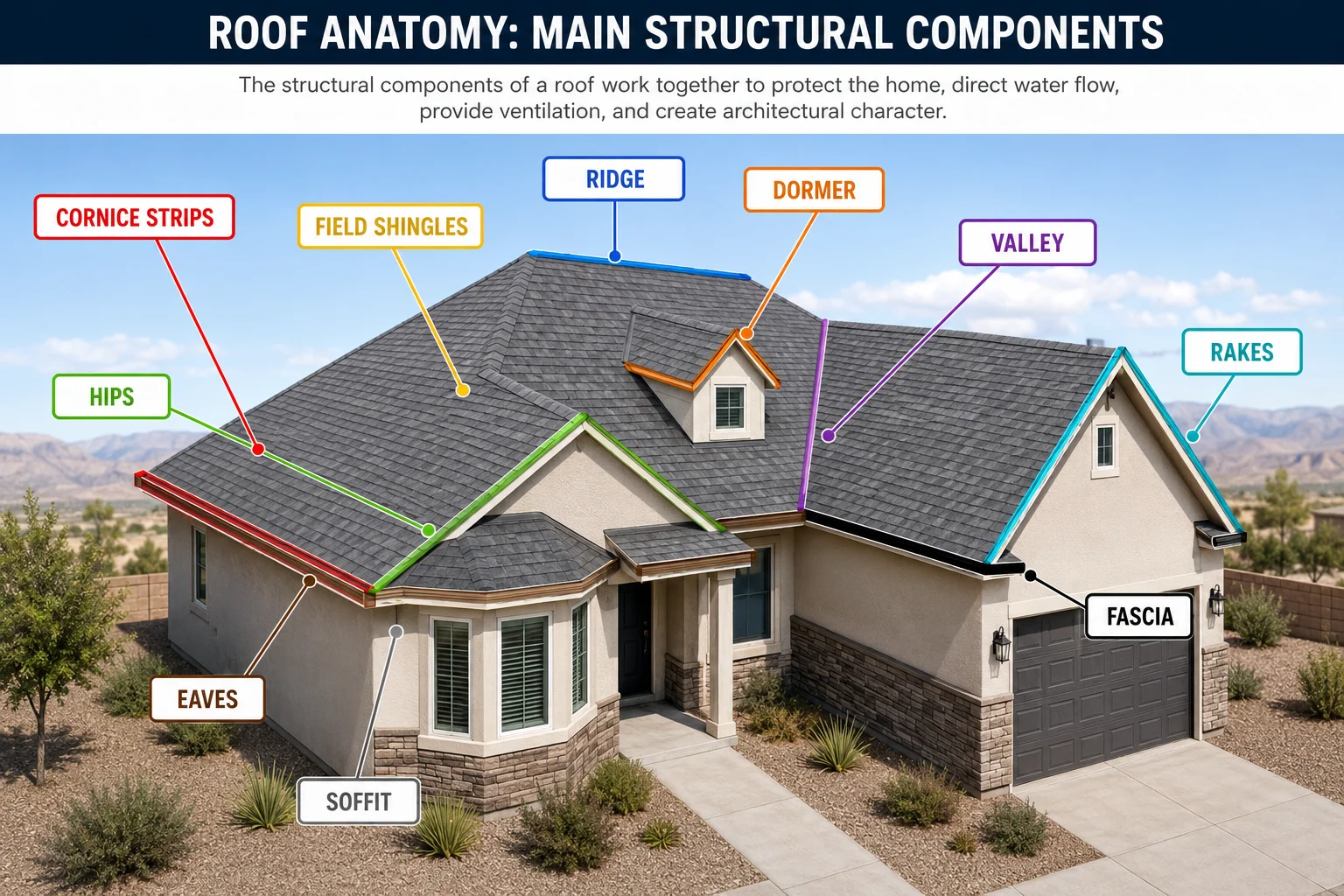
🔴 Cornice Strips
🟠 Dormer
🟡 Field Shingles
🟢 Hips
🔵 Ridge
🟣 Valley
🟤 Eaves
⚫ Fascia
🩵 Rakes
🩶 Soffit
🔴 Cornice Strips
Cornice strips are roof sections that extend beyond the main roof slope without connecting directly to it.
The word “cornice” means “ledge.”
These extensions help:
- Protect exterior walls.
- Divert rainwater.
- Add architectural character.
While decorative, cornice strips also play an important protective role by keeping water farther away from the home’s exterior.
🟠 Dormer
A dormer is a small vertical structure that protrudes from the sloping plane of the roof.
The word derives from the Latin “dormitorium,” meaning “sleeping room.”
Historically, dormers provided:
- Natural light.
- Additional headroom.
- Ventilation.
Today, they remain popular because they add both function and architectural beauty.
🟡 Field Shingles
Field shingles are the main roofing shingles that cover the majority of the roof surface.
They serve as:
- The primary weather barrier.
- Protection against UV rays.
- Resistance to rain and wind.
- A major contributor to curb appeal.
Although highly visible, shingles are only one part of a much larger roofing system.
🟢 Hips
Hips are sloping external corners where two roof planes meet.
Much like the hips of the human body create an angle, roof hips connect intersecting slopes.
They help:
- Strengthen roof geometry.
- Improve water runoff.
- Resist wind uplift.
🔵 Ridge
The ridge is the highest point of the roof.
It forms where two roof slopes meet.
Besides defining the roof’s shape, the ridge:
- Provides structural support.
- Helps maintain weather resistance.
- Often houses ridge vents for attic ventilation.
🟣 Valley
Valleys are V-shaped areas where two roof sections meet.
These are among the most important water-management areas on a roof.
Because large amounts of water flow through valleys, they require:
- Proper flashing.
- High-quality shingles.
- Careful installation.
Poorly installed valleys are one of the most common sources of leaks.
🟤 Eaves
Eaves are the horizontal overhanging edges of the roof that extend beyond the home’s exterior walls.
The word comes from Old English and means:
“edge” or “border.”
Their purpose is to:
- Protect walls.
- Shield windows.
- Move water away from siding.
- Improve shade around the home.
⚫ Fascia
Fascia consists of flat horizontal boards mounted along the lower edge of the roof.
Located just below the eaves, fascia serves as:
- Structural support for gutters.
- Protection for roof edges.
- A finished architectural detail.
Though often overlooked, fascia is essential for maintaining a clean roofline.
🩵 Rakes
Rakes are the sloped edges located on the gable ends of a roof.
They extend from:
- The eaves
- Up to the ridge.
Rakes help:
- Protect exposed roof edges.
- Resist wind damage.
- Improve the appearance of the roof.
🩶 Soffit
The soffit is the underside of the roof overhang.
Many soffits contain small vents that allow fresh air to enter the attic.
This airflow:
- Reduces attic temperatures.
- Controls moisture.
- Improves energy efficiency.
- Extends roof life.
In hot climates like El Paso, soffit ventilation is especially important.
PART 2
Roof Accessories: Small Components With Big Responsibilities
Some roofing components aren’t part of the structure itself.
Instead, they help manage ventilation, waterproofing, or natural light.
Although smaller, these accessories are just as important.
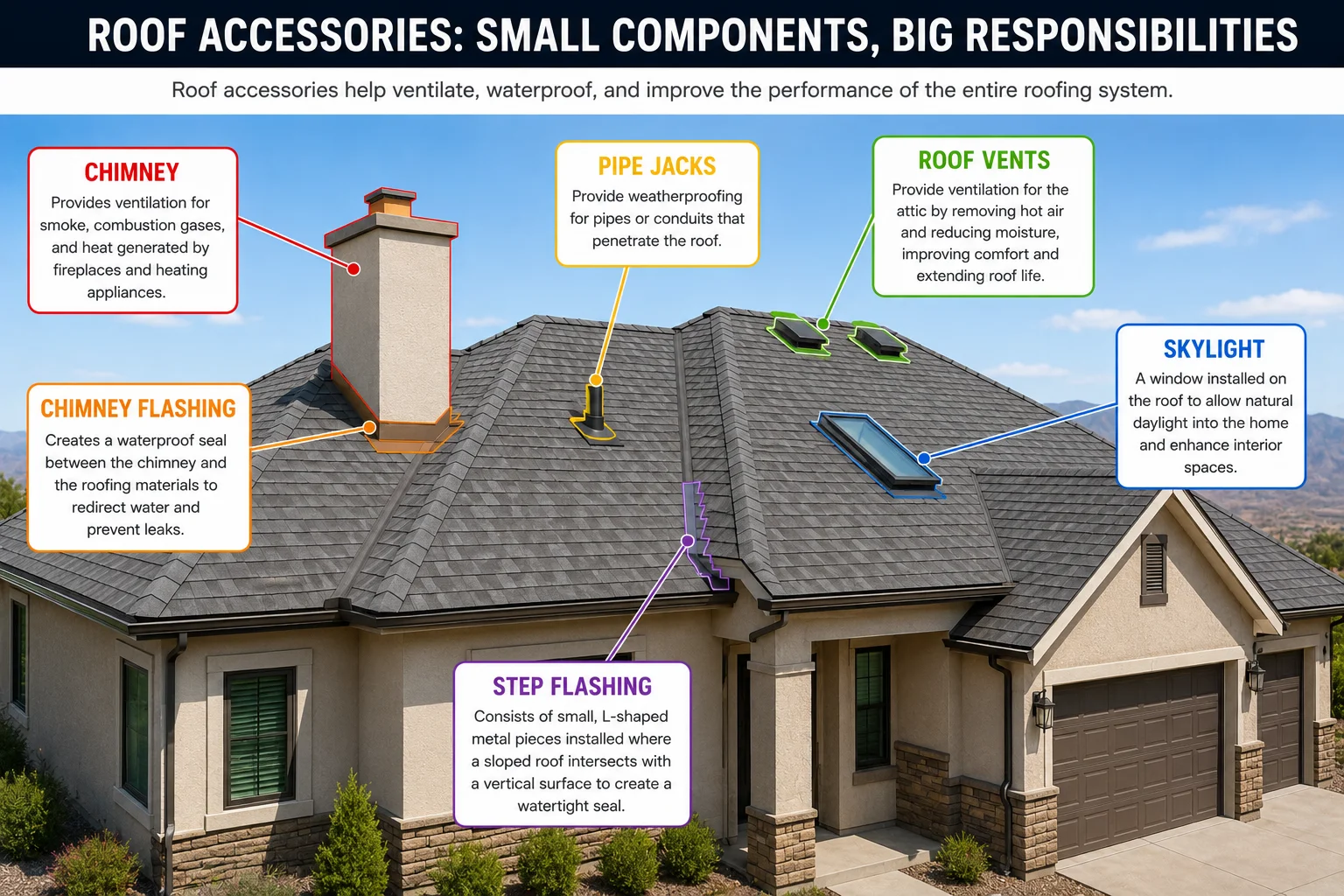
🔴 Chimney
🟠 Chimney Flashing
🟡 Pipe Jacks
🟢 Roof Vents
🔵 Skylight
🟣 Step Flashing
🔴 Chimney
The chimney provides ventilation for:
- Smoke.
- Combustion gases.
- Heat generated by fireplaces and heating appliances.
However, the most vulnerable area is not the chimney itself—
it’s the area where the chimney meets the roof.
🟠 Chimney Flashing
Chimney flashing creates a waterproof seal between the chimney and roofing materials.
Its purpose is to:
- Redirect water.
- Prevent leaks.
- Protect roof decking.
Most chimney leaks occur because flashing has deteriorated or was installed incorrectly.
🟡 Pipe Jacks
Pipe jacks provide weatherproofing for pipes or conduits that penetrate the roof.
They consist of:
- A flashing base.
- A flexible collar.
- Waterproof seals.
Over time, heat and UV exposure may cause these materials to crack and fail.
🟢 Roof Vents
Roof vents provide ventilation for the attic.
Their primary job is to:
- Remove hot air.
- Reduce moisture.
- Improve airflow.
Proper roof ventilation:
✔ Improves comfort.
✔ Helps lower cooling costs.
✔ Extends roof life.
🔵 Skylight
A skylight is a window installed directly on the roof.
Its purpose is to allow natural daylight into the home.
Modern skylights can:
- Increase natural light.
- Improve energy efficiency.
- Enhance interior spaces.
However, proper installation is essential to prevent leaks.
🟣 Step Flashing
Step flashing consists of small, L-shaped metal pieces installed where a sloped roof intersects with a vertical surface.
Its layered design creates:
- A watertight seal.
- Protection against water intrusion.
- Long-term waterproofing.
Step flashing is one of the most important—and least visible—components in the roofing system.
A Roof Is More Than Shingles
A roof is not a single product.
It’s an integrated system.
From the 🔵 Ridge at the very top to the 🩶 Soffit beneath the eaves.
From the 🟣 Valley, where rainwater concentrates, to the 🟠 Chimney Flashing that quietly keeps water out.
Every component has a job.
Understanding how these pieces work together helps homeowners make smarter decisions about inspections, maintenance, repairs, and replacements.
At Mighty Dog Roofing of El Paso, we inspect every part of the roofing system—not just the shingles—to ensure your home stays protected year-round.
Call Mighty Dog Roofing of El Paso today at 915-289-0664 to schedule your professional roof inspection.