
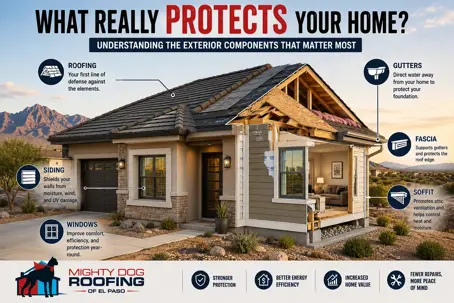
Many homeowners think the roof is simply the visible layer of shingles or tile.
But roofing systems are actually composed of several layers that work together to provide structural support, waterproofing, and ventilation.
Beneath the visible roofing material lies the roof deck, usually made of plywood or oriented strand board (OSB). This structural layer supports the entire roofing system.
Above the deck is the underlayment, a protective membrane designed to provide an additional barrier against moisture.
In critical areas such as valleys and roof penetrations, specialized waterproof membranes may also be installed to help prevent leaks.
Finally, the visible roofing material—whether shingles, tile, or metal—provides the exterior surface homeowners recognize.
But even the best shingles cannot perform properly without everything underneath them.
This layered system is why professional roofing inspections evaluate much more than the surface of the roof.
Flashing: The Most Important Component You’ve Probably Never Noticed
If you ask a roofing professional where most leaks begin, the answer may surprise you.
Most leaks do not start in the middle of the roof.
They typically begin around:
- Roof-to-wall intersections
- Chimneys
- Skylights
- Valleys
- Plumbing penetrations
- Vent pipes
These vulnerable areas rely on a component called flashing.
Flashing is usually made of metal and is installed to redirect water away from openings and transitions.
Without properly installed flashing, water can penetrate areas hidden from view and travel behind walls or ceilings before any visible damage appears.
In fact, many of the repairs homeowners assume are caused by roofing materials are actually the result of flashing failures.
Small details often make the biggest difference.
Siding: Your Home’s Exterior Armor
Siding does much more than improve curb appeal.
It acts as a protective shell around your home, shielding exterior walls from moisture, wind, dust, and UV radiation.
In El Paso, siding faces unique challenges.
Intense sunlight, seasonal storms, temperature fluctuations, and occasional heavy rains can gradually wear down exterior materials.
When siding becomes damaged, moisture can penetrate behind the surface and remain hidden for long periods.
This may lead to:
- Mold growth
- Rotting wood
- Interior wall damage
- Reduced insulation performance
- Higher energy bills
Warning signs of siding problems may include:
- Cracks
- Warping
- Peeling paint
- Stains
- Gaps around windows and doors
Because damage often begins behind the visible surface, professional inspections are essential for identifying problems early.
Windows: More Important Than Most Homeowners Realize
Windows are responsible for much more than views and natural light.
They play a critical role in:
- Indoor comfort
- Energy efficiency
- UV protection
- Temperature regulation
- Noise reduction
Older or inefficient windows may allow significant heat gain, particularly during El Paso’s long summers.
This forces air conditioning systems to work harder and may lead to:
- Higher energy bills
- Uneven room temperatures
- Hot spots inside the home
- Reduced indoor comfort
Many homeowners are surprised to learn that a room that always feels warmer than the rest of the house may have nothing to do with the HVAC system.
The windows themselves may be the source of the problem.
Modern energy-efficient windows use advanced technologies such as:
- Low-E glass coatings
- Double or triple panes
- Improved seals
- Insulated frames
These features help reduce heat transfer while maintaining natural light and outdoor views.
Gutters: Small System, Huge Responsibility
Gutters may seem simple.
After all, they’re just channels designed to move rainwater away from the house.
But their role is much more important.
Properly functioning gutters help protect:
- Roof edges
- Fascia boards
- Siding
- Landscaping
- Foundations
When gutters become clogged or damaged, water begins looking for another path.
This can lead to:
- Roof edge deterioration
- Water intrusion behind siding
- Soil erosion
- Foundation settlement
- Exterior staining
Many expensive repairs start with something as simple as neglected gutters.
Even in El Paso’s desert climate, sudden summer storms can quickly expose gutter problems that remained hidden during dry months.
Routine inspections and maintenance can prevent these issues from becoming major repairs.
Soffit and Fascia: The Components Most Homeowners Overlook
Walk outside and look beneath the edge of your roof.
You’ll find two important components:
Soffit
The soffit is the horizontal surface underneath the roof overhang.
Its primary purpose is ventilation.
Proper soffit ventilation helps:
- Reduce attic temperatures
- Improve energy efficiency
- Control moisture
- Extend roof life
Fascia
The fascia is the vertical board attached to the roof edge.
It serves as:
- The attachment point for gutters
- Protection for roof edges
- A finishing element for the exterior
Though rarely noticed, these components are essential to maintaining a healthy roofing system.