
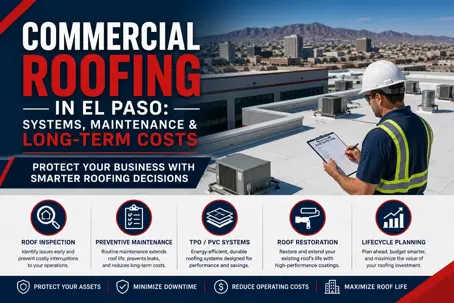
Everything Business Owners Need to Know About Protecting Their Commercial Property
For commercial property owners, a roof is far more than a building component—it’s a business asset.
Whether you manage a warehouse, office building, retail center, manufacturing facility, school, church, medical office, or apartment complex, your roofing system protects inventory, equipment, employees, tenants, and daily operations.
Unlike residential roofing, commercial roofing projects often involve larger roof surfaces, specialized materials, mechanical equipment, drainage systems, and long-term maintenance planning.
A minor roof leak that might inconvenience a homeowner can interrupt business operations, damage expensive equipment, force tenant relocations, or lead to significant financial losses in a commercial property.
That’s why commercial roofing decisions should focus on lifecycle performance—not simply the lowest installation cost.
This guide explains the most common commercial roofing systems, how they perform in West Texas, what maintenance programs should include, and how business owners can make informed long-term roofing decisions.
Whether you’re planning preventive maintenance, evaluating roof restoration, or preparing for a complete roof replacement, understanding your options can help maximize the return on your roofing investment.
⸻
Why Commercial Roofing Is Different from Residential Roofing
Although both protect buildings from the weather, commercial and residential roofing systems operate under very different conditions.
Commercial roofs are generally much larger, experience greater thermal movement, support mechanical equipment, and often receive regular foot traffic from maintenance personnel.
Because of these differences, commercial roofing systems require specialized materials, installation techniques, inspection procedures, and maintenance programs.
⸻
Commercial Roofs Often Include
- HVAC equipment
- Exhaust systems
- Skylights
- Solar equipment
- Roof hatches
- Mechanical curbs
- Electrical conduits
- Multiple roof penetrations
- Internal drainage systems
Each penetration creates another location that must be properly waterproofed and maintained throughout the life of the roof.
⸻
Business Continuity Matters
Commercial roofing projects are often planned around:
- Employee safety
- Customer access
- Tenant operations
- Production schedules
- Inventory protection
- Equipment downtime
- Weather windows
A successful commercial roofing project minimizes operational disruption while maximizing long-term roof performance.
⸻
Quick Take
Commercial roofing is less about shingles and more about protecting business operations, minimizing downtime, and managing long-term facility costs.
⸻
Types of Commercial Buildings
Every commercial property presents unique roofing challenges.
The roofing system should be selected according to the building’s function, occupancy, equipment, and long-term maintenance requirements.
⸻
Office Buildings
Office facilities prioritize:
- Energy efficiency
- Leak prevention
- Occupant comfort
- Professional appearance
- Long service life
⸻
Warehouses
Warehouses typically require roofing systems capable of protecting:
- Inventory
- Logistics operations
- Loading areas
- High interior volumes
Because of their large roof surfaces, even small leaks can affect extensive portions of the facility.
⸻
Retail Centers
Retail properties benefit from roofing systems that minimize maintenance interruptions and help maintain comfortable indoor environments for customers and tenants.
⸻
Industrial Facilities
Industrial buildings frequently contain:
- Manufacturing equipment
- Process heat
- Ventilation systems
- Specialized penetrations
- Heavy rooftop equipment
Roof durability and maintenance planning become especially important.
⸻
Schools and Universities
Educational facilities require roofing systems that emphasize:
- Reliability
- Safety
- Budget predictability
- Long service life
- Minimal disruption during occupancy
⸻
Medical Facilities
Healthcare buildings demand exceptional waterproofing performance because roof failures can affect sensitive equipment and patient care areas.
⸻
Churches and Community Buildings
Many churches feature complex roof geometries and long ownership horizons, making durability and lifecycle cost especially important.
⸻
Apartment Complexes
Multi-family properties require roofing systems that reduce maintenance requests while protecting multiple occupants under a single roof system.
⸻
Quick Take
The best commercial roofing system depends on how the building is used—not simply on the size of the roof.
⸻
The Most Common Commercial Roofing Systems
Selecting the right roofing material is one of the most important long-term decisions a property owner will make.
Each roofing system offers different advantages depending on climate, building design, maintenance strategy, and budget.
⸻
TPO Roofing
Thermoplastic Polyolefin (TPO) is one of today’s most widely installed commercial roofing systems.
Advantages include:
- High solar reflectivity
- Excellent energy efficiency
- Heat-welded seams
- Lightweight construction
- Strong UV resistance
- Competitive lifecycle costs
Ideal for:
- Warehouses
- Retail centers
- Office buildings
- Schools
⸻
PVC Roofing
PVC roofing offers many benefits similar to TPO while providing exceptional chemical resistance.
Frequently selected for:
- Restaurants
- Food processing facilities
- Manufacturing plants
- Medical facilities
⸻
EPDM Roofing
EPDM is a durable synthetic rubber roofing membrane known for:
- Flexibility
- Weather resistance
- Long service life
- Proven performance
It performs particularly well where large roof movements occur due to thermal expansion.
⸻
Modified Bitumen
Modified Bitumen combines asphalt technology with reinforced membranes to create a durable roofing system suitable for many commercial applications.
Advantages include:
- Multiple installation methods
- Strong puncture resistance
- Reliable waterproofing
- Excellent repairability
⸻
Built-Up Roofing (BUR)
One of the oldest commercial roofing systems still in use.
BUR consists of multiple layers that provide:
- Redundant waterproofing
- Durability
- Proven long-term performance
Many existing commercial buildings continue operating successfully with properly maintained BUR systems.
⸻
Spray Polyurethane Foam (SPF)
SPF roofing creates a seamless insulated roofing system.
Advantages include:
- Exceptional insulation
- Seamless waterproofing
- Lightweight application
- Renewable through recoating
Especially effective for many flat roofs in hot climates.
⸻
Roof Coating Systems
Roof coatings help extend the service life of existing roofing systems when the roof remains structurally sound.
Common coating technologies include:
- Silicone
- Acrylic
- Polyurethane
- Elastomeric systems
Roof restoration often provides an economical alternative to complete replacement.
⸻
Standing Seam Metal Roofing
Often used on:
- Industrial facilities
- Agricultural buildings
- Commercial offices
- Institutional buildings
Advantages include:
- Long lifespan
- Excellent durability
- Strong wind resistance
- Minimal maintenance
⸻
Flat Roof vs. Low-Slope Roof
Although the terms are frequently used interchangeably, they are not identical.
A flat roof is designed with minimal slope to promote drainage, while a low-slope roof incorporates a slight pitch that improves water runoff.
Both systems require carefully designed drainage to prevent standing water and maintain long-term performance.
⸻
Advantages
- Easier equipment access
- Efficient use of building footprint
- Simplified maintenance
- Easier installation of solar systems
- Lower construction profile
⸻
Challenges
- Drainage management
- Ponding water
- Roof penetrations
- Foot traffic
- Mechanical equipment maintenance
Regular inspections help identify developing issues before they impact business operations.
⸻
What Makes Commercial Roofing Unique?
Commercial roofing extends beyond the roof membrane itself.
Long-term performance depends on managing an interconnected system that includes waterproofing, insulation, drainage, ventilation, rooftop equipment, and ongoing maintenance.
Successful commercial roofing programs prioritize:
- Preventive maintenance
- Routine inspections
- Drainage performance
- Energy efficiency
- Leak prevention
- Lifecycle planning
- Budget forecasting
- Asset management
Rather than reacting to leaks as they occur, proactive maintenance helps extend roof life, reduce emergency repairs, and protect business continuity.
⸻
Quick Take
The most cost-effective commercial roof is rarely the one with the lowest installation price—it is the system that delivers the best long-term performance, minimizes operational disruptions, and reduces total lifecycle costs.
Commercial Roof Inspections: The Foundation of Long-Term Roof Performance
A commercial roof is one of the largest capital assets on a building, yet it is often one of the least frequently inspected.
Unlike residential roofs, commercial roofing systems typically support HVAC equipment, electrical conduits, solar panels, exhaust systems, and maintenance personnel throughout the year. These factors increase wear and create more opportunities for leaks and premature deterioration.
Routine inspections help identify small issues before they interrupt business operations or require expensive emergency repairs.
Rather than waiting for water to enter the building, proactive inspections allow facility managers to address problems while they are still manageable.
What Does a Commercial Roof Inspection Include?
A comprehensive commercial inspection evaluates the entire roofing system—not just the membrane.
Typical inspection items include:
Roof Membrane
Inspectors evaluate:
- Tears
- Punctures
- Blisters
- Open seams
- Membrane shrinkage
- UV deterioration
- Surface wear
Flashing and Penetrations
Special attention is given to:
- HVAC curbs
- Plumbing vents
- Electrical conduits
- Skylights
- Pipe boots
- Roof hatches
- Expansion joints
Most commercial roof leaks originate around penetrations rather than in the field membrane itself.
Drainage Systems
Inspectors verify:
- Roof drains
- Scuppers
- Overflow drains
- Downspouts
- Gutters
- Ponding water
- Drain obstructions
Proper drainage is essential because standing water accelerates roof deterioration and increases structural loading.
Rooftop Equipment
Commercial roofs frequently support:
- HVAC units
- Exhaust fans
- Solar equipment
- Satellite systems
- Mechanical platforms
Each piece of equipment requires periodic inspection to ensure surrounding waterproofing remains intact.
Quick Take
Commercial roof inspections protect far more than the roof—they help safeguard business operations, inventory, employees, tenants, and equipment.
Preventive Maintenance Programs
The most cost-effective commercial roof is not necessarily the newest one.
It is the roof that receives consistent preventive maintenance throughout its service life.
Preventive maintenance shifts the focus from reacting to leaks toward preventing them altogether.
A Typical Maintenance Program May Include
Semi-Annual Roof Inspections
Most commercial buildings benefit from inspections:
- Each spring
- Each fall
Additional inspections should follow significant hailstorms, high winds, or severe weather events.
Drain Cleaning
Removing debris from:
- Roof drains
- Scuppers
- Gutters
- Downspouts
helps prevent ponding water and improves drainage performance.
Sealant Maintenance
Sealants naturally age over time.
Routine inspection and replacement around penetrations help maintain waterproofing integrity.
Membrane Repairs
Small punctures and seam separations should be repaired promptly before moisture reaches the insulation or roof deck.
Documentation
Professional maintenance programs often include:
- Inspection reports
- Roof photographs
- Repair history
- Maintenance recommendations
- Lifecycle planning updates
These records support budgeting and future roofing decisions.
Quick Take
Preventive maintenance costs significantly less than emergency roof replacement caused by years of deferred repairs.
The Most Common Commercial Roofing Problems
Commercial roofing systems experience different stresses than residential roofs.
Some of the most common issues include:
Ponding Water
Standing water that remains on the roof for extended periods may contribute to:
- Membrane deterioration
- Increased structural loading
- Biological growth
- Drainage problems
Open Seams
Membrane seams may separate because of:
- Thermal movement
- Aging
- Installation deficiencies
- Wind uplift
Even small seam openings may allow moisture beneath the roofing system.
Roof Penetration Failures
Every rooftop penetration represents a potential leak point.
Common locations include:
- HVAC curbs
- Pipe penetrations
- Electrical conduits
- Skylights
- Exhaust vents
Flashing Failures
Flashing protects transitions between roofing materials and building components.
Movement, weather exposure, and aging may eventually require repairs.
Foot Traffic Damage
Commercial roofs frequently support maintenance personnel servicing HVAC equipment and other rooftop systems.
Repeated foot traffic may create:
- Membrane punctures
- Surface wear
- Equipment damage
- Displaced walkway pads
Storm Damage
Commercial roofs may experience:
- Hail impacts
- Wind uplift
- Debris punctures
- Drainage blockage
- Flashing displacement
Routine post-storm inspections help identify hidden damage before leaks develop.
Commercial Roof Leaks
When a commercial roof begins leaking, the visible water entry point often differs from the actual source.
Water may travel considerable distances beneath roofing materials before appearing inside the building.
For this reason, professional leak investigations typically involve:
- Interior inspection
- Roof inspection
- Moisture tracing
- Drainage evaluation
- Penetration inspection
- Membrane testing (when necessary)
Treating only the visible symptom rarely resolves the underlying problem.
Quick Take
Finding the true source of a commercial roof leak requires systematic investigation—not guesswork.
Emergency Commercial Roof Repairs
Not every roofing problem can wait for scheduled maintenance.
Immediate response may be necessary when leaks threaten:
- Inventory
- Manufacturing equipment
- Electronic systems
- Medical equipment
- Tenant spaces
- Customer safety
Temporary Emergency Measures
Depending on the situation, roofing professionals may recommend:
- Emergency roof tarping
- Temporary membrane patches
- Drain clearing
- Temporary waterproofing
- Debris removal
- Interior water management
These actions reduce additional damage until permanent repairs can be completed.
Roof Restoration vs. Roof Replacement
A complete roof replacement is not always the only option.
When the existing roof remains structurally sound, restoration may significantly extend its service life.
Restoration solutions often include:
- Silicone coatings
- Acrylic coatings
- Polyurethane coatings
- Localized membrane repairs
- Flashing replacement
- Drainage improvements
Restoration can improve waterproofing, energy efficiency, and lifecycle performance while reducing disruption to business operations.
When Replacement May Be the Better Option
Replacement deserves consideration when:
- Moisture has saturated insulation.
- Structural components are compromised.
- The roofing system has reached the end of its service life.
- Multiple restoration attempts have already been performed.
- Repair costs continue increasing year after year.
A professional condition assessment helps determine which approach delivers the greatest long-term value.
Lifecycle Planning and Capital Budgeting
Commercial roofing should be managed as a long-term asset—not simply as a repair expense.
Facility owners who plan ahead are better positioned to avoid unexpected capital expenditures.
A lifecycle strategy typically includes:
- Annual inspections
- Preventive maintenance
- Roof condition scoring
- Repair forecasting
- Restoration planning
- Replacement budgeting
- Energy performance evaluation
Instead of reacting to emergencies, property owners can schedule improvements strategically and reduce operational disruptions.
Commercial Roof Maintenance Calendar
Monthly
- Visual inspection from the ground
- Check for drainage issues after heavy rain
Quarterly
- Remove debris from drains and gutters
- Inspect rooftop equipment for potential roof impacts
Spring
- Comprehensive professional inspection
- Repair winter weather damage
- Verify drainage performance
Summer
- Inspect for UV-related deterioration
- Monitor rooftop equipment and sealants
Fall
- Professional inspection before winter
- Remove leaves and debris
- Verify flashing and drainage systems
After Every Major Storm
- Inspect for hail damage
- Check membrane integrity
- Evaluate rooftop equipment
- Document conditions with photographs
Pro Tips
Pro Tip #1
Budget for preventive maintenance every year. Small annual investments often prevent major capital expenses later.
Pro Tip #2
Keep detailed inspection records. Historical documentation makes it easier to identify recurring issues and prioritize future repairs.
Pro Tip #3
Coordinate rooftop maintenance performed by HVAC, electrical, and telecommunications contractors to minimize unnecessary foot traffic and accidental roof damage.
Pro Tip #4
Address drainage issues immediately. Ponding water is one of the most common contributors to premature commercial roof deterioration.
Choosing the Right Commercial Roofing System
Selecting a commercial roofing system isn’t simply about solving today’s roofing problem.
It’s about choosing a solution that aligns with your building’s function, operational needs, maintenance strategy, energy goals, and long-term financial planning.
The least expensive roof to install is not always the least expensive roof to own.
For commercial property owners, the better question is:
“Which roofing system delivers the lowest total cost over its entire service life?”
Initial Cost vs. Lifecycle Cost
Many roofing decisions focus on installation price alone.
However, commercial roofing should be evaluated over decades—not months.
A lower installation cost may eventually be offset by:
- Higher maintenance expenses
- More frequent repairs
- Increased energy consumption
- Earlier replacement
- Business interruptions
Conversely, premium roofing systems often require greater upfront investment but reduce ownership costs over time.
Example Comparison
Roofing System | Initial Cost | Maintenance | Expected Lifespan | Energy Performance | Lifecycle Value |
TPO | Moderate | Low | 20–30 Years | Excellent | Excellent |
PVC | Higher | Low | 25–35 Years | Excellent | Excellent |
EPDM | Moderate | Low | 25–35 Years | Good | Very Good |
Modified Bitumen | Moderate | Moderate | 20–30 Years | Good | Good |
SPF Roofing | Moderate | Moderate | Renewable | Excellent | Excellent |
Roof Coatings | Low | Moderate | Extension System | Excellent | Very Good |
Standing Seam Metal | High | Low | 40–60+ Years | Excellent | Outstanding |
Quick Take
The most economical commercial roof is often the one that minimizes maintenance, energy consumption, and future replacement—not simply the one with the lowest installation price.
Energy Efficiency and Operating Costs
For many commercial buildings, the roof directly affects utility expenses.
Large roof surfaces absorb significant solar radiation, increasing cooling demands throughout much of the year in West Texas.
Modern commercial roofing systems are designed to reduce heat gain through reflective surfaces, insulation improvements, and optimized ventilation.
Benefits may include:
- Lower cooling loads
- Reduced HVAC runtime
- More stable indoor temperatures
- Improved occupant comfort
- Potentially lower operating costs
For facilities operating year-round, even modest energy savings can accumulate significantly over the life of the roofing system.
Roof Restoration: Extending Roof Life Without Full Replacement
Not every aging commercial roof needs to be removed.
When inspections indicate that the structural components remain sound, restoration may offer an effective alternative.
Typical restoration strategies include:
- Silicone coating systems
- Acrylic coating systems
- Polyurethane coatings
- Seam reinforcement
- Flashing improvements
- Localized membrane repairs
Because restoration usually requires less demolition than full replacement, it may reduce business disruption while extending roof performance.
When Restoration Makes Sense
Restoration is often appropriate when:
- The roof remains structurally sound.
- Moisture intrusion is limited.
- Insulation remains serviceable.
- Damage is localized.
- Preventive maintenance has been consistent.
When Replacement Is Usually Preferred
Replacement may provide greater long-term value when:
- Moisture has saturated insulation.
- Structural deterioration is present.
- Repeated repairs are becoming more frequent.
- The roofing system has exceeded its practical service life.
- Multiple roofing layers complicate future maintenance.
Commercial Roofing Decision Matrix
Every facility has different priorities.
Use this simplified guide to match roofing systems with operational goals.
Lowest Initial Investment
Modified Bitumen
or
Roof Coating (when restoration is appropriate)
Lowest Long-Term Maintenance
Standing Seam Metal
PVC
TPO
Highest Energy Efficiency
Reflective TPO
Reflective PVC
SPF Roofing
Cool Roof Coatings
Large Distribution Warehouses
TPO
PVC
Standing Seam Metal
Manufacturing Facilities
PVC
Standing Seam Metal
SPF
Retail Centers
TPO
Modified Bitumen
Roof Restoration Systems
Medical Facilities
PVC Roofing
Because of its excellent chemical resistance and long-term waterproofing performance.
Multi-Family Properties
TPO
Standing Seam Metal
Modified Bitumen
depending on roof configuration.
Quick Take
The “best” commercial roofing system depends on how the building operates—not simply on the roofing material itself.
Asset Management Rather Than Reactive Repairs
Successful facility owners rarely wait for leaks before making roofing decisions.
Instead, they manage roofing systems as long-term assets.
An effective asset management strategy includes:
- Annual budgeting
- Condition assessments
- Preventive maintenance
- Repair forecasting
- Energy monitoring
- Lifecycle planning
- Capital improvement scheduling
This proactive approach helps reduce emergency expenditures while improving long-term facility performance.
Myth vs. Reality
Myth
“A commercial roof should only be repaired once it begins leaking.”
Reality
By the time water enters the building, damage has often been developing for months. Preventive inspections identify issues much earlier.
Myth
“Replacing the entire roof is always better than restoration.”
Reality
When the existing roof remains structurally sound, restoration may significantly extend service life while reducing costs and minimizing operational disruption.
Myth
“All commercial roofing membranes perform the same.”
Reality
Different systems vary in energy efficiency, chemical resistance, maintenance requirements, durability, and expected lifespan. Selecting the right system depends on the building’s specific operational needs.
Myth
“Roof maintenance is an unnecessary expense.”
Reality
Preventive maintenance is typically one of the most cost-effective investments a property owner can make, helping avoid emergency repairs and extending the life of the roofing system.
Pro Tips
Pro Tip #1
Evaluate commercial roofing projects based on total lifecycle cost, not just installation price.
Pro Tip #2
Schedule professional inspections at least twice per year and after significant weather events.
Pro Tip #3
Keep detailed maintenance records. Historical documentation supports budgeting, warranty management, and long-term capital planning.
Pro Tip #4
Coordinate HVAC, electrical, telecommunications, and solar contractors to minimize unnecessary roof traffic and reduce accidental membrane damage.
Pro Tip #5
Address drainage issues immediately. Standing water is one of the leading causes of premature deterioration on low-slope commercial roofs.
Annual Commercial Roofing Planning Calendar
January–March
- Review previous year’s maintenance records.
- Schedule spring roof inspection.
- Identify priority repairs.
April–June
- Complete preventive maintenance.
- Repair membrane damage.
- Inspect sealants and flashing.
- Verify drainage systems.
July–September
- Monitor UV exposure.
- Evaluate rooftop equipment.
- Plan future capital improvements.
October–December
- Conduct fall inspection.
- Remove seasonal debris.
- Prepare for winter weather.
- Update lifecycle budget projections.
Frequently Asked Questions
How often should a commercial roof be inspected?
Most commercial roofing systems should receive professional inspections at least twice a year—typically in the spring and fall—and after major hailstorms, wind events, or severe weather.
Regular inspections help identify small issues before they interrupt business operations.
What is the average lifespan of a commercial roof?
The lifespan depends on the roofing system, installation quality, maintenance, and climate.
Typical ranges include:
- TPO: 20–30 years
- PVC: 25–35 years
- EPDM: 25–35 years
- Modified Bitumen: 20–30 years
- Standing Seam Metal: 40–60+ years
- SPF Roofing: Renewable with proper recoating
Routine maintenance can significantly extend service life.
What causes most commercial roof leaks?
Most leaks occur around:
- HVAC equipment
- Roof penetrations
- Flashing
- Expansion joints
- Open seams
- Drainage systems
The leak visible inside the building is often far from the actual point where water entered the roof.
Can a commercial roof be restored instead of replaced?
In many cases, yes.
If the roof remains structurally sound and moisture damage is limited, restoration may extend its service life while reducing costs and minimizing disruption.
A professional inspection is necessary to determine whether restoration is appropriate.
What is ponding water?
Ponding water refers to water that remains on a roof for an extended period after rainfall.
Persistent ponding can accelerate membrane deterioration, increase structural loads, and contribute to premature roof failure if left unaddressed.
Which commercial roofing system is the most energy efficient?
Reflective roofing systems such as TPO, PVC, SPF, and cool roof coatings generally provide excellent thermal performance, particularly in hot climates like West Texas.
How long does a commercial roof replacement take?
Project duration depends on:
- Building size
- Roofing system
- Weather
- Material availability
- Occupancy requirements
- Existing roof conditions
Many projects are completed in phases to minimize disruption to daily operations.
Can business operations continue during roof replacement?
Often, yes.
Professional contractors typically coordinate schedules, work areas, and safety measures to help businesses remain operational whenever practical.
What is the difference between restoration and maintenance?
Maintenance focuses on preventing deterioration through inspections, cleaning, and minor repairs.
Restoration renews the roofing system to extend its service life without performing a full replacement.
Does preventive maintenance really reduce costs?
Yes.
Routine maintenance often helps identify developing issues before they require major repairs or premature roof replacement, reducing total ownership costs over time.
Commercial Roof Maintenance Checklist
Use this checklist to help maintain the long-term performance of your commercial roof.
Monthly
☐ Walk the property and check for visible drainage problems.
☐ Inspect rooftop equipment for obvious issues.
☐ Look for debris around drains and gutters.
Quarterly
☐ Verify that drainage systems remain unobstructed.
☐ Inspect sealants around roof penetrations.
☐ Check walk pads for wear or displacement.
☐ Review rooftop equipment for signs of leaks.
Twice Per Year
☐ Schedule a professional roof inspection.
☐ Document the roof’s overall condition.
☐ Repair minor membrane damage.
☐ Inspect flashing and expansion joints.
☐ Verify proper drainage.
☐ Update maintenance records.
After Every Major Storm
☐ Inspect for hail damage.
☐ Check flashing and roof penetrations.
☐ Remove storm debris.
☐ Photograph visible damage.
☐ Schedule a professional inspection if needed.
Commercial Roofing Capital Planning Worksheet
Before budgeting for your next roofing project, consider the following:
Planning Question | Notes |
Current roof age | |
Roofing system type | |
Date of last inspection | |
Current condition | |
Number of repairs completed in the last five years | |
Any recurring leaks? | |
Energy efficiency concerns | |
Restoration feasible? | |
Replacement timeframe | |
Estimated capital budget Keeping this information updated helps property owners and facility managers make proactive, data-driven decisions. Why Commercial Property Owners Choose Mighty Dog RoofingCommercial roofing projects require more than installation expertise. They require careful planning, clear communication, and an understanding of how roofing decisions affect daily business operations. Mighty Dog Roofing works with commercial property owners, facility managers, and business operators to provide:
Our objective is to help businesses protect their facilities while minimizing operational disruptions and maximizing the return on their roofing investment. ConclusionA commercial roof should be viewed as a long-term business asset rather than simply another building expense. Through regular inspections, preventive maintenance, strategic restoration, and informed replacement planning, property owners can reduce lifecycle costs, improve energy efficiency, and avoid unexpected disruptions. The best commercial roofing strategy is proactive—not reactive. Planning ahead protects your facility, supports business continuity, and helps preserve the value of your property for years to come. Ready to Protect Your Commercial Property?Whether you manage a warehouse, retail center, office building, industrial facility, medical office, or apartment complex, Mighty Dog Roofing provides commercial roofing solutions tailored to your operational needs. Our experienced team can help you:
Schedule a FREE Commercial Roof Assessment and receive expert recommendations designed to protect your business and your investment. | |