
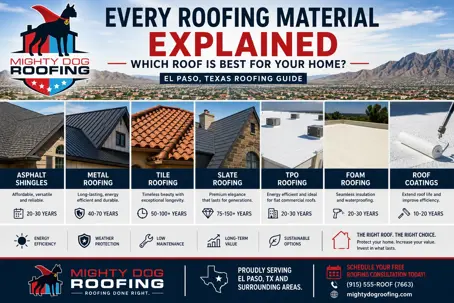
Your Roof Is More Than Just Shingles
For most homeowners, choosing a new roof begins with one simple question:
“Which roofing material should I choose?”
It sounds like a straightforward decision, but selecting the right roofing system is about much more than appearance.
The material covering your home influences nearly every aspect of roof performance—from how well it withstands storms and intense sunlight to how much maintenance it requires over the next several decades. It can affect your monthly energy bills, your home’s resale value, your insurance premiums, and even your comfort during the hottest months of the year.
Many homeowners naturally compare roofing materials based only on price.
However, the lowest initial cost doesn’t always produce the lowest lifetime cost.
A roofing system that lasts twice as long, requires fewer repairs, and reduces cooling expenses may ultimately provide far greater value than a less expensive alternative.
Choosing wisely requires understanding how each roofing material performs under real-world conditions.
This guide compares today’s most common residential and commercial roofing systems, explaining their advantages, limitations, maintenance requirements, expected lifespan, and ideal applications—especially for homes and businesses in El Paso, Texas.
By the end of this guide, you’ll understand:
- Which roofing material lasts the longest.
- Which option performs best in West Texas.
- Which roof offers the best value.
- Which materials require the least maintenance.
- Which roofing system improves energy efficiency.
- Which products work best for residential and commercial properties.
- How professional roofers evaluate roofing materials before making recommendations.
Whether you’re replacing an aging roof or building a new home, this guide will help you make a confident, informed decision.
Why Roofing Material Matters More Than Most Homeowners Realize
When people think about a roof, they often focus only on preventing leaks.
While waterproofing is certainly the roof’s primary purpose, modern roofing systems perform many additional functions that directly influence the home’s comfort, efficiency, and long-term value.
The material you choose affects:
Energy Efficiency
Some roofing systems absorb large amounts of solar heat.
Others reflect sunlight and help maintain cooler attic temperatures.
In a climate like El Paso’s, where summer temperatures frequently exceed 100°F (38°C), that difference can noticeably influence cooling costs.
Durability
Not every roofing material ages the same way.
Some perform exceptionally well for decades with minimal maintenance, while others require more frequent repairs due to weather exposure.
Understanding expected lifespan helps homeowners evaluate long-term value rather than focusing solely on installation cost.
Maintenance Requirements
Every roofing system requires some level of maintenance.
However, the frequency and complexity vary significantly depending on the material.
Some systems benefit from periodic inspections and minor repairs.
Others can perform reliably for decades with relatively little attention.
Storm Resistance
High winds, hail, heavy rain, and debris affect each roofing material differently.
Choosing a roof that matches your local weather conditions can significantly reduce future repair costs.
Curb Appeal
A roof typically represents one of the largest visible surfaces on any home.
The right material can dramatically enhance architectural style, improve resale value, and complement surrounding landscaping.
Property Value
Buyers often consider roof condition one of the most important aspects of a home’s overall condition.
A newer, professionally installed roofing system can increase buyer confidence and reduce concerns during the inspection process.
Quick Take
A roof isn’t simply a protective covering.
It’s a long-term investment that influences comfort, efficiency, maintenance costs, and property value for decades.
Why El Paso’s Climate Changes the Equation
Many roofing articles discuss materials as though every home experiences the same environment.
That simply isn’t true.
The ideal roofing system for Minnesota may perform very differently in West Texas.
El Paso presents one of the most demanding climates for roofing materials due to its combination of intense sunlight, low humidity, high winds, blowing dust, and seasonal hailstorms.
Choosing the right roofing material means understanding how each option responds to these local conditions.
Extreme UV Exposure
One of the biggest threats to roofing systems in El Paso is prolonged ultraviolet radiation.
Day after day, direct sunlight gradually breaks down roofing materials.
Over time, UV exposure may cause:
- Asphalt shingles to become brittle.
- Protective granules to loosen.
- Rubber components to crack.
- Sealants to dry out.
- Surface colors to fade.
Some materials tolerate UV exposure significantly better than others.
Wind Events
Strong desert winds frequently exceed the design expectations of older roofing systems.
Wind may:
- Lift shingles.
- Break adhesive seals.
- Damage flashing.
- Loosen ridge caps.
- Carry debris across the roof.
Selecting materials with strong wind resistance helps reduce future maintenance.
Heat
Roof surfaces often become dramatically hotter than the surrounding air temperature.
This continuous heating and cooling cycle causes roofing materials to expand during the day and contract overnight.
Over thousands of cycles, this natural movement contributes to material fatigue.
Hail
Although hailstorms are unpredictable, they remain one of the leading causes of roofing insurance claims across Texas.
Different roofing materials respond very differently to hail impacts.
Some absorb impacts better.
Others crack more easily.
Understanding these differences helps homeowners evaluate long-term durability.
Dust and Sand
Desert environments introduce another factor that many homeowners overlook.
Fine dust accumulates around flashing, roof valleys, gutters, and drainage systems.
Routine maintenance becomes especially important for preserving proper water flow.
Quick Take
When choosing a roof in El Paso, climate should influence the decision just as much as appearance or price.
A roofing material that performs exceptionally well in another part of the country may not deliver the same results under West Texas conditions.
Understanding a Complete Roofing System
One of the biggest misconceptions homeowners have is believing that shingles are the roof.
In reality, shingles are only the outermost layer of a much more complex system.
Every modern roof consists of multiple components working together to protect the structure from moisture, heat, wind, and weather.
Understanding these components helps explain why two roofs using the same shingles can perform very differently depending on installation quality.
A complete roofing system typically includes:
- Roof decking
- Underlayment
- Ice and water barrier (where applicable)
- Flashing
- Drip edge
- Starter shingles
- Field shingles or roofing panels
- Ridge cap system
- Ridge ventilation
- Soffit ventilation
- Fasteners
- Sealants
- Gutters and drainage components
Each element plays an important role in protecting the home.
Replacing shingles without addressing damaged flashing, deteriorated underlayment, or poor ventilation may leave underlying problems unresolved.
Quick Take
The best roofing material cannot compensate for a poorly designed roofing system.
Long-term performance depends on the quality of every component—not just the visible surface.
Asphalt Shingles: America’s Most Popular Roofing Material
For decades, asphalt shingles have remained the most widely installed residential roofing material in North America.
Their popularity comes from an excellent balance of affordability, appearance, reliability, and ease of installation. Modern architectural shingles are available in a wide range of colors and profiles, allowing homeowners to complement almost any architectural style while benefiting from proven weather protection.
For many homes in El Paso, asphalt shingles provide an excellent combination of value and performance when installed correctly and supported by proper attic ventilation.
Advantages of Asphalt Shingles
- Cost-effective compared to most premium roofing materials.
- Available in a wide variety of colors and architectural styles.
- Easier and faster to repair than many alternative systems.
- Strong manufacturer warranty options.
- Compatible with most residential homes.
- Excellent balance between performance and initial investment.
Potential Limitations
Although asphalt shingles perform well in many situations, they are not perfect.
Homeowners should also consider:
- Continuous UV exposure gradually accelerates aging.
- Granule loss increases over time.
- Lower lifespan than metal, tile, or slate roofing.
- Wind damage may occur if shingles lose their adhesive bond.
- Premium architectural shingles generally perform better than basic three-tab shingles.
Typical Lifespan
Under proper installation and maintenance, architectural asphalt shingles typically provide:
20–30 years
Actual lifespan depends on:
- Roof ventilation
- Installation quality
- Storm frequency
- Sun exposure
- Maintenance practices
Best Applications
Asphalt shingles are ideal for:
- First-time homeowners.
- Budget-conscious roof replacements.
- Traditional residential neighborhoods.
- Homes with standard roof pitches.
- Properties where future repairs should remain economical.
Quick Take
If you’re looking for the best balance between upfront cost, appearance, and long-term performance, architectural asphalt shingles remain one of the strongest overall choices.
Metal Roofing: Exceptional Durability and Energy Efficiency
Metal roofing has become one of the fastest-growing roofing systems in Texas.
While many homeowners once associated metal roofs with barns or commercial buildings, modern residential metal roofing offers sleek architectural designs, exceptional longevity, and outstanding weather resistance.
For homes exposed to intense sunlight, strong winds, and large temperature swings, metal roofing provides several significant advantages.
Advantages of Metal Roofing
- Extremely long service life.
- Outstanding wind resistance.
- Excellent fire resistance.
- Reflects solar heat effectively.
- Minimal routine maintenance.
- Highly recyclable.
- Modern architectural appearance.
- Performs exceptionally well in hot climates.
Potential Limitations
Metal roofing also has considerations homeowners should understand.
These include:
- Higher initial investment.
- Specialized installation requirements.
- Some systems require experienced installers.
- Cosmetic dents may occur after severe hail, depending on material thickness.
- Color selection should consider solar reflectance and neighborhood aesthetics.
Common Types of Metal Roofing
Several metal roofing systems are available.
The most common include:
Standing Seam Metal
Widely considered the premium residential option.
Characteristics:
- Concealed fasteners.
- Excellent weather resistance.
- Clean architectural appearance.
- Superior longevity.
Corrugated Metal Panels
Often selected for:
- Agricultural buildings.
- Workshops.
- Utility structures.
- Certain residential styles.
Stone-Coated Steel
Combines the durability of steel with the appearance of traditional shingles or tile.
Many homeowners appreciate this option because it offers premium performance while maintaining a more traditional architectural appearance.
Typical Lifespan
Most quality metal roofing systems provide:
40–70 years
Some premium systems may last even longer when properly maintained.
Best Applications
Metal roofing is an excellent choice for:
- Long-term homeowners.
- Energy-conscious families.
- Homes exposed to strong winds.
- Modern architectural styles.
- Owners seeking minimal maintenance.
Quick Take
Although metal roofing requires a higher initial investment, its durability, energy efficiency, and longevity often produce one of the lowest lifetime ownership costs.
Asphalt Shingles vs. Metal Roofing
Choosing between asphalt shingles and metal roofing is one of the most common decisions homeowners face.
Both systems perform well—but each excels in different situations.
Feature | Asphalt Shingles | Metal Roofing |
|---|---|---|
Initial Investment | Lower | Higher |
Expected Lifespan | 20–30 years | 40–70 years |
Maintenance | Moderate | Low |
Wind Resistance | Good | Excellent |
Energy Efficiency | Good | Excellent |
Appearance Options | Excellent | Excellent |
Repair Simplicity | Easier | More specialized |
Long-Term Value | High | Very High |
Neither option is universally better.
The right choice depends on budget, ownership plans, architectural style, and long-term priorities.
Myth vs. Reality
Myth
Metal roofs attract lightning.
Reality
Metal roofing does not increase the likelihood of a lightning strike. In fact, because metal is non-combustible, it can provide excellent fire resistance if lightning were to strike nearby.
Myth
Metal roofs are extremely noisy during rainstorms.
Reality
Modern residential metal roofing is installed over solid decking with insulation and underlayment. Noise levels inside the home are generally comparable to other roofing systems.
Myth
Asphalt shingles always wear out quickly in Texas.
Reality
High-quality architectural shingles, combined with proper ventilation and regular maintenance, can provide decades of reliable performance even in challenging climates.
Professional Recommendations
If your priorities are:
Lowest Initial Cost
Architectural Asphalt Shingles
Lowest Lifetime Cost
Standing Seam Metal Roofing
Highest Energy Efficiency
Reflective Metal Roofing
Simplest Future Repairs
Architectural Asphalt Shingles
Long-Term Home Ownership
Metal Roofing
Traditional Residential Appearance
Architectural Asphalt Shingles
Tile Roofing: Timeless Beauty and Exceptional Longevity
Tile roofing has protected homes for centuries and remains one of the most recognizable premium roofing systems available today. Its distinctive appearance, impressive lifespan, and excellent resistance to heat make it particularly attractive in warm climates.
Because tile naturally reflects more solar heat than many traditional roofing materials, it can help reduce attic temperatures while providing outstanding durability.
Homeowners often choose tile roofing because they want both architectural elegance and long-term performance.
Clay Tile vs. Concrete Tile
Although they look similar, these materials perform differently.
Clay Tile
Clay tile is manufactured from natural fired clay and is valued for its rich color, classic appearance, and exceptional longevity.
Advantages include:
- Naturally fade resistant
- Excellent heat resistance
- Long lifespan
- Premium appearance
- Minimal maintenance
Potential considerations:
- Higher initial investment
- Heavier than many roofing materials
- Requires proper structural support
Concrete Tile
Concrete tile offers many of the same visual benefits at a lower cost.
Advantages include:
- More economical than clay
- Wide variety of colors
- Excellent durability
- Strong wind resistance
- Attractive architectural styles
Potential considerations:
- Heavier than asphalt shingles
- May require periodic surface maintenance over many decades
Typical Lifespan
Clay Tile
75–100+ years
Concrete Tile
50–75 years
Best Applications
Tile roofing is ideal for:
- Mediterranean architecture
- Spanish-style homes
- Luxury residences
- Long-term homeowners
- Hot climates such as El Paso
Quick Take
If long-term durability and architectural beauty are your priorities, tile roofing is one of the strongest investments available.
Slate Roofing: The Premium Roofing Standard
Few roofing materials match the elegance and longevity of natural slate.
Often found on historic estates, luxury homes, and landmark buildings, slate has earned its reputation through exceptional durability and timeless appearance.
Natural Slate
Advantages
- Extremely long lifespan
- Fire resistant
- Excellent weather resistance
- Premium architectural appearance
- Minimal aging
Limitations
- Very heavy
- Premium installation cost
- Requires specialized installers
Synthetic Slate
Modern synthetic slate reproduces the appearance of natural stone while reducing weight and installation complexity.
Advantages
- Lower weight
- Easier installation
- Lower cost
- Attractive appearance
Typical Lifespan
Natural Slate
75–150+ years
Synthetic Slate
40–60 years
Quick Take
Natural slate remains one of the longest-lasting roofing systems ever developed, but its weight and cost make it best suited for premium homes designed to support it.
TPO Roofing: One of the Most Popular Commercial Roofing Systems
Thermoplastic Polyolefin (TPO) has become one of the fastest-growing commercial roofing systems in North America.
Designed primarily for flat and low-slope roofs, TPO combines durability, energy efficiency, and relatively low maintenance.
Because its white reflective surface reduces solar heat absorption, it is especially valuable in warm climates.
Advantages
- Excellent solar reflectivity
- Energy efficient
- Lightweight
- Heat-welded seams
- Strong UV resistance
- Low maintenance
- Cost-effective lifecycle
Limitations
- Primarily intended for commercial buildings
- Requires experienced installers
- Installation quality is critical
Typical Lifespan
20–30 years
Best Applications
- Warehouses
- Office buildings
- Retail centers
- Schools
- Industrial facilities
- Apartment complexes
Quick Take
For many commercial properties in Texas, TPO provides one of the best balances between performance, efficiency, and cost.
Spray Polyurethane Foam (SPF) Roofing
Foam roofing creates a seamless waterproof membrane by spraying expanding polyurethane foam directly onto the roof surface.
Once cured, protective coatings shield the foam from UV exposure.
Because there are no mechanical seams across most of the roof, SPF offers excellent waterproofing performance.
Advantages
- Excellent insulation
- High energy efficiency
- Seamless waterproofing
- Lightweight
- Can often be renewed through recoating
- Ideal for many flat roofs
Limitations
- Requires specialized installation
- Protective coatings require periodic renewal
- Overspray must be carefully controlled
Typical Lifespan
20–30 years, with periodic recoating extending service life.
Best Applications
- Commercial buildings
- Flat roofs
- Industrial facilities
- Retrofit projects
Quick Take
SPF roofing combines waterproofing and insulation into a single roofing system, making it particularly attractive for commercial buildings seeking improved energy performance.
Roof Coatings: Extending the Life of an Existing Roof
Not every aging roof requires immediate replacement.
In many situations, roof coatings can restore waterproofing, improve energy efficiency, and extend service life at a lower cost than installing an entirely new roofing system.
However, coatings are only appropriate when the existing roof remains structurally sound.
Silicone Coatings
Ideal for:
- Ponding water resistance
- High UV exposure
- Commercial roofs
Acrylic Coatings
Best for:
- Reflectivity
- Cost-conscious projects
- Dry climates
Elastomeric Coatings
Provide:
- Flexibility
- Crack bridging
- Improved weather resistance
Polyurethane Coatings
Known for:
- High impact resistance
- Durability
- Heavy foot traffic performance
Quick Take
Roof coatings are restoration products—not structural repairs. A professional inspection should determine whether a coating or a full replacement is the better solution.
Solar Roofing: Energy Generation Meets Roof Protection
As homeowners increasingly invest in renewable energy, roofing systems are evolving beyond simple weather protection.
Today’s options include traditional solar panel installations as well as integrated solar shingles.
Traditional Solar Panels
Advantages
- Proven technology
- High energy production
- Broad availability
- Easier servicing
Solar Shingles
Advantages
- Streamlined appearance
- Integrated design
- Improved curb appeal
Considerations
- Higher installation cost
- Fewer manufacturers
- Specialized installation requirements
Quick Take
The best solar solution depends on energy goals, budget, roof orientation, and long-term ownership plans.
Roof Ventilation: The Hidden System That Protects Every Roof
Even the highest-quality roofing material cannot perform at its best without proper ventilation.
A balanced ventilation system helps regulate attic temperatures, reduce moisture buildup, and extend the life of roofing materials.
Intake Ventilation
Typically provided through soffit vents, intake ventilation allows cooler outside air to enter the attic.
Exhaust Ventilation
Ridge vents, roof vents, or powered ventilation systems allow hot, moisture-laden air to escape.
Benefits of Proper Ventilation
- Longer roof lifespan
- Lower attic temperatures
- Improved energy efficiency
- Reduced moisture accumulation
- Better indoor comfort
- Protection against premature shingle aging
Quick Take
Ventilation is often the most overlooked component of a roofing system, yet it plays one of the biggest roles in long-term performance and energy efficiency.
Which Roofing Material Lasts the Longest?
One of the most common questions homeowners ask is how long a new roof will last. While no roofing system lasts forever, choosing the right material—and maintaining it properly—can significantly extend its service life.
Below is a general comparison of common roofing materials under proper installation and maintenance.
Roofing Material | Typical Lifespan | Maintenance Level | Best For |
|---|---|---|---|
Architectural Asphalt Shingles | 20–30 years | Moderate | Most residential homes |
Standing Seam Metal | 40–70 years | Low | Long-term homeowners |
Concrete Tile | 50–75 years | Low | Warm climates |
Clay Tile | 75–100+ years | Low | Premium homes |
Natural Slate | 75–150+ years | Low | Luxury and historic properties |
TPO Roofing | 20–30 years | Low | Commercial buildings |
SPF Roofing | 20–30 years* | Moderate | Flat commercial roofs |
Roof Coatings | Varies | Moderate | Roof restoration |
Which Roofing Material Requires the Least Maintenance?
Every roof benefits from periodic inspections, but some systems require significantly less ongoing attention than others.
Lowest Maintenance
- Standing Seam Metal Roofing
- Clay Tile Roofing
- Natural Slate Roofing
Moderate Maintenance
- TPO Roofing
- Concrete Tile
- Architectural Asphalt Shingles
Higher Maintenance
- SPF Roofing (periodic recoating)
- Roof Coating Systems (inspection and renewal)
Quick Take
Lower maintenance does not mean “maintenance-free.” Annual inspections remain one of the most effective ways to maximize roof lifespan.
Which Roofing Material Is the Most Energy Efficient?
Energy efficiency has become one of the most important considerations for homeowners in hot climates like El Paso.
Roof color, reflectivity, insulation, ventilation, and material all influence attic temperatures and cooling costs.
Excellent
- Reflective Metal Roofing
- TPO Roofing
- Cool Roof Coatings
Very Good
- Clay Tile
- Concrete Tile
Good
- Light-Colored Asphalt Shingles
Quick Take
The most energy-efficient roof combines reflective materials with proper attic ventilation and insulation.
Which Roofing Material Is Best for Different Homeowners?
No single roofing material is the best choice for every property. The ideal solution depends on your priorities.
Best Value
Architectural Asphalt Shingles
Ideal for homeowners seeking reliable performance at a competitive price.
Best Long-Term Investment
Standing Seam Metal Roofing
Excellent for homeowners planning to stay in their home for decades.
Best Luxury Option
Natural Slate Roofing
Exceptional beauty and unmatched longevity.
Best for Southwest Architecture
Clay Tile Roofing
Complements Mediterranean and Spanish-style homes while performing exceptionally well in warm climates.
Best for Commercial Buildings
TPO Roofing
A proven solution for low-slope commercial roofs requiring durability and energy efficiency.
Best for Flat Roof Retrofits
SPF Roofing
Provides insulation and waterproofing in a single seamless application.
Quick Take
The “best” roofing material depends on your budget, architectural style, long-term plans, and local climate—not simply on price.
Roofing Material Decision Guide
If you’re still unsure which roofing system is right for your home, use the following simplified decision path.
Are you primarily concerned about budget?
Yes
→ Architectural Asphalt Shingles
No
↓
Do you plan to stay in the home for more than 20 years?
Yes
↓
Standing Seam Metal Roofing or Tile Roofing
No
↓
Architectural Asphalt Shingles
Is energy efficiency one of your highest priorities?
Yes
↓
Reflective Metal Roofing, TPO Roofing, or Cool Roof Systems
Do you own a commercial building?
Yes
↓
TPO Roofing or SPF Roofing
Are aesthetics your primary concern?
Yes
↓
Clay Tile, Slate, or Standing Seam Metal Roofing
Common Myths About Roofing Materials
Myth
Metal roofs attract lightning.
Reality
Metal roofing does not increase the likelihood of a lightning strike. Its non-combustible properties can actually be advantageous in fire-prone conditions.
Myth
Tile roofs never require maintenance.
Reality
Although highly durable, tile roofs still benefit from periodic inspections and maintenance.
Myth
All asphalt shingles are the same.
Reality
Architectural shingles generally offer better durability, wind resistance, and appearance than traditional three-tab shingles.
Myth
Roof coatings can fix every old roof.
Reality
Coatings are restoration products. They cannot correct structural damage or severely deteriorated roofing systems.
Myth
The most expensive roof is always the best investment.
Reality
The ideal roofing system depends on your home’s needs, your budget, and your long-term ownership goals.
Frequently Asked Questions
Which roofing material lasts the longest?
Natural slate generally offers the longest lifespan, often exceeding 100 years under proper conditions.
Which roofing material is best for Texas?
Metal roofing, clay tile, architectural asphalt shingles, and TPO systems all perform well in Texas when installed correctly.
Which roof is the most affordable?
Architectural asphalt shingles typically provide the lowest initial installation cost.
Which roofing material is best for energy efficiency?
Reflective metal roofing, TPO membranes, and cool roof coatings offer excellent thermal performance.
Is metal roofing worth the additional investment?
For many homeowners planning long-term ownership, lower maintenance and extended lifespan can offset the higher upfront cost.
Does roof color matter?
Yes. Lighter-colored roofs generally reflect more sunlight and may reduce attic temperatures.
Can I install solar panels on any roof?
Most roofing systems can support solar panels, although installation methods vary depending on the material.
Should I replace my roof before installing solar?
If your existing roof is nearing the end of its lifespan, replacing it before installing solar equipment is often the most practical approach.
Conclusion
Choosing a roofing material is about more than selecting a color or comparing installation costs.
The right roof should complement your home’s architecture, perform well in El Paso’s demanding climate, align with your long-term ownership plans, and provide lasting value.
Each material offers unique strengths. Asphalt shingles remain an excellent choice for affordability and versatility. Metal roofing excels in longevity and energy efficiency. Tile and slate provide unmatched durability and architectural appeal. TPO and SPF systems continue to lead the commercial roofing market, while roof coatings can extend the life of existing roofs under the right conditions.
Rather than asking, “Which roofing material is best?”, a better question is:
“Which roofing material is best for my home?”
A professional roofing consultation can help answer that question by evaluating your property’s design, budget, energy goals, and long-term maintenance expectations.
Ready to Choose the Right Roof?
Selecting a roofing system is one of the most important investments you’ll make in your home.
Whether you’re replacing an aging roof, planning new construction, or comparing materials after storm damage, professional guidance can help you make a confident decision.
Schedule a FREE Roofing Consultation with Mighty Dog Roofing and receive expert recommendations based on your home’s unique needs—not a one-size-fits-all sales pitch.