
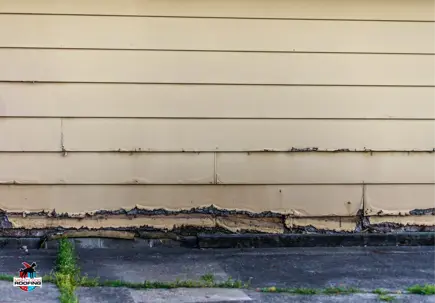
With more than 100 days of elevated dew points each year, Pennsylvania ranks among the dampest states on the East Coast. Homeowners across Chester County and Delaware County tend to focus on indoor comfort during those sticky months. Yet few realize how that relentless atmospheric water vapor eats away at their exterior cladding — gradually, season after season — until the consequences become impossible to ignore. At Mighty Dog Roofing, we document this progression on local homes every single year.
How Humidity Damages Siding — the Mechanism
How Moisture Gets Into Siding Systems
Water finds its way behind wall assemblies through three distinct pathways. Cracks, gaps, and deteriorated caulk allow direct surface penetration. Vapor drive — the physical movement of warm, damp air toward cooler wall cavities — intensifies during Pennsylvania's sweltering summer months. Ground-level splash combined with direct soil contact creates a persistent water source that most property owners ignore during the routine siding maintenance Pennsylvania conditions demand.
Why the Damage Builds Slowly and Goes Unnoticed
Exterior finishes can look perfectly healthy while water quietly degrades the layers beneath them. Paint and protective coatings conceal the real condition, creating a deceptive sense of normalcy. Often, by the time a homeowner spots anything wrong, the humidity siding damage Pennsylvania properties suffer has already been advancing for several years.
Common reasons humidity damage goes undetected:
- Exterior coatings trap dampness inside rather than blocking it from entering
- Deterioration begins in hidden zones — behind trim boards, at butt joints, and around wall penetrations
- Warm-season drying cycles mask symptoms temporarily each year
- Early indicators get dismissed as routine cosmetic aging
The window between initial water intrusion and obvious deterioration typically spans two to five years, largely depending on the cladding type and the precision of the original moisture barrier siding installation.
What Humidity Does to Vinyl Siding
Surface Resistance vs What's Behind It
Vinyl panels themselves repel water effectively — but the components they cover do not. Dampness migrates past vinyl at overlapping seams, utility cutouts, and trim connections where sealant has cracked or pulled away. Once confined behind the panels, warm air saturates the protective wrap and sheathing. Because vinyl restricts ventilation, trapped water lingers far longer than it should, and the moisture siding Chester County homes build up behind vinyl frequently triggers concealed structural decay.
Mold and Mildew on Vinyl Surfaces
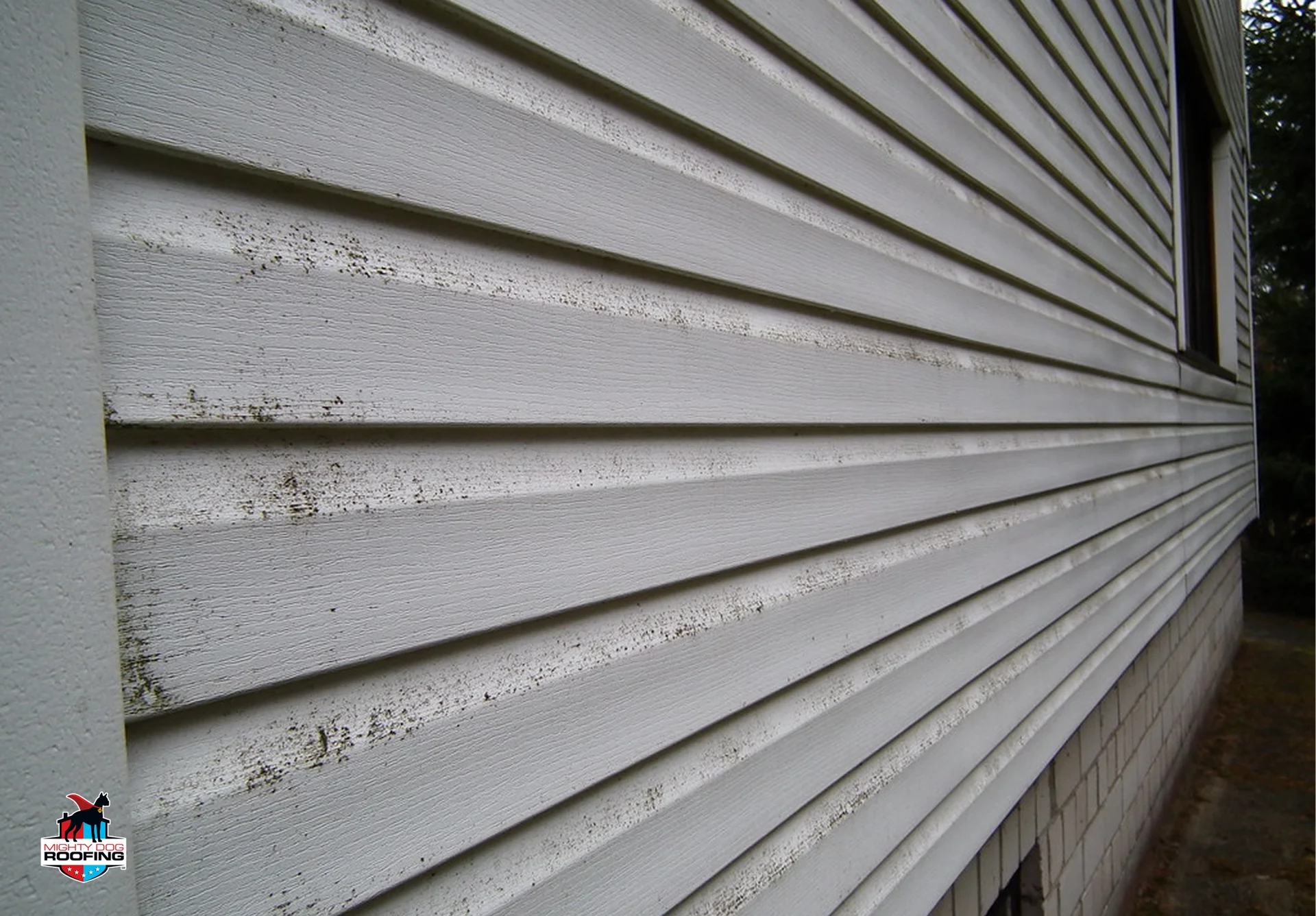
Hot, damp Pennsylvania summers encourage dark fungal growth on vinyl that many homeowners confuse with permanent staining. A simple test helps: wipe the discolored area with a diluted bleach solution. If it cleans off but reappears within a few weeks, a deeper water problem is almost certainly fueling the regrowth. Washing vinyl panels thoroughly at least once annually stops surface colonies before they signal — or contribute to — more serious material breakdown beneath.
What Humidity Does to Fiber Cement Siding
Where Fiber Cement Is Vulnerable
Unprimed cut edges absorb water at an alarming rate — and this represents the single most frequent failure point Mighty Dog Roofing encounters during field evaluations. At butt joints and exposed end cuts, raw fiber cement draws water deep into its composite core, weakening the board from within. When homeowners delay repainting beyond the manufacturer's suggested schedule, the entire face of the board grows vulnerable to siding damage humidity PA weather patterns speed up considerably.
How to Protect Fiber Cement in PA Conditions
Defense starts on installation day. Every factory-cut and field-cut edge requires primer before the board gets fastened to the wall — never afterward. Leaving raw edges exposed, even briefly, invites accelerated water absorption during the most critical break-in period. From that point forward, two priorities drive long-term performance: caulk condition and paint integrity.
Key maintenance steps for fiber cement in Pennsylvania:
- Examine and refresh caulk at every joint and penetration on a yearly basis
- Address chipped or cracked paint within 30 days of noticing it
- Plan a complete repaint cycle every 7–10 years, moving it up if chalking becomes visible
- Trim back any plants or shrubs that hold dampness against the exterior face
A residential siding contractor who specializes in fiber cement will fine-tune these intervals according to your home's specific orientation and exposure level.
What Humidity Does to Wood Siding
Wood and Moisture — an Ongoing Battle
Wood is hygroscopic — it constantly absorbs and expels water vapor in response to atmospheric conditions. Each wet-dry cycle forces the boards to expand and contract, and over time that repetitive movement fractures paint films, loosens joints, and erodes the protective seal meant to keep water out. Wood siding moisture problems grow especially severe on north-facing elevations and tree-shaded sections across Chester County, where limited sunlight keeps surfaces damp well beyond normal drying windows.
Rot — How It Starts and How Fast It Spreads
Three ingredients feed wood rot: persistent dampness, organic cellulose fibers, and poor ventilation. Wood cladding supplies all three whenever upkeep falls behind. Once fungal decay takes hold, it migrates laterally from the affected board into neighboring studs and sheathing — all without any telltale surface clue. Early-stage rot yields slightly when pressed with a screwdriver tip, but the vast majority of homeowners only react once boards are visibly disintegrating or paint is peeling off in large strips.
What Actually Extends Wood Siding Life in PA
Recoating every four to five years — compared to the seven-year interval typical of arid regions — aligns with the accelerated wear Pennsylvania's climate inflicts on wood. Beyond coatings, keeping a minimum six-inch clearance between the lowest board and grade level, directing drainage away from the foundation, and pruning nearby vegetation all reduce chronic water contact. In the end, how carefully the original installer handled flashing, back-priming, and joint detailing dictates whether wood cladding in this region lasts 15 years or 40. A trusted residential siding company near you can assess your wood exterior and recommend the right maintenance schedule before damage sets in.
The Wall Behind the Siding — What Humidity Does There
Moisture Barriers — When They Work and When They Don't
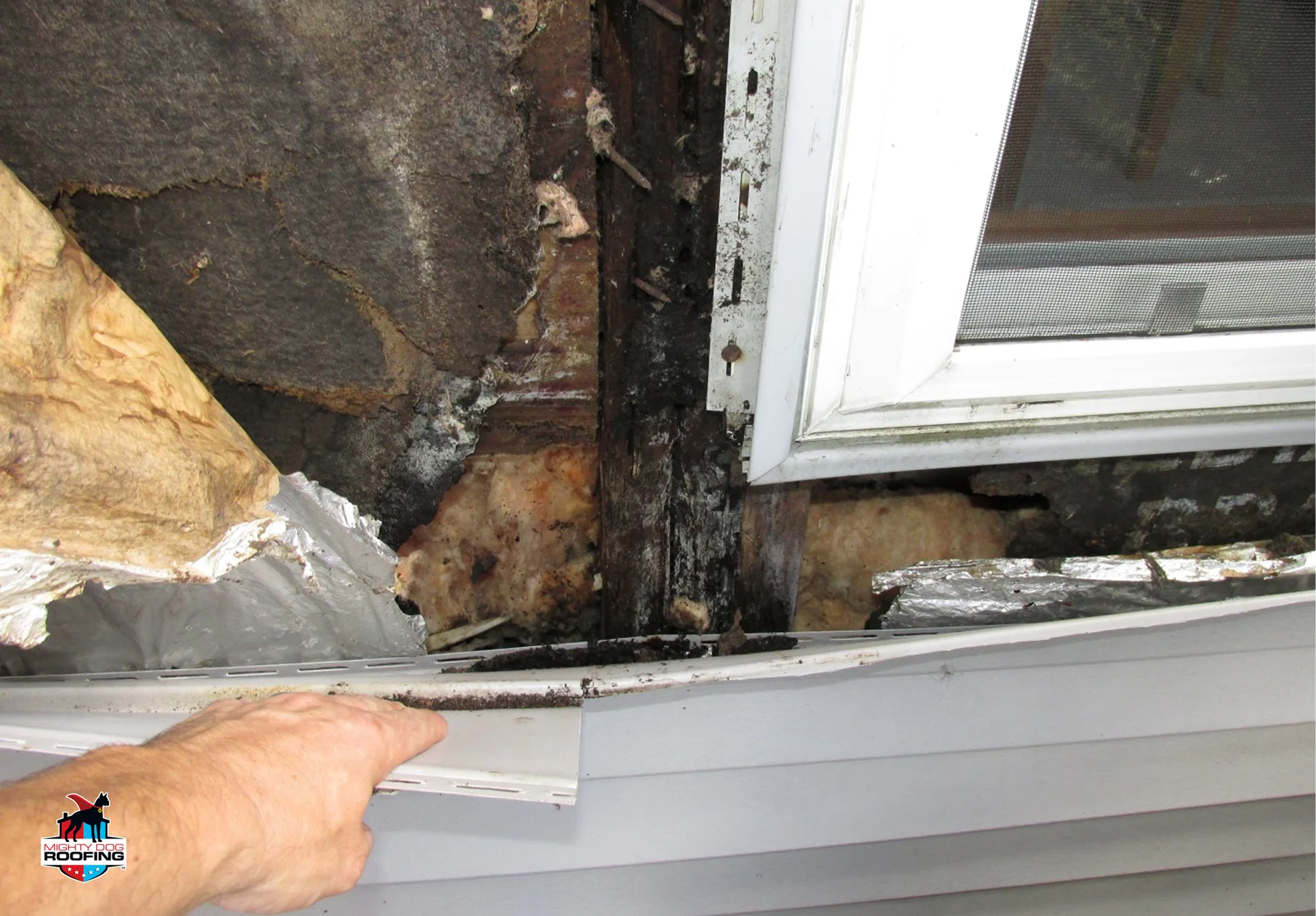
When correctly installed and lapped, a housewrap barrier blocks bulk water from contacting sheathing while still letting vapor pass outward. Over the years, though, aged or improperly overlapped wraps fail without any outward warning — adhesive breaks down, seams open, and water begins pooling against the substrate. During siding replacement Chester County homeowners plan, Mighty Dog Roofing strongly advises inspecting and replacing the wrap at the same time — because this window of access rarely comes around twice.
Sheathing and Framing Damage from Chronic Humidity
Extended water contact causes OSB and plywood sheathing to swell, separate at the layers, and shed load-bearing capacity. Soft, spongy zones develop behind cladding that appears flawless from the street. Once deterioration reaches the framing, costs escalate sharply — a straightforward panel job transforms into a structural rebuild requiring carpentry, mold treatment, and sometimes temporary bracing to stabilize the wall during the work.
Signs Humidity Has Already Caused Damage
What to Look for on the Surface
Several visible clues reveal that water has been migrating through your wall assembly. Paint that lifts or curls from the bottom edge of a board upward is among the strongest indicators of inward vapor pressure from the cavity behind it. Warping, buckling, or cupping that appeared within the last twelve months points to internal water-content shifts inside the cladding itself.
Surface warning signs to watch for:
- Paint blistering or flaking that originates along the lowest board edges
- Boards lifting off the wall plane or curling at their ends
- Dark staining lines at seams and joints that follow water travel routes
- Caulk cracking open or bulging outward from connection points
Spotting two or more of these symptoms on a single wall elevation strongly suggests that water has been active behind the exterior for an extended period — and a professional assessment is warranted.
What to Look for Inside
Indoor clues can be just as revealing. A lingering musty odor in rooms that share an exterior wall deserves attention. Drywall that feels soft or shows yellow-brown discoloration near outside corners — especially low on the wall — often traces back to water traveling inward. Rising cooling costs without an obvious mechanical explanation may indicate that wall insulation has become saturated, because wet insulation forfeits its thermal resistance and forces the HVAC system into overtime.
What to Do If You Suspect Humidity Damage
Assessment Before Repair
Before committing to any scope of work, probe suspect areas with a screwdriver or awl — visual appearance alone hides a great deal. A professional evaluation from Mighty Dog Roofing goes further, using electronic meter readings, sheathing tap-tests, and barrier assessments to map the true extent of deterioration. If storm events played a role, photograph every affected area with dates so your insurance carrier can process the claim accurately.
Getting the Right Fix
Localized repair makes sense when deterioration stays confined to a handful of boards with sound sheathing behind them. Once water has migrated across larger sections or compromised framing members, however, a comprehensive replacement delivers far stronger long-term value. An experienced siding team examines not only the outer panels but every layer of the wall assembly during the evaluation. Reach out to Mighty Dog Roofing for a free estimate before hidden deterioration advances to the structural framework.