
Why Cranston Roofs Fail Faster Under Tree Shade
From the historic, tree-canopied streets around Meshanticut Lake to the mid-century ranch and colonial properties in Dean Estates and Garden City, Cranston features some of Rhode Island’s most sought-after residential neighborhoods. However, the mature landscaping and inland topography that make Cranston so appealing also subject local roofs to severe environmental strain.
Heavy shade from tall oak and maple trees creates localized microclimates. Shaded roof planes stay damp long after a storm passes, creating a breeding ground for roof moss. As moss expands, it can lift shingle tabs and weaken factory seals, allowing water to work backward beneath the shingle surface. When winter arrives, that trapped moisture can freeze and contribute to destructive ice dams along the eaves.
In 2026, replacing a roof in Cranston requires addressing the underlying building science, not just installing new shingles over old problems.
The Substrate Standard: Remediating Plank Gaps in Older Cranston Homes
Many homes built in Cranston prior to 1970 feature dimensional plank decking rather than modern plywood sheets. Decades of humidity swings cause these boards to shrink and shift, frequently leaving gaps between planks that exceed 1/4 inch.
Under Rhode Island code requirements and manufacturer warranty rules, shingles must be fastened into a solid, continuous nailable substrate. Driving roofing nails into empty board gaps leaves fasteners with little to no holding power. During a 60+ MPH wind gust, shingles can loosen or blow off when the fastening pattern is compromised.
To restore structural integrity, Mighty Dog Roofing of Rhode Island installs a solid overlay of 1/2-inch CDX plywood whenever plank gaps exceed code limits. This creates a rigid diaphragm and provides consistent nail purchase across the entire roof surface.
Eliminating Ice Dams with Balanced Airflow
Inland Cranston can experience colder winter night drops than coastal shoreline towns, increasing ice dam risk. Ice dams form when warm attic air melts snow on the upper roof, causing water to run down and refreeze over cold eaves.
Our replacement system reduces ice dam risk through a three-part approach:
Continuous Intake and Exhaust
We install unobstructed intake ventilation (or Smart Vents where soffits are enclosed) paired with a ridge vent to help equalize attic temperatures with exterior air.
Self-Adhered Ice and Water Shield
We apply self-adhered waterproofing membrane along eaves, valleys, and key wall transitions to help block backed-up water from reaching the deck.
Class 3 High-Wind Architectural Shingles
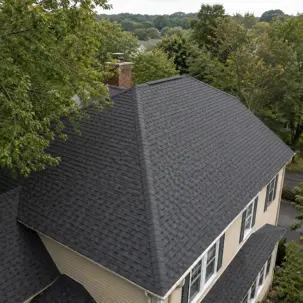
We finish with heavy-duty architectural shingles with reinforced nailing zones (for example, IKO Dynasty with ArmourZone) designed to improve wind uplift resistance when installed to manufacturer specifications.
Verification Through Drone Diagnostics
Steep, multi-plane Cranston roofs require precise evaluation. We use our Drone Super Scan protocol to document roof conditions and critical details like valleys and chimney flashing before and after installation, giving homeowners visual proof of a job built to documented standards.
Rhode Island Service Locations:
Ashaway, Barrington, Bradford, Bristol, Carolina, Central Falls, Charlestown, Chepachet, Clayville, Coventry, Cranston, Cumberland, East Greenwich, East Providence, Exeter, Forestdale, Foster, Glendale, Greene, Greenville, Harrisville,Hope,Hope Valley, Hopkinton, Jamestown, Johnston, Kenyon, Kingston, Lincoln, Little Compton, Manville, Mapleville, Middletown, Narragansett, Newport, North Kingstown, North Providence, North Scituate, North Smithfield, Oakland, Pascoag, Pawtucket, Portsmouth, Providence, Riverside, Rockville, Rumford, Saunderstown, Shannock, Scituate, Slatersville, Smithfield, Tiverton, Wakefield, Warren, Warwick, West Greenwich, West Kingston, West Warwick, Westerly, Wood River Junction, Woonsocket, Wyoming
FAQ
What is the maximum allowable deck board gap for a roof in Cranston, RI?
Under the IRC and common asphalt shingle manufacturer guidelines, roof board gaps should not exceed 1/4 inch. When gaps are wider, a 1/2-inch CDX plywood overlay is a common corrective approach to create a continuous nailable substrate and protect warranty eligibility.
Why are ice dams so common on homes near Meshanticut and Dean Estates?
Heavy tree shade reduces winter sun exposure at the eaves, while attic heat loss can warm the upper roof deck. This temperature imbalance melts snow higher on the roof, and the runoff can refreeze at the colder, shaded eave line.
Can you replace a roof in Cranston during the winter months?
Yes. Modern synthetic underlayments and self-adhering membranes support cold-weather installation. Extra care is taken to follow manufacturer cold-weather requirements so shingles seal properly when temperatures rise (or hand-sealing is used when specified).