
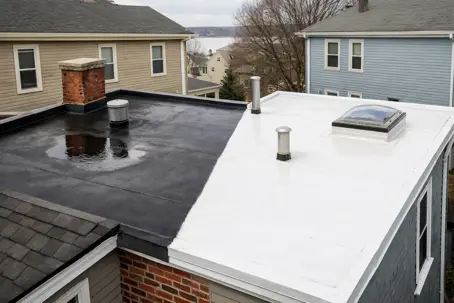
If you own a classic triple-decker, a home with a low-slope dormer, or a flat-roofed sunroom in Rhode Island, you already know a hard truth:
Standard asphalt shingles do not belong on flat sections.
When the pitch is too low, water does not shed fast enough. It can pond, back up, and find its way into seams and nail lines.
So when you call a roofer about a residential flat roof in Rhode Island, you will usually hear two options:
- TPO (thermoplastic polyolefin)
- EPDM (ethylene propylene diene monomer), commonly called “rubber”
Both can work when installed correctly.
But for many Rhode Island residential flat roofs, EPDM is often the safer, more forgiving choice - especially when you factor in winter performance and long-term repairability.
Below is a homeowner-first comparison (no hype) so you can choose the right system for your building.
First: make sure you are solving the right problem
Before we talk membrane, remember that most flat-roof leaks are not just “the material.”
They are usually caused by:
- Poor drainage or ponding water
- Weak edge details
- Bad transitions into shingles (dormers, porch roofs)
- Chimney or wall flashing failures
- Old skylight curbs
A good contractor should diagnose the leak path and propose a full system solution, not just sell a roll of membrane.
EPDM vs TPO in Rhode Island: the real differences
1) Winter performance: snow, ice, and freeze-thaw cycles
Rhode Island winters create repeated freeze-thaw swings. That movement stresses seams, edges, and penetrations.
EPDM advantage: flexibility in cold weather
EPDM is a synthetic rubber. In general, rubber stays more flexible in cold temperatures than many plastic-based materials.
That flexibility matters because:
- The roof moves as temperatures swing
- Seams and penetrations are less likely to be stressed by expansion and contraction
- Repairs can be made without relying on perfect heat-weld conditions
TPO reality: performance depends heavily on product quality and installation
TPO is a thermoplastic membrane. Many modern TPO systems perform well, but results depend on:
- The specific manufacturer and membrane thickness
- Proper welding technique
- Clean, dry conditions during installation and repair
For residential roofs with lots of small details (dormers, porches, tight edges), the install quality matters as much as the material.
2) Color and heat: does black EPDM “melt snow”?
You will hear the claim that black EPDM helps with snow melt.
There is some common-sense truth here: darker surfaces absorb more solar heat than bright white surfaces.
But the bigger Rhode Island issue is not “black vs white.” It is:
- Drainage
- Edge ice build-up
- Whether the roof is insulated and vented correctly where it transitions into the main roof
So yes, color can play a role, but do not let color distract from the system details that prevent leaks.
3) Track record and long-term predictability
EPDM: decades of residential history
EPDM has been used for a long time in North American roofing, including in cold climates.
When installed correctly, many EPDM roofs can deliver long service life and are relatively straightforward to maintain.
TPO: newer, with more variation between products
TPO has been widely used for years, but the market has seen more variation between manufacturers and formulations over time.
That does not make TPO “bad.” It does mean you should care about:
- Brand and membrane thickness
- Warranty terms
- Contractor experience with that exact system
4) Repairs: what happens 10 years from now?
This is where residential homeowners should pay attention.
EPDM repairs are often simpler
EPDM can often be patched with compatible materials and adhesives, which can make small repairs more accessible.
TPO repairs can be more equipment-dependent
TPO seams are typically heat-welded. That can be excellent when done correctly, but it may require specialized tools and the right conditions.
For a homeowner, the practical question is:
“If I need a repair later, will it be easy to find a contractor who can service this exact system?”
The verdict for many Rhode Island homes
If you have a low-slope or flat section on a Rhode Island home (triple-decker, dormer, porch roof, sunroom), EPDM is often a strong choice because it is flexible, proven, and repair-friendly.
That said, a well-installed TPO system from a reputable manufacturer can also perform very well.
The best approach is to choose the contractor and the system together:
- Demand the exact manufacturer, membrane thickness, and scope in writing
- Confirm how edges, drains, and transitions are handled
- Ask how future repairs will be performed
If you have a flat or low-slope roof section in Rhode Island and you are deciding between EPDM and TPO, we can inspect the roof, identify the leak risks, and recommend the right system for your building.
Call (401) 425-4108 or visit our Contact Us page to schedule an inspection.
FAQ
What is better for a residential flat roof in Rhode Island: TPO or EPDM?
For many Rhode Island residential flat roofs, EPDM is a popular choice because it is flexible in cold weather and is generally repair-friendly. TPO can also perform well when installed correctly using a high-quality system.
How long does an EPDM rubber roof last?
Service life depends on installation, drainage, and maintenance, but EPDM roofs are known for long-term durability when installed correctly.
Can you put asphalt shingles on a flat roof?
In general, shingles are not designed for very low-slope or flat roofs because water does not shed fast enough. Low-slope areas typically require a membrane system designed for ponding and seam protection.