
Can professional roofers match 20-year-old shingles during repairs?
Professional roofers can usually identify the closest available shingle match, but matching 20-year-old shingles exactly is often impossible. The original product may be discontinued, while years of fading and weathering can change its appearance. Consequently, replacement shingles may look darker or have a different texture despite sharing a similar brand and color.
Why Is It Difficult to Match 20-Year-Old Shingles?
Roofing materials change over time. Even if the manufacturer still produces a shingle with the same color name, the new version may not look identical to one installed two decades earlier. Several factors can create noticeable differences:
Product discontinuation: Manufacturers regularly update their shingle collections, colors, dimensions, and construction methods. The original shingle may no longer be available.
Sun exposure: Ultraviolet exposure can gradually fade or alter the color of existing shingles, especially on roof slopes that receive substantial sunlight.
Weathering: Rain, wind, snow, temperature changes, and airborne debris can affect the surface granules and overall texture of older roofing.
Production variations: Shingles manufactured in separate production batches can have subtle color differences, even when they carry the same product and color names.
Previous repairs: If the roof has already been repaired, it may contain shingles of different ages and shades.
These conditions mean a sample viewed in a catalog or supplier warehouse may appear different after installation. A professional roofer considers both the original product and the roof’s current weathered appearance when searching for a suitable replacement.
How Do Professional Roofers Find the Closest Shingle Match?
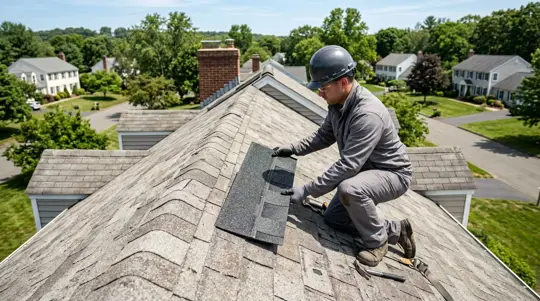
A roofer begins by examining the existing roof installation and identifying the characteristics of the shingles. This evaluation may include the color blend, width, profile, thickness, texture, granule pattern, and visible exposure of each shingle course.
If the manufacturer and product line can be identified, the roofer may check whether the same shingle is still available. When it has been discontinued, the next step is to compare current products that share similar dimensions, construction, and visual characteristics. A close match must fit the roofing system properly, not merely resemble the existing color from the ground.
Roofers may also compare physical samples against the roof in natural daylight. Lighting can affect how roofing colors appear, so reviewing a sample outdoors provides a more useful comparison than relying entirely on photographs or digital color charts.
For homeowners in Ridgefield, Connecticut, the goal is generally to find a compatible shingle that supports a sound repair while minimizing visual contrast. However, professional selection does not guarantee that a new shingle will blend invisibly with material that has weathered for 20 years.
Will New Shingles Blend In With the Existing Roof?
New shingles may become somewhat less noticeable after exposure to outdoor conditions, but homeowners should not assume that they will eventually match perfectly. A new shingle typically retains stronger color and more surface granules than an older one. That contrast can remain visible, particularly when the repair is located on a prominent roof slope.
The visibility of a repair depends on several factors:
The difference between the original and replacement colors
The size and location of the repaired area
The amount of fading on the existing roof
The direction and intensity of sunlight
The roof’s pitch and visibility from the street
Differences in shingle thickness, pattern, or texture
A small repair on a less visible section may attract little attention, while a larger patch on the front-facing slope may be more apparent. Professional roofers can explain the likely visual result before the repair begins, allowing homeowners to make an informed decision.
When Should Homeowners Consider More Than a Shingle Repair?
A close shingle match may be appropriate when damage is limited and the surrounding roofing remains serviceable. However, appearance is only one part of the decision. A roofer should also evaluate the condition of nearby shingles, the roof deck, flashing, underlayment, and other components affected by the damaged area.
If shingles are brittle, cracked, curling, losing granules, or difficult to manipulate without further damage, completing an isolated repair may be challenging. Widespread aging or repeated leaks can also indicate that the concern extends beyond a few missing or damaged shingles.
In these situations, a professional roofing inspection can help determine whether a localized repair remains practical or whether broader roof installation work should be considered. Ridgefield and Fairfield County homeowners should base that decision on the roof’s overall condition, compatibility of available materials, and expected appearance rather than color matching alone.
FAQ
Can roofers use shingles from another manufacturer for a repair?
They may be able to use a comparable product, but the replacement must have suitable dimensions, construction, and installation requirements. Similar color alone does not establish compatibility.
Why do replacement shingles look darker than old shingles?
New shingles have not experienced years of sunlight, precipitation, surface wear, or granule loss. Their original color and texture can therefore appear stronger than the surrounding roofing.
Can a roofer guarantee an invisible shingle repair?
An invisible repair generally cannot be guaranteed when existing shingles are heavily weathered or discontinued. A roofer can identify the closest practical match and explain likely differences.
Should shingles be selected from photographs alone?
Photographs can help with initial identification, but lighting and camera settings may distort color. Comparing a physical sample with the roof outdoors usually provides a more accurate assessment.
Can professional roofers match 20-year-old shingles during repairs?
Professional roofers can usually find the closest available match, but an exact match to 20-year-old shingles is often impossible. Older shingles may be discontinued, faded, weathered, or made from a different production batch. New shingles can therefore look darker or have a different texture even when the brand and color name are similar.
Conclusion
Professional roofers can often locate shingles that closely resemble 20-year-old roofing, but age, weathering, discontinued products, and manufacturing differences frequently prevent an exact match. The repair may remain visible even when the replacement is compatible and carefully selected.