Can a tornado take off a metal roof?
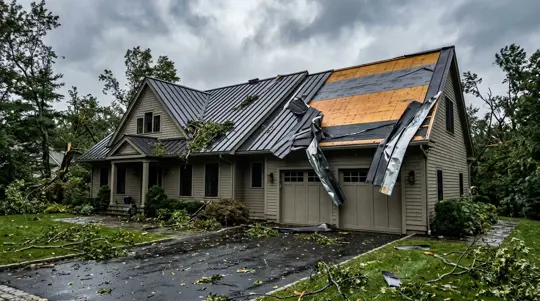
Yes, a tornado can remove or severely damage a metal roof because no residential roofing system is tornado-proof. Properly selected and installed metal roofing can provide strong wind and impact resistance, but its performance depends on the complete roof assembly, fastening, roof edges, deck, structure, storm intensity, and flying debris.
How Can a Tornado Damage or Remove a Metal Roof?
A tornado produces intense, rapidly changing wind forces that can act on a roof from several directions. These forces may create uplift, which pulls roofing materials away from the roof deck. Pressure changes and wind entering through a damaged window, door, vent, or other opening can place additional stress on the roof assembly.
Metal panels can also be damaged by airborne objects. Branches, building materials, outdoor furniture, and other debris may puncture panels, deform seams, or damage flashing. Even when the metal surface remains largely intact, forces from the storm can affect the underlying deck, framing, fasteners, and connections.
The outcome depends on the intensity and path of the tornado. A metal roof may sustain localized panel or flashing damage in one storm, while a more powerful or direct tornado may remove large sections of roofing or damage the supporting structure. Metal roofing is not immune to these forces.
What Determines How a Metal Roof Performs in Extreme Wind?
A metal roof performs as a system rather than as a collection of panels alone. Its ability to resist wind depends on how well every part of that system transfers forces to the building structure.
Important factors include:
Panel type and material: Metal roofing products have different profiles, thicknesses, seam designs, and tested performance characteristics.
Fastening method: Fastener type, spacing, placement, and attachment into suitable materials all affect resistance to uplift.
Seams and connections: Secure seams help adjacent panels remain connected when exposed to changing wind pressures.
Roof edges and corners: Eaves, rakes, ridges, and corners often experience significant wind forces, making secure edge details especially important.
Roof deck condition: A deteriorated, damaged, or poorly secured deck may weaken the attachment of the entire roofing system.
Building structure: Rafters, trusses, sheathing, and structural connections influence whether the roof remains attached to the home.
Installation quality: A suitable product may not perform as intended if panels, flashing, fasteners, or edge components are installed incorrectly.
For homeowners in Ridgefield, Connecticut, professional evaluation of the entire assembly provides more useful information than examining the metal panels by themselves.
Does Metal Roofing Provide Strong Wind and Impact Resistance?
Metal roofing can provide substantial wind and impact resistance when the product is appropriate for the building and installed as part of a properly designed assembly. However, resistance does not mean that the roof is tornado-proof or guaranteed to remain undamaged during every severe storm.
A securely installed system may be better able to resist panel lifting, seam separation, and certain debris impacts. Its actual performance still depends on storm intensity, roof geometry, installation details, existing condition, and the integrity of the structure beneath it.
This distinction is important when planning a new roof installation. Homeowners should discuss the selected roofing product, fastening pattern, edge details, underlayment, deck condition, and structural attachment with a qualified roofing professional. Those components work together, and weaknesses in one area may affect the performance of the entire system.
What Should Homeowners Do After a Tornado or Severe Wind Event?
After a tornado or severe wind event, remain away from downed electrical lines, unstable trees, loose materials, and visibly damaged sections of the building. Do not climb onto the roof to inspect it. Metal panels and structural components may be loose even when the damage is not obvious from the ground.
From a safe location, look for visible concerns such as:
Missing, lifted, bent, or displaced metal panels
Open or separated seams
Loose flashing around roof edges, chimneys, vents, or skylights
Punctures or dents caused by flying debris
Sagging areas or changes in the roofline
Water stains, dripping, or daylight visible from inside
Debris resting on the roof or against the building
Photograph visible conditions when it is safe to do so, and avoid making permanent repairs before the roofing system has been evaluated. A professional inspection can assess the metal surface, attachment points, flashing, deck, and accessible structural components.
Homes in Fairfield County may also have connected exterior damage involving siding, windows, gutters, or skylights. Examining these areas can help identify openings that may allow water to enter even if the main roof covering appears intact.
FAQ
Can strong winds lift metal roof panels without removing the entire roof?
Yes. Wind can lift individual panels, open seams, loosen fasteners, or damage roof edges while leaving other portions of the metal roof attached.
Is visible denting the only sign of tornado damage to a metal roof?
No. Damage may also involve loose seams, displaced flashing, compromised fasteners, punctures, water intrusion, or hidden problems affecting the deck and structural connections.
Should homeowners inspect a metal roof themselves after a tornado?
Homeowners may document visible conditions from a safe location, but they should not climb onto a potentially unstable roof. A professional inspection is the safer approach.
Can damaged metal roof panels always be repaired individually?
Not always. Repair options depend on the extent of the damage, panel availability, seam design, underlying deck condition, and whether the remaining roof assembly is secure.
Can a tornado take off a metal roof?
Yes, a tornado can remove or severely damage a metal roof because no residential roofing system is tornado-proof. Properly selected and installed metal roofing can offer strong wind and impact resistance, but performance depends on the complete roof assembly, fastening, edges, deck, structure, storm intensity, and flying debris.
Conclusion
A tornado can take off or severely damage a metal roof. Although a properly selected and installed system can offer strong resistance to wind and impact, its performance depends on the panels, fasteners, edges, deck, structure, storm intensity, and debris exposure.
If your Ridgefield home has experienced tornado conditions or severe wind, contact Mighty Dog Roofing of Fairfield County for a professional roofing inspection. The team can evaluate visible and accessible components and explain whether repair or roof installation should be considered