

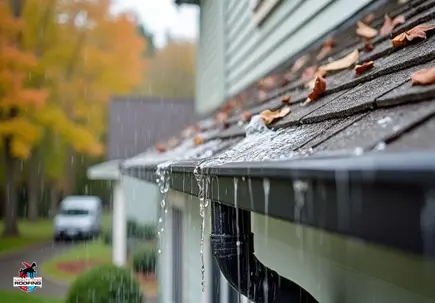
Most homeowners think about their gutters when water is already coming through the ceiling or pooling against the foundation. By then, the repair can be more extensive and costly than it would have been if the drainage issue had been identified earlier. In Newark, Delaware, autumn brings cooler air and falling leaves, but it can also bring periods of heavy rain that put extra pressure on drainage systems that have had all summer to accumulate debris and experience wear.
The ground itself changes the equation. After a humid Delaware summer, the soil around many foundations may already contain significant moisture. When fall storms roll through New Castle County, saturated soil may have less capacity to absorb additional water. Every overflowing gutter and every downspout that discharges water too close to the foundation can contribute to standing water and drainage problems.
At Mighty Dog Roofing of Greater Chadds Ford, fall is an important time to address drainage problems before repeated rainfall and falling leaves make existing issues worse.
Why Fall Is the Critical Window for Your Drainage System
How Saturated Soil Changes the Flooding Equation
A gutter and downspout system has one primary job: move water off the roof and away from the house before it can pool near the foundation. During drier periods, stretches between storms give the ground more time to absorb water, so a slightly undersized downspout or a missing extension may not immediately cause visible problems. Fall can remove some of that margin. Clay-heavy soil common around Newark and New Castle County can hold water longer, and repeated autumn storms may leave less time for the ground to drain between events. A drainage flaw that was barely noticeable in July can become much more apparent when the soil is already saturated.
What a Clogged or Undersized System Actually Costs You
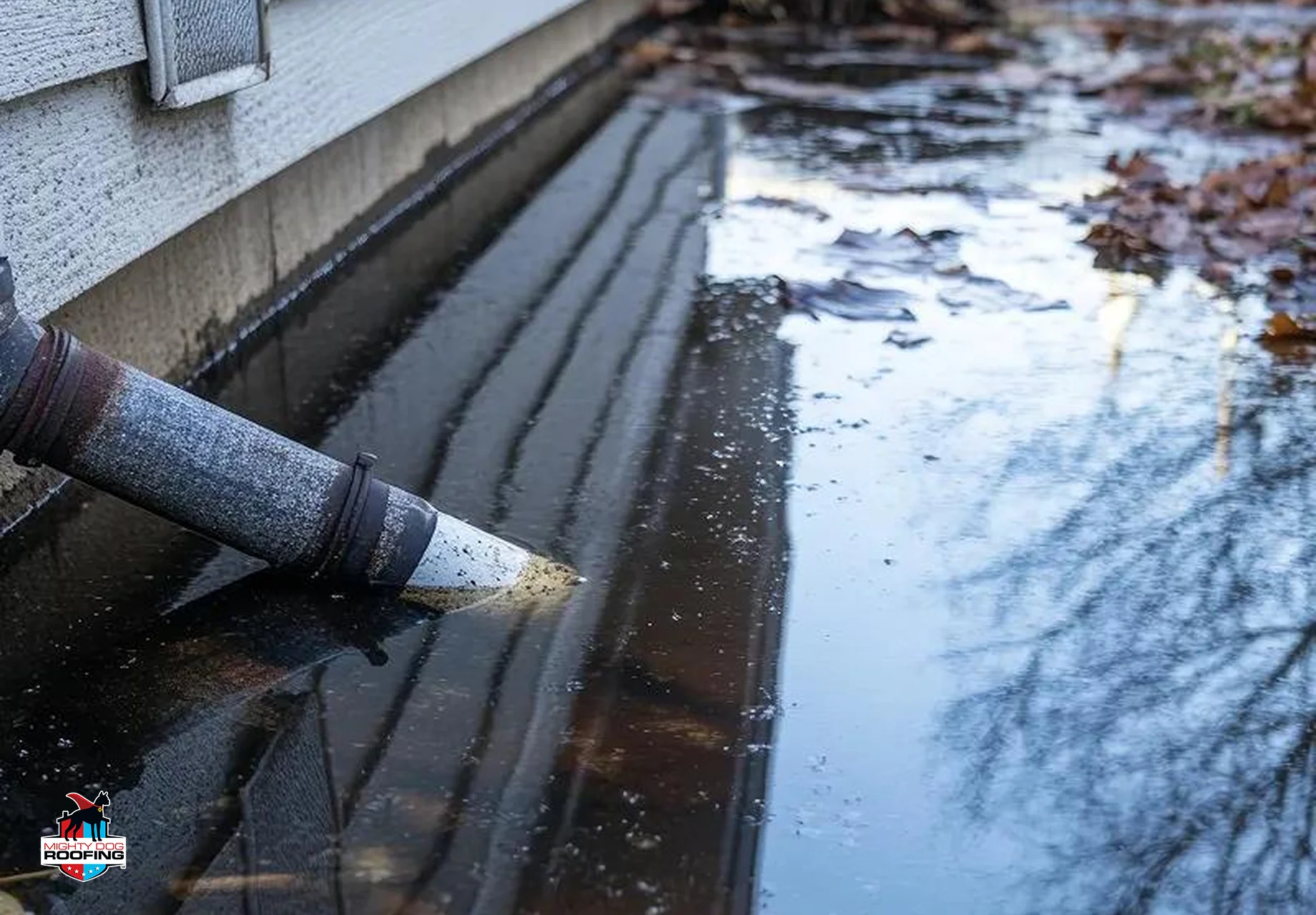
A blocked downspout outlet doesn't just mean a puddle in the yard. Water can back up in the gutter trough, overflow the front edge, and run down the fascia and siding — the kind of repeated moisture exposure that can eventually require more than simple gutter repair and installation.
Water pooling against the foundation can also create hydrostatic pressure that can force water into basements and crawl spaces through small cracks or other vulnerable areas.
If overflowing gutters, damaged outlets, or failing drainage components continue to create problems, a professional assessment can help determine whether the issue is a simple repair or a larger drainage problem. If gutter or drainage problems allow water to accumulate near the roofline during freezing weather, ice formation can create additional roofing damage and turn a small drainage issue into a problem that may require roof repair services.
What Proper Fall Drainage Prep Gets Right
Protecting the Foundation Before Freeze-Thaw Cycles Begin
Once winter arrives, any water that's been pooling near the foundation goes through repeated freeze-thaw cycles — expanding as it freezes, contracting as it thaws, and gradually widening any existing crack in the process. Addressing drainage flaws in the fall, while the ground is still workable and grading or extensions can still be adjusted, removes the water before it has a chance to start that cycle at all.
Reducing the Risk of Ice Forming Along the Roofline
A gutter system that's already overwhelmed by fall rain and leaf debris is the same system that has to handle the season's first hard freeze. Water that can't drain properly sits at the roof edge, and once temperatures drop, that standing water is what typically forms the first ice buildup of the season along the eaves. Clearing and correcting drainage issues in the fall directly reduces how much water is sitting there when the freeze actually hits.
Avoiding the Jump From a Simple Repair to a Full Replacement
A loose fastener, a small gap at a seam, or a slightly undersized downspout is typically an inexpensive fix in October. Left through a winter of freeze-thaw cycling and repeated ice exposure, that same minor flaw often widens into a section that needs to be replaced rather than repaired. Addressing these issues in the fall is usually the difference between a routine gutter repair and a more involved, more expensive project once spring arrives.
Common Downspout and Drainage Problems Around Newark Homes
Not every drainage issue looks the same, and not every fix requires a full replacement. Here's what shows up most often on fall inspections in the area, and what actually resolves it:
Drainage Issue | Fall Warning Sign | Risk If Ignored | Recommended Fix |
Undersized downspouts | Water sheets over the gutter edge during moderate rain instead of draining through the spout | Fascia rot, siding damage, and pooling at the foundation | Upsize to 3" × 4" downspouts or add a second downspout run |
Clogged outlet or elbow | Leaves and granules piled at the downspout opening; slow or no flow | Overflow floods flower beds, walkways, and window wells | Gutter repair with full debris removal and guard installation |
Downspouts discharging too close to the house | Water pooling within 3 feet of the foundation | Basement seepage and foundation cracking | Extend downspouts 5–10 feet with rigid or flexible extensions |
Poor yard grading | Standing water lingers 24+ hours after rain | Soil erosion, mosquito breeding, and mold risk near the house | Regrade soil to slope away from the foundation |
Aging or damaged gutters | Rust streaks, sagging sections, or leaking seams | Structural failure and water intrusion at the roofline | Gutter repair or full gutter installation where sections are beyond saving |
The Downspout Extension and Grading Standard That Actually Works
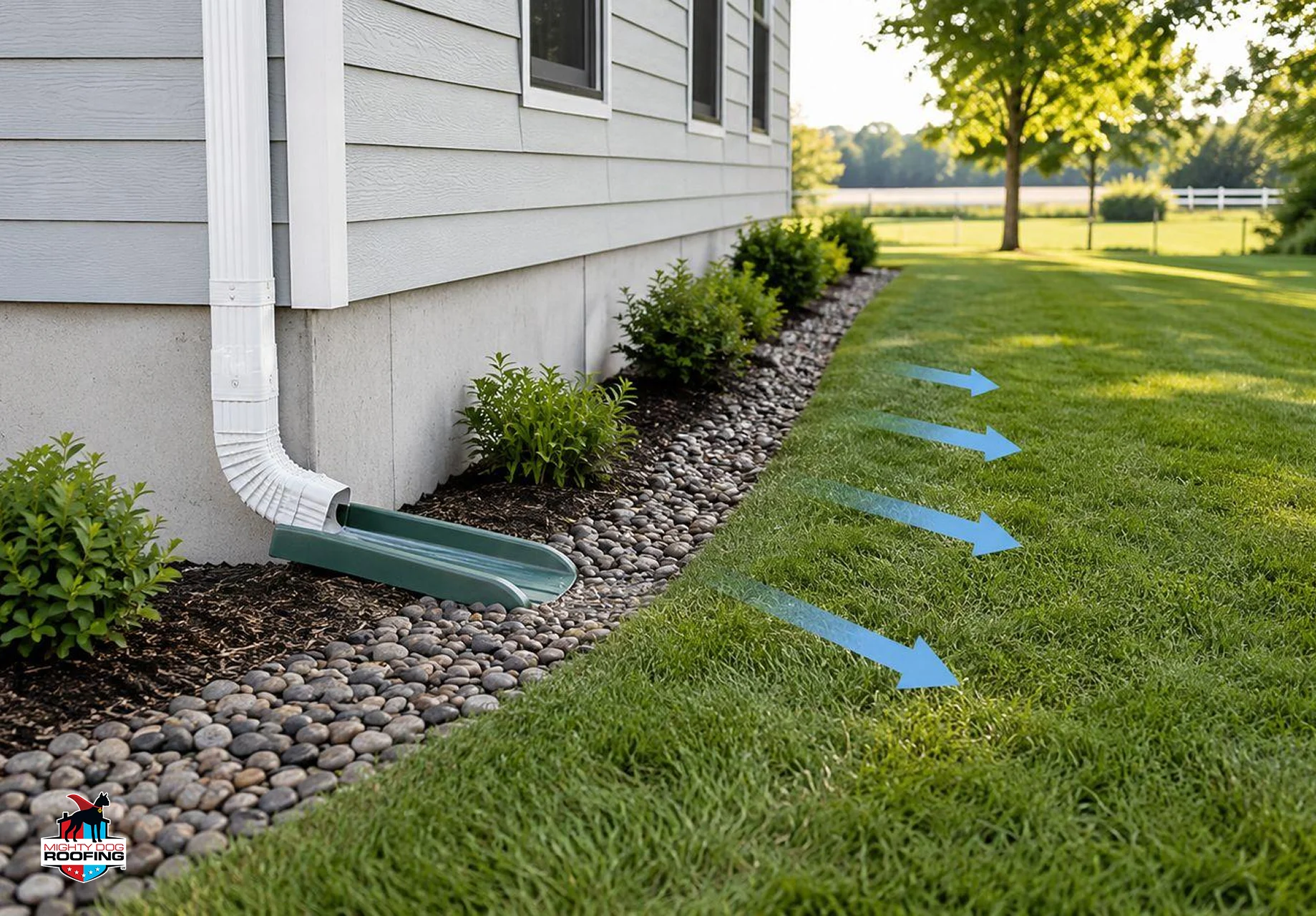
As a general rule, downspouts should discharge water at least 5 to 10 feet away from the foundation, and the ground within that zone should slope away from the house at roughly a quarter inch of drop per foot. A splash block alone often isn't enough — it disperses water at the point of discharge but may not move it far enough away from the foundation, which is why rigid or flexible extensions are commonly added. On larger roof sections, a single 2″ × 3″ downspout may not provide enough capacity for the volume of water generated during heavy rainfall. Upsizing to a 3″ × 4″ downspout or adding a second downspout can be more effective than relying on an extension alone.
How Fall Drainage Needs Compare to Other Times of Year
Drainage systems face a different kind of pressure depending on the season, and understanding that pattern is part of knowing why fall gets so much attention:
Season | Rainfall & Soil Pattern | Drainage Risk Level | Best Action |
Spring (Apr–Jun) | Frequent showers on soil that's often still softened from winter thaw | Moderate — most flaws are still minor and easy to catch | Good time for a first-half-year gutter and downspout check |
Summer (Jul–Aug) | Heavier bursts of rain, but longer dry stretches between storms | Lower — the ground has more time to absorb water between events | Plan any fall upgrades or repairs while the system isn't under pressure |
Fall (Sep–Nov) | Frequent, sustained rain on top of a season's worth of leaf debris | Highest of the year — flaws that were invisible all summer show up now | The best window to inspect, repair, and prepare before the ground freezes |
Winter (Dec–Feb) | Freezing temperatures turn standing water into ice | Existing flaws worsen, and repairs become harder and more expensive | Reactive or emergency work only — most fixes should already be done |
Fall vs. Spring
Spring showers test a drainage system, but the ground has usually finished its winter thaw and isn't carrying the same accumulated moisture that fall soil often holds after a full summer. A spring inspection is a reasonable checkpoint, but it typically catches fewer serious flaws than a fall one does, simply because the ground hasn't been pushed as hard yet.
Fall vs. Summer
Summer storms can be intense, but they're usually followed by longer dry stretches that give the ground time to recover. Fall trades that recovery time for near-constant moisture, on top of the leaf and debris load that summer doesn't produce. A system that handled every summer storm without issue can still struggle once fall conditions set in.
Fall vs. Winter
By winter, the window for a straightforward repair has often closed. Frozen ground makes regrading impractical, and any water still finding its way to the foundation is now doing so as ice rather than liquid. Winter drainage work tends to be reactive and more limited in scope than fall work, which is exactly why fall is the season worth acting in rather than waiting through.
Signs Your Newark Home Needs Drainage Attention This Fall
Call for gutter repair or drainage work now if:
- Water visibly overflows the gutter edge during moderate-to-heavy rain instead of draining through the downspouts
- You see erosion trenches, mulch washouts, or standing puddles within 5 feet of the foundation more than a day after rain
- A downspout empties directly onto a patio, driveway, or right next to a basement window
- Gutters sag, pull away from the fascia, or show rust streaks and separated seams.
You likely have more room before winter if:
- Gutters drain cleanly with no overflow during a normal fall rain
- Downspouts already extend at least 5 feet from the foundation onto sloped ground
- A recent inspection found no clogs, sagging, or standing water near the house.
How to Prepare Your Drainage System Before Winter
What to Confirm Before Scheduling
Before booking a cleaning or repair, confirm whether one visit is enough or whether a second cleaning after peak leaf drop makes sense for a heavily wooded lot. Ask whether downspout sizing was checked against the actual roof area it serves rather than simply replacing the existing downspout like-for-like, and whether grading around the foundation is part of the assessment. If gutter guards are being discussed, make sure the quote clearly states whether they are included or listed as a separate line item.
Getting Ahead of the Season
Fall can bring increased demand for gutter installation and gutter repair across New Castle County, particularly after heavy rain and peak leaf drop. Homeowners who schedule a roof inspection before drainage problems become more serious can address issues earlier and potentially avoid a more complicated repair later in the season.
There's no single downspout fix that solves every property's drainage — every home's soil, grading, and roofline is different. But for Newark homeowners who've watched water pool in the same spot every October, now is a good time to have the drainage system evaluated before repeated rainfall turns a small drainage issue into a larger foundation or yard drainage problem.