Key Takeaways
- Multi-family complexity: Triple-deckers and 2-4 unit properties require specialized installation techniques to merge steep-slope shingles with low-slope porch roofs.
- Code strictness: Investors should require code-compliant ice barrier installation and documented scope to avoid inspection issues.
- Substrate liability: Driving fasteners into historic spaced plank decking can reduce holding power and create warranty and wind-risk problems; continuous CDX plywood overlays are often the right fix.
- Capital strategy: Investors can utilize zero-down options for qualified buyers (terms vary) to replace failing roofs while preserving liquidity for interior renovations.
The Unique Challenges of Rhode Island Investment Properties
Rhode Island has a robust residential real estate investment market. From fix-and-flips in Woonsocket and East Providence to long-term BRRRR (Buy, Rehab, Rent, Refinance, Repeat) strategies built around Providence County triple-deckers, investors rely heavily on historic housing stock.
However, purchasing a multi-family property built in 1910 comes with exterior liabilities. When managing CapEx (capital expenditures) on an investment property, the roof is the most important protective barrier. If the roof fails, water intrusion can destroy newly renovated tenant kitchens, bathrooms, and drywall, wiping out cash flow and driving up holding costs.
Treating a multi-family roof like a standard single-family ranch is a common and expensive error. In 2026, real estate investors should understand the building science and code expectations that help protect the asset and support smooth municipal inspections.
Internal link suggestion: Reference your Providence service-area page here when discussing Providence County investment properties.
Navigating the Triple-Decker: Steep to Low-Slope Transitions
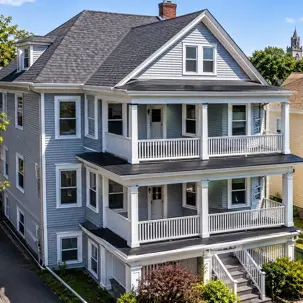
The defining architectural feature of many Rhode Island multi-family homes is the stacked front or rear porch assembly. This creates complex roofing geometry: a steep, multi-story main roof that transitions into a flat or low-slope porch roof.
The Material Divide
Standard architectural asphalt shingles rely on gravity to shed water. They cannot be installed on flat or low-slope porch roofs (typically any pitch lower than 2:12), because standing water can work backward under the shingle courses.
For flat sections, a continuous single-ply membrane is typically used. Investors usually choose between:
- EPDM: A black synthetic rubber membrane known for flexibility and long-term performance on low-slope roofs.
- TPO: A heat-welded membrane with welded seams and strong puncture resistance.
The Transition Zone
A common failure point is where the steep shingled roof intersects the flat porch roof. Water rushing down the steep slope hits the flat section with high volume. If the membrane and flashing details are not executed correctly, water can back up and damage framing between units.
Internal link suggestion: When referencing triple-deckers and Providence County density, link to your Pawtucket geo page.
Code Compliance and Substrate Upgrades in 2026
When executing a BRRRR strategy or a fix-and-flip, the property must pass municipal inspection to secure a Certificate of Occupancy or satisfy refinance requirements. Cutting corners on the roof can derail your exit plan.
Ice Barrier Requirements (Keep It Code-Compliant)
Rhode Island roofs require code-compliant protection against winter backup leaks. A self-adhering ice and water barrier is installed at vulnerable eave areas as required, helping protect the roof deck when meltwater refreezes and backs up.
Resolving Spaced Plank Decking
Century-old multi-family properties were often framed with dimensional plank decking. Over time, boards can shrink and warp, leaving gaps.
If a contractor drives fasteners into empty gaps, shingles can lose holding power. That increases blow-off risk and can create manufacturer compliance issues.
When we uncover spaced plank decking, wide gaps, or compromised sheathing, we typically recommend a continuous overlay using code-appropriate rated panels (often 1/2-inch CDX plywood or equivalent). This provides a smoother, more rigid surface for fastening and helps improve wind resistance.
Energy Efficiency and Utility Incentives
Many investors pay utilities for common areas or want to attract higher-quality tenants with more efficient units. When replacing the main roof, you have a good opportunity to evaluate attic insulation and air sealing.
Local ratepayer-funded incentives may still be available through utility programs for eligible insulation and air sealing upgrades. Coordinating those improvements while the roof scope is being planned can strengthen the thermal boundary, lower heating costs, and reduce the conditions that contribute to ice dams.
Preserving Capital: Financing Your CapEx
The primary hurdle in real estate investing is liquidity. Tying up a large cash outlay in a roof replacement can limit your ability to execute high-ROI interior renovations (like kitchens and bathrooms) that directly increase rent and forced appreciation.
To help investors preserve capital, Mighty Dog Roofing of Rhode Island connects property owners with zero-down options for qualified buyers (terms vary).
Before you acquire your next property or begin your rehab, use our interactive Rhode Island Roof Pricing Estimator to generate a fast cost snapshot
We can follow up with a non-invasive drone scan to document roof conditions for underwriting and scope planning.
Rhode Island Service Locations:
Ashaway, Barrington, Bradford, Bristol, Carolina, Central Falls, Charlestown, Chepachet, Clayville, Coventry, Cranston, Cumberland, East Greenwich, East Providence, Exeter, Forestdale, Foster, Glendale, Greene, Greenville, Harrisville,Hope,Hope Valley, Hopkinton, Jamestown, Johnston, Kenyon, Kingston, Lincoln, Little Compton, Manville, Mapleville, Middletown, Narragansett, Newport, North Kingstown, North Providence, North Scituate, North Smithfield, Oakland, Pascoag, Pawtucket, Portsmouth, Providence, Riverside, Rockville, Rumford, Saunderstown, Shannock, Scituate, Slatersville, Smithfield, Tiverton, Wakefield, Warren, Warwick, West Greenwich, West Kingston, West Warwick, Westerly, Wood River Junction, Woonsocket, Wyoming
Frequently Asked Questions
Can you install architectural shingles on a flat triple-decker porch?
No. Shingles rely on gravity to shed water and cannot be installed on flat or low-slope surfaces (typically pitches below 2:12). Flat porch roofs typically require a continuous membrane system like EPDM or TPO.
What are the Rhode Island building code requirements for ice barriers?
Rhode Island requires code-compliant ice and water barrier protection at vulnerable eave areas. The exact application depends on roof geometry and local inspection requirements, so your contractor should scope and document it correctly.
Do federal tax credits still cover attic insulation in 2026?
Federal tax credit rules can change. If incentives matter to your underwriting, verify current eligibility and program terms before you assume a credit applies.
How can real estate investors estimate roofing costs quickly?
Investors can get an instant, to-the-penny roof quote for your Rhode Island home here, to quickly underwrite rehab budgets before purchasing a property.