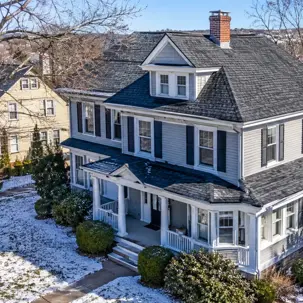
Woonsocket boasts a rich industrial history, beautiful parks, and densely packed neighborhoods featuring stunning Victorian, Colonial, and triple-decker architecture. While these historic properties have immense character, they also endure the brunt of northern Rhode Island’s volatile winter weather.
The most destructive force facing a Woonsocket roof is the freeze-thaw cycle. During winter, daytime sunlight warms the roof surface, causing snow to melt and run toward the gutters. As the sun goes down, temperatures plummet, freezing that water into solid ice. Because water expands by roughly 9% when it freezes, it acts as a hydraulic wedge. If water has seeped under an aging shingle or into a cracked chimney flashing, the expanding ice can pry roofing materials apart and open the door to leaks.
The Freeze-Thaw Threat to Woonsocket Homes
Freeze-thaw damage is not just about ice dams. It is about repeated expansion and contraction in the most vulnerable parts of the roof system:
- Eaves and overhangs: Cold roof edges refreeze meltwater first.
- Valleys and transitions: Concentrated runoff increases the chance of backup.
- Chimneys and step flashing: Older masonry and tired seal points can open up under stress.
- Historic roof decks: Plank decking and inconsistent substrates can reduce fastener holding power.
If your home has older shingles, visible curling, recurring winter leaks, or staining near exterior walls, freeze-thaw cycling may be doing more damage than you can see from the ground.
Upgrading Substrates and Sub-Roof Defenses
Many historic Woonsocket homes built over a century ago utilize dimensional plank decking rather than modern plywood. Over decades, these planks can shrink, warp, and separate.
Nailing new shingles into gapped plank decking can violate manufacturer specifications and may leave your roof vulnerable to wind and ice damage. When we uncover spaced plank decking, wide gaps, or compromised sheathing during a tear-off, we typically recommend a continuous overlay using code-appropriate rated panels (often 1/2-inch CDX plywood or equivalent). This provides a rigid, continuous surface that helps ensure consistent nail bite and more predictable shingle performance.
Furthermore, Rhode Island homes need code-compliant eave protection. We install self-adhering ice and water barrier at the eaves as required, creating a watertight layer that self-seals around roofing nails and helps protect the roof deck during freeze-thaw conditions.
Ventilation and Attic Conditions: The Quiet Multiplier
Freeze-thaw problems often get worse when attic conditions are working against you. Poor ventilation and uneven attic insulation can create hot spots on the roof deck that melt snow faster, feeding more water to the eaves.
During a Drone Super Scan and inspection, we look for common red flags like:
- Blocked soffit intake
- Under-sized ridge exhaust
- Bathroom fan ducting that terminates in the attic
- Moisture staining or frost on nails and sheathing
Correcting ventilation and moisture pathways helps stabilize roof temperatures and reduces the conditions that accelerate ice-related damage.
Financial Planning: Get Clarity Before Winter Hits
Securing your historic home against winter weather should not drain your emergency savings. We connect homeowners with zero-down options for qualified buyers (terms vary), so you can plan the right scope without forcing a rushed decision.
To start planning, calculate your roof replacement cost with our RI Pricing Estimator here: https://www.mightydogroofing.com/rhode-island/pricing-estimator/ and schedule a Drone Super Scan to document your exact needs safely from the air.
Rhode Island Service Locations:
Ashaway, Barrington, Bradford, Bristol, Carolina, Central Falls, Charlestown, Chepachet, Clayville, Coventry, Cranston, Cumberland, East Greenwich, East Providence, Exeter, Forestdale, Foster, Glendale, Greene, Greenville, Harrisville,Hope,Hope Valley, Hopkinton, Jamestown, Johnston, Kenyon, Kingston, Lincoln, Little Compton, Manville, Mapleville, Middletown, Narragansett, Newport, North Kingstown, North Providence, North Scituate, North Smithfield, Oakland, Pascoag, Pawtucket, Portsmouth, Providence, Riverside, Rockville, Rumford, Saunderstown, Shannock, Scituate, Slatersville, Smithfield, Tiverton, Wakefield, Warren, Warwick, West Greenwich, West Kingston, West Warwick, Westerly, Wood River Junction, Woonsocket, Wyoming
Frequently Asked Questions
What is the freeze-thaw cycle on a roof?
The freeze-thaw cycle occurs when snow melts on a roof during sunny winter days and refreezes into ice at night. This expanding ice can pry up shingles, widen flashing gaps, and lead to destructive interior leaks over time.
What happens if a contractor nails shingles into gapped plank decking?
Fasteners driven into empty gaps between old planks lack the necessary pull-through resistance to hold shingles securely. This can violate manufacturer requirements and leaves the roof more susceptible to blow-offs and winter damage.
How can I get a fast quote for a roof replacement in Woonsocket?
Get an instant, to-the-penny roof quote for your Rhode Island home here, to receive an immediate, accurate cost snapshot based on your property’s size and roofing selections.