
Why Johnston Roofs Need a Wind-Resistant Assembly
Living in Johnston, Rhode Island offers a great mix of suburban space and quick access to Providence. But geographically, the town features significant elevations and wide-open ridges. When severe weather rolls through Providence County, Johnston’s elevated neighborhoods can see higher-velocity wind gusts.
If you are planning a roof replacement in Johnston, treating it like a standard commodity install is a fast track to premature failure. A high-exposure roof should be engineered as a complete, wind-resistant assembly.
The Substrate Trap: Why Plywood Matters
A high-wind roof is only as reliable as the wood it is anchored to. Many older homes in Johnston were constructed using dimensional wood planks. Over the decades, those planks can dry, shrink, and shift, creating gaps.
If a roofer drives a nail into a gap between boards, that fastener has little to no holding power. In strong gusts, shingles can loosen or blow off when the fastening pattern is compromised. Swollen or deteriorated OSB from past leaks can also reduce holding power.
Our deck inspection standard
During tear-off, we inspect the substrate for:
- Plank gaps
- Soft spots and rot
- Swollen or delaminated OSB
Our corrective approach
When the deck is not suitable, we install a continuous overlay of 1/2-inch CDX plywood to create a solid, consistent diaphragm for fastening.
Defending the Edges: Eaves and Rakes Matter Most
Wind uplift is typically most aggressive at the perimeter of the roof, including eaves and rakes.
Starter strip lock-down
A proper Johnston roof replacement includes dedicated starter shingles (or starter strip) installed to manufacturer specifications to lock down the first course.
Drip edge integration
We pair starter strip detailing with metal drip edge to help protect the roof edge and reduce wind-driven rain from reaching vulnerable fascia and edge conditions.
The Sierra Gray Aesthetic (Curb Appeal Without Compromise)
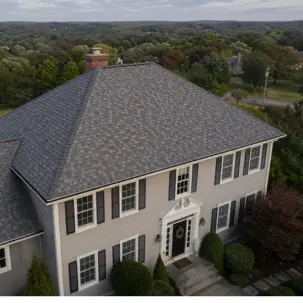
A roof replacement should also be a major curb appeal upgrade. Instead of defaulting to flat, builder-grade colors, dimensional architectural options like Sierra Gray can deliver a premium look.
Sierra Gray blends slate and charcoal tones, pairs well with traditional New England siding colors, and helps hide minor surface dirt.
Transparent Payments: The Zero-Risk Cash Schedule
Do not let the next major windstorm test an aging roof. We provide transparent pricing and use our Zero-Risk Cash Schedule to align payments with clear project milestones.
Rhode Island Service Locations:
Ashaway, Barrington, Bradford, Bristol, Carolina, Central Falls, Charlestown, Chepachet, Clayville, Coventry, Cranston, Cumberland, East Greenwich, East Providence, Exeter, Forestdale, Foster, Glendale, Greene, Greenville, Harrisville,Hope,Hope Valley, Hopkinton, Jamestown, Johnston, Kenyon, Kingston, Lincoln, Little Compton, Manville, Mapleville, Middletown, Narragansett, Newport, North Kingstown, North Providence, North Scituate, North Smithfield, Oakland, Pascoag, Pawtucket, Portsmouth, Providence, Riverside, Rockville, Rumford, Saunderstown, Shannock, Scituate, Slatersville, Smithfield, Tiverton, Wakefield, Warren, Warwick, West Greenwich, West Kingston, West Warwick, Westerly, Wood River Junction, Woonsocket, Wyoming
FAQ
What is the best type of roof decking for high-wind areas?
A solid, continuous roof deck is critical. In many cases, 1/2-inch CDX plywood is a strong option because it provides consistent fastening and resists moisture-related issues better than compromised decking.
Why are my shingles blowing off in the wind?
Shingles commonly blow off due to poor nail placement, weakened sealant bonds, or fasteners driven into rotted wood or gaps in the roof deck. A continuous, sound deck helps ensure proper nail bite and more reliable performance.