
The Roofing-First Rule: Synchronize Lifespans
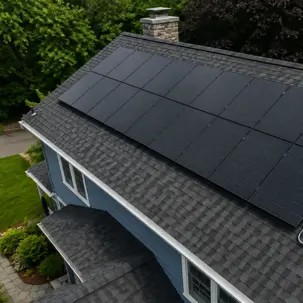
Rhode Island homeowners are increasingly exploring solar as a way to stabilize long-term household operating costs. But a solar array is only as reliable as the roof system supporting it.
Most residential solar PV systems are designed around long service lives, and the attachment hardware is mechanically anchored into your roof structure. If your shingles fail five years after solar installation, you may be forced to pay out-of-pocket detach and reset labor just to replace the roof.
The simple rule
If your asphalt shingle roof is already aging, it is usually smarter to replace the roof first (or coordinate roof replacement and solar installation together) so the roof and array lifespans are aligned.
The Costly Mistake: Installing Solar on an Aging Shingle Roof
Asphalt shingles do not fail overnight. As roofs age, the granule surface wears down, sealant bonds weaken, and underlayment becomes less forgiving.
Solar panels can also change roof conditions by:
- Reducing sun exposure on the covered shingle field (which can slow drying after storms)
- Increasing heat concentration in certain assemblies depending on airflow and array standoff height
- Introducing multiple penetrations that must be flashed correctly for decades
Detach and reset is real money
If you have to remove a solar array later to replace the roof, the added labor can be significant. Planning for detach and reset up front is part of a solar-ready roofing strategy.
Structural Roof Deck Prep: Why a Solid Deck Matters
Solar racking does not float on top of shingles. Mounts are anchored through the roofing system into framing members using structural fasteners.
If the roof deck is compromised, fasteners and mounts cannot perform as intended.
Why plank decking can fail solar attachment
Many older Rhode Island homes have 1x plank decking. Over time, boards shrink and shift, leaving gaps. If a mount lands over a gap, or the wood is soft from past leaks, the attachment can lose holding power.
Our solar-ready deck standard
During tear-off, we inspect the substrate. When we find rot, delamination, or plank gaps that exceed acceptable limits, we install a continuous overlay of 1/2-inch CDX plywood to create a solid nailable and anchorable diaphragm.
Underlayment Under Solar: High-Temperature Waterproofing
Standard underlayments are not all designed for higher heat conditions that can occur beneath solar arrays.
What we install under the array footprint
For solar-ready roof replacements, we use high-temperature, self-adhered waterproofing protection in the array footprint and at other high-risk areas (eaves, valleys, and key transitions). This adds a second line of defense if wind-driven rain or backed-up water ever reaches the underlayment layer.
Penetration Flashing Mechanics: Boots, Not Caulk
Every solar mount is a roof penetration. The long-term performance depends on engineered flashing details.
The rule
Do not rely on surface caulking or roofing mastic as the primary waterproofing method.
The correct approach
We coordinate with the solar installer so mounts and conduit penetrations are sealed with engineered flashing boots and metal integration details designed for long service life.
Ventilation and Moisture Control: Protect the Roof Under the Array
A solar-ready roof is not only about mounts. It is also about managing heat and moisture.
Balanced intake and exhaust
We design intake and exhaust ventilation to help keep attic conditions stable. This reduces the risk of condensation, mold, and winter ice dam formation, and it supports shingle performance over time.
Verification Through Drone Super Scan Documentation
Solar-ready work should be documented.
We use our Drone Super Scan process to capture:
- Pre-project roof conditions and layout
- Post-installation documentation of shingle alignment, flashing zones, and overall workmanship
This gives homeowners a clear record of what was installed and why.
Rhode Island Solar Incentives (2026): What We Cover and What We Do Not
Solar incentives can change year to year and can vary based on utility, installer, system design, and how the project is financed.
Our promise
We will not publish hard incentive numbers in this guide.
What we can do
We can help you make sure the roof system is built correctly for solar, and we can coordinate detach and reset planning so you avoid expensive surprises.
For incentive specifics, we recommend confirming current programs directly with your solar installer, Rhode Island Energy, and official state and federal resources.
Solar-Ready Roof Engineering Checklist
Use this checklist before signing a solar contract:
- 1. Drone Super Scan baseline documentation
- 2. Full tear-off to the deck (no shortcuts over failing layers)
- 3. Substrate inspection for rot and plank gaps
- 4. 1/2-inch CDX plywood overlay where required
- 5. High-temperature self-adhered waterproofing in the array footprint
- 6. Architectural shingles installed to manufacturer specs
- 7. Engineered flashing boots for mounts and conduit penetrations
- 8. Balanced ventilation plan (intake plus exhaust)
- 9. Detach and reset plan documented in writing (if roof is not new)
Rhode Island Service Locations:
Ashaway, Barrington, Bradford, Bristol, Carolina, Central Falls, Charlestown, Chepachet, Clayville, Coventry, Cranston, Cumberland, East Greenwich, East Providence, Exeter, Forestdale, Foster, Glendale, Greene, Greenville, Harrisville,Hope,Hope Valley, Hopkinton, Jamestown, Johnston, Kenyon, Kingston, Lincoln, Little Compton, Manville, Mapleville, Middletown, Narragansett, Newport, North Kingstown, North Providence, North Scituate, North Smithfield, Oakland, Pascoag, Pawtucket, Portsmouth, Providence, Riverside, Rockville, Rumford, Saunderstown, Shannock, Scituate, Slatersville, Smithfield, Tiverton, Wakefield, Warren, Warwick, West Greenwich, West Kingston, West Warwick, Westerly, Wood River Junction, Woonsocket, Wyoming
FAQ
Should I replace my roof before installing solar panels in Rhode Island?
Often, yes. If your roof is already aging, replacing it first can help you avoid paying detach and reset labor later just to replace worn shingles.
What deck thickness is required for solar panel installation in RI?
Solar attachments need a solid, continuous deck and secure framing attachment. Many roofs are built with 7/16-inch OSB or thicker, but older plank decks may need correction. The right solution depends on the existing deck condition, gap size, and the solar mounting requirements.
Do solar panels void my roof warranty?
Not automatically. When mounts and penetrations are installed and flashed correctly using approved methods, solar does not have to void your roof warranty. Poor flashing, improper fasteners, or unapproved methods can create leak risk and may affect coverage in those areas.
Do you install solar panels?
Mighty Dog Roofing of Rhode Island focuses on roofing. We do not sell solar installations. We can coordinate with your solar provider and we offer solar panel detach and reset planning so your roof and solar system work together.