What Is a Flat Roof?
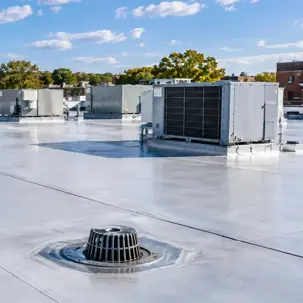
A flat roof is not actually flat. Every low-slope roof in Rhode Island is built with a slight pitch, usually between a quarter-inch and a half-inch per foot, so water drains instead of sitting on it. Shingles cannot do that job: below a certain pitch, water runs under them instead of over them. Flat roofs use a continuous waterproof membrane instead.
Rhode Island has more flat and low-slope roofing than most people realise. It is on the top floor of triple-deckers in Providence, Pawtucket, and Central Falls, on mill buildings and storefronts in Pawtucket and Woonsocket, on commercial buildings and additions across Cranston and Warwick, and on porches, dormers, and rear additions on houses all over the state, including historic homes in Newport and East Greenwich where a low-slope section sits behind a pitched front roof.
That mix is why a flat-roof guide has to cover two kinds of roof at once: the small residential flat section a homeowner may not even know they have, and the large commercial flat roof a property owner is responsible for keeping dry. The materials overlap, but the decisions, the costs, and the failure modes are different.
Common Low-Slope Roofing Systems
- TPO (thermoplastic polyolefin). A single-ply white membrane, heat-welded at the seams. It reflects heat, which helps on a large commercial roof in summer, and the welded seams are strong when they are done right. It is the most common choice for new commercial flat roofs in Rhode Island today.
- EPDM (synthetic rubber). A black single-ply membrane, seamed with adhesive or tape. It has been around the longest, it handles Rhode Island freeze-thaw well, and it is forgiving on roofs with a lot of movement. Rubber roofing such as EPDM lasts over 40 years when installed properly. It absorbs heat rather than reflecting it, which is a real consideration on a roof with no shade.
- PVC. A single-ply membrane similar to TPO, heat-welded, and especially resistant to chemicals and grease. That matters on a restaurant or a building with rooftop kitchen exhaust. It is usually the most expensive of the single-ply options.
- Modified bitumen. Asphalt-based rolls, torched, cold-applied, or self-adhered, often in two layers. It is a workhorse on smaller residential flat sections and on roofs that get walked on, because it is tougher underfoot than a single ply. Torch-down work needs a crew that knows fire safety, especially on an occupied building.
- Built-up roofing (BUR). Layers of felt and hot asphalt, finished with gravel or a cap sheet. It is the oldest flat-roof system, heavy, and very durable when it is built right. You will still find it on older commercial buildings in Providence and Pawtucket.
- Silicone coatings. A coating applied over a sound existing membrane to extend its life, rather than a new roof. We only apply coatings to healthy rubber/EPDM and metal roofs, and only when the roof meets the guidelines that keep moisture out and avoid mold growth. It is a restoration option, not a fix for a saturated or rotting roof.
No system is maintenance-free, and no system survives a bad installation. Seams, flashing at walls and curbs, and drains are where flat roofs fail, whatever the membrane is.
Why Rhode Island Is Hard on Flat Roofs
Flat roofs in Rhode Island fail in Rhode Island ways.
- Ponding water. A flat roof that holds water for more than 48 hours after rain is a roof with a drainage problem. Standing water adds weight, speeds up membrane wear, and finds every weak seam. In winter, that pond freezes, expands, and pries at seams and flashing. If your roof still has puddles two days after a storm, that is the first thing an inspection should look at.
- Freeze-thaw. Water gets into a small seam or a cracked flashing detail, freezes overnight, and opens it a little wider. Repeat that through a Rhode Island winter and a pinhole becomes a leak. This is the same freeze-thaw cycle that causes ice dams on pitched roofs, working on a flat roof from the top down.
- Nor'easters and wind uplift. A nor'easter drives rain sideways and lifts at membrane edges, parapet caps, and flashing. A flat roof on the coast, in Newport, Narragansett (https://www.mightydogroofing.com/rhode-island/areas-we-serve/narragansett/), or Jamestown, takes salt air as well, which corrodes metal edge details and fasteners faster than the same roof would inland.
- Snow load and drains. Heavy, wet snow sits on a flat roof instead of sliding off. Drains and scuppers clog with leaves in the fall, and a clogged drain turns a flat roof into a shallow pool. Clearing drains before winter is the cheapest flat-roof maintenance there is.
- Foot traffic and rooftop equipment. HVAC units, vents, and skylights mean penetrations, and every penetration is a flashing detail that can fail. A roof that gets walked on for maintenance needs walkway pads or a tougher system, or the membrane wears through where people step.
Coastal vs Inland, Residential vs Commercial
Coastal flat roofs in Newport, Narragansett, Jamestown, Barrington, and East Greenwich get heavier, wetter snow from nor'easters, salt air on metal details, and wind-driven rain at parapets. Inland flat roofs in Providence, Cranston, Johnston, Lincoln, and Woonsocket run colder, hold snow longer, and get more freeze-thaw cycles. The membrane choice may be the same in both places, but the flashing details, the drainage, and the maintenance schedule are not.
The residential flat section and the commercial flat roof also need different thinking. A homeowner with a flat section over a porch or an addition usually needs a repair or a small replacement, and the question is which system ties into the pitched roof cleanly. A commercial owner with 5,000 square feet of flat roof needs a system with a maintenance plan, a drainage plan, and a realistic service life, because the cost of getting it wrong is a leak over inventory, tenants, or equipment.
Historic buildings add one more layer. A flat section on a historic home in Providence or Newport may sit behind a slate or cedar pitched roof, with original decking underneath and chimney flashing nearby. The membrane has to work with the building, not against it, and the deck underneath has to be inspected before any new system goes on.
Repair, Restore, or Replace?
- Repair makes sense when the membrane is mostly sound, the leak is at one seam or one flashing detail, the insulation underneath is dry, and the roof still drains. A good repair finds the actual source, which is often not directly above the stain inside, and fixes the detail rather than patching over it.
- Recoat or restore makes sense when the membrane is sound across the roof but worn on the surface, seams are holding, and there is no trapped moisture - and only on healthy rubber/EPDM and metal roofs that meet our guidelines. A silicone coating can add years to a roof like that. It does not make sense when the insulation is wet or the deck is soft, because a coating seals the problem in instead of fixing it, and a coating over a roof that does not meet the guidelines can trap moisture and lead to mold growth.
- Replace is the right call when the membrane has failed in several places, the insulation underneath is wet, the deck is soft or rotted, or the roof has been patched so many times that no one knows what is underneath anymore. A replacement starts with removing the failed system so the deck underneath can be inspected and any damaged decking or wet insulation replaced. We do not install a second layer over a failed roof - it hides damage underneath that shows up later, worse. Emergency tarping can keep water out while a replacement is scheduled, so a leak does not have to become interior damage.
An inspection with advanced drone imaging can show the condition of the membrane, the flashing, and the drainage without anyone walking a wet or fragile roof, and it documents what the roof actually looks like before any work starts. That documentation matters for a commercial owner and for an insurance claim alike.
Maintenance and Inspection
A flat roof rewards a little attention and punishes neglect. Twice a year, in spring and in fall, and after every major storm:
- Clear drains, scuppers, and gutters. Leaves and debris are the most common cause of ponding.
- Check for standing water 48 hours after rain. Mark where it sits and how deep it is.
- Look at seams, flashing at walls and curbs, and the edge metal. Lifted edges and cracked sealant are early warnings.
- Keep foot traffic to walkways, and keep new penetrations to a minimum. Every new vent or unit is a new flashing detail.
Drone imaging can document visible exterior conditions, but it cannot reliably determine whether insulation is wet or pinpoint every leak. Further assessment may include hands-on inspection or moisture testing. Do not climb onto a wet, snowy, damaged, or otherwise unsafe roof.
Flat Roof Costs and Financing
We do not quote a flat price for a flat roof, because the cost depends on the roof: the system, the size, the condition of the deck and insulation underneath, the number of penetrations, and how the roof drains. A small residential flat section and a large commercial roof are different jobs, and a recoat and a full replacement are different jobs again.
A full flat roof replacement in Rhode Island typically runs $8-$14 per square foot. That is the complete job, not just the membrane: full tear-off to the deck, deck repair where it is needed, ISO insulation to R-30, the level Rhode Island's energy code requires above the deck on low-slope commercial roofs, cover board, the membrane itself, flashing, C6 drip edges, and drains and scuppers. The range is wide on purpose - a straightforward roof lands near the bottom, and a difficult one (bad deck, wet insulation, many penetrations, poor access, tapered insulation for drainage) lands near the top or above it. A free inspection is the step that turns the range into a number for your roof.
You will see lower per-square-foot numbers published elsewhere, and they are usually not the same job. A $2-$4 silicone figure is a coating, not a replacement. A $4-$8 membrane figure is the membrane and the labor to lay it, with no tear-off, no insulation, no deck work, and no edge metal. Those parts are most of the cost of a real replacement, and the insulation is not optional: Rhode Island requires R-30 continuous insulation above the deck on low-slope commercial roofs, which is about two layers of polyiso board.
A coating on a healthy roof that meets our guidelines typically runs about half the cost of a full replacement, around $4-$7 per square foot. It is a restoration, not a new roof, and it only makes sense on a roof that qualifies.
For the repairs that follow a flat-roof leak, our pricing estimator gives real ranges: roof repair $850-$4,500 depending on scope. A free inspection gives you an exact scope for your roof, and you can get a price range from the estimator.
Financing may be available for qualified buyers, with terms that vary. A free inspection is the step that turns a range into a number for your roof.
Rhode Island Service Locations:
Ashaway, Barrington, Bradford, Bristol, Carolina, Central Falls, Charlestown, Chepachet, Clayville, Coventry, Cranston, Cumberland, East Greenwich, East Providence, Exeter, Forestdale, Foster, Glendale, Greene, Greenville, Harrisville,Hope,Hope Valley, Hopkinton, Jamestown, Johnston, Kenyon, Kingston, Lincoln, Little Compton, Manville, Mapleville, Middletown, Narragansett, Newport, North Kingstown, North Providence, North Scituate, North Smithfield, Oakland, Pascoag, Pawtucket, Portsmouth, Providence, Riverside, Rockville, Rumford, Saunderstown, Shannock, Scituate, Slatersville, Smithfield, Tiverton, Wakefield, Warren, Warwick, West Greenwich, West Kingston, West Warwick, Westerly, Wood River Junction, Woonsocket, Wyoming
Frequently Asked Questions
How long does a flat roof last in Rhode Island?
It depends on the system and on maintenance. Rubber roofing such as EPDM lasts over 40 years when installed properly. A well-installed single-ply or modified bitumen roof that is kept clean and drained can last 20 years or more. A roof that ponds water, never gets its drains cleared, and is patched instead of repaired will fail much sooner, whatever the membrane is. Warranties on flat systems range from 40 to 50 years.
Why does my flat roof leak when it rains, but not every time?
Wind-driven rain finds different seams than still rain, and a leak often shows up only when water ponds in one spot or a drain backs up. The stain inside is rarely directly below the source. An inspection traces the water path instead of guessing from the stain.
Can a flat roof be repaired, or does it always need replacing?
It can often be repaired. If the membrane is mostly sound, the insulation underneath is dry, and the leak is at one seam or flashing detail, a repair is the right call. Replacement is for roofs where the membrane has failed in several places, the insulation is wet, or the deck is soft.
What is ponding water, and how much is too much?
Ponding is water that stays on the roof after rain. Water that is still there 48 hours after a storm is a drainage problem, and it shortens the life of the membrane. It usually means a drain is clogged, the pitch has settled, or the roof was built without enough slope.
Is a coating a real fix for a flat roof?
A coating is a real fix for a sound roof that is wearing out on the surface - but only on healthy rubber/EPDM and metal roofs that meet our guidelines. It is not a fix for a wet or rotted roof. A coating over saturated insulation or a soft deck hides the problem and makes the eventual replacement more expensive, and a coating over a roof that does not meet the guidelines can trap moisture and lead to mold growth.
Do flat roofs work on Rhode Island homes, or only on commercial buildings?
They work on both. Many Rhode Island homes have a flat section over a porch, a dormer, or an addition, and triple-deckers often have flat or very low-slope roofs. The system and the flashing details are chosen for the building, not for the category.
What to Do Next
If your flat roof is ponding, leaking, or you are not sure what system is up there, get a free inspection before the next storm. We will look at the membrane, the flashing, and the drainage, show you exactly where water is getting in with advanced drone imaging, and give you a clear plan: repair, recoat, or replace.
Call (401) 425-4108, or get a price range from the estimator at https://www.mightydogroofing.com/rhode-island/pricing-estimator/.