When budgeting for a roof replacement, many homeowners focus on aesthetics and price. In Rhode Island, one of the most important forces is invisible: wind uplift.
Coastal storms and fast-moving weather systems can create strong pressure changes at roof edges, corners, eaves, and rakes. If a roofing system is not built as a complete assembly - from the deck to the shingles - wind can exploit small weaknesses and start lifting shingles where the forces are highest.
This 2026 guide breaks down practical, homeowner-friendly building science: what matters most in a high-wind roofing system, what shortcuts to avoid, and which upgrades can improve durability.
The Substrate Standard: Why the Roof Deck Matters
A high-wind shingle cannot perform if it is nailed into a compromised foundation. The roof deck is what every fastener ultimately relies on.
The risk with spaced plank decking
Many older Rhode Island homes were built with spaced plank decking rather than continuous plywood sheathing. Over time, boards can shrink and separate. If nails land in gaps, fastening strength drops dramatically.
When a continuous plywood overlay may be recommended
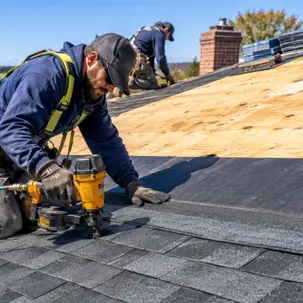
During a full tear-off, the decking can be inspected for gaps, rot, and flatness. When gaps exceed typical manufacturer requirements or the deck is not providing consistent fastening, a continuous overlay using rated panels (often 1/2-inch CDX plywood) may be recommended to create a flatter, more rigid substrate.
The Fatal Shortcut: Why Roof Overlays Can Fail in Wind
A roof overlay is when a second layer of shingles is installed over an existing layer. In wind-prone conditions, overlays can be a risky choice.
Fasteners must penetrate properly into the structural deck to achieve the intended wind performance. Multiple shingle layers can reduce effective penetration and can also conceal deck issues that should be corrected before a new system is installed.
Shingle Technology: Reinforced Nailing Zones
Once the deck is sound, the shingle system and installation details matter.
Many premium architectural shingles use reinforced nailing zones to improve fastening performance. Examples include Owens Corning TruDefinition Duration (SureNail) and IKO Dynasty (ArmourZone). These systems are designed to provide a clearer nailing target and stronger resistance to fastener pull-through when installed per manufacturer specifications.
Ventilation and Pressure Management
Wind uplift is partly a pressure problem. When wind creates negative pressure outside, attic pressure can contribute to uplift forces if the system is not balanced.
Balanced ventilation - intake paired with exhaust - supports roof health by managing heat and moisture. In some homes with limited soffit intake, a roof-deck intake solution (such as Smart Vent style products) may be considered as part of a complete ventilation plan.
Start With a Safer Inspection and a Clear Budget
Before recommending upgrades, we start with documentation. Our advanced drone inspection uses high-resolution drone imaging to evaluate roof geometry, edges, and visible damage without unnecessary foot traffic.
If you want a fast baseline number before scheduling an inspection, use our interactive Rhode Island Roof Pricing Estimator: https://www.mightydogroofing.com/rhode-island/pricing-estimator/
We also offer financing options, including zero-down options for qualified buyers (terms vary).
Rhode Island Service Locations:
Ashaway, Barrington, Bradford, Bristol, Carolina, Central Falls, Charlestown, Chepachet, Clayville, Coventry, Cranston, Cumberland, East Greenwich, East Providence, Exeter, Forestdale, Foster, Glendale, Greene, Greenville, Harrisville,Hope,Hope Valley, Hopkinton, Jamestown, Johnston, Kenyon, Kingston, Lincoln, Little Compton, Manville, Mapleville, Middletown, Narragansett, Newport, North Kingstown, North Providence, North Scituate, North Smithfield, Oakland, Pascoag, Pawtucket, Portsmouth, Providence, Riverside, Rockville, Rumford, Saunderstown, Shannock, Scituate, Slatersville, Smithfield, Tiverton, Wakefield, Warren, Warwick, West Greenwich, West Kingston, West Warwick, Westerly, Wood River Junction, Woonsocket, Wyoming
FAQ
Why do some roofing warranties get denied after a wind event?
Warranty coverage can depend on proper installation and compliance with manufacturer requirements. Common issues include incorrect nailing, insufficient fasteners, installing over an unsuitable deck, or using an overlay where it is not permitted.
What is the difference between CDX plywood and OSB for roof decking?
CDX plywood is made from cross-laminated veneers and is generally more tolerant of short-term moisture exposure. OSB can be cost-effective, but it may swell at edges when exposed to moisture. The best choice depends on the roof design and manufacturer requirements.
How does intake ventilation help during wind and storm seasons?
Balanced intake and exhaust ventilation helps manage heat and moisture in the attic, which supports roof durability. A vent plan should be designed for the specific home and existing conditions.
Can I finance a high-wind roof replacement?
Yes. Financing options vary by lender and borrower profile. We can connect homeowners with options, including zero-down options for qualified buyers (terms vary).