If your Providence home already has rooftop solar, you have probably noticed something in winter: snow does not always melt off the panels gradually.
That is because solar panels have a low-friction glass surface. When snow builds up on a steep roof plane, it can hold for a while, then release suddenly in heavy sheets once the sun warms the panel surface.
Homeowners often call this a rooftop avalanche. It is not just dramatic. It can be a real safety and property-damage hazard.
Important note: Mighty Dog Roofing of Rhode Island does not install new solar arrays. We do help homeowners with roof safety retrofits and solar detach and reset when roofing work is needed.
Quick answer: why solar panels shed snow in sheets
Standard architectural shingles have a granular surface that adds friction. Solar panels are smoother, so snowpack can slide more easily.
When temperatures fluctuate (common in Rhode Island winters), the panel surface can warm and create a thin melt layer between the snow and the glass. That reduces friction even more, and the snow can release all at once.
Why this is a safety issue in Providence
A sheet of wet snow is heavy. When it slides off a roof plane, it can hit with enough force to cause damage.
Homeowners report issues like:
- Bent or torn gutters
- Crushed shrubs and foundation landscaping
- Damage to vehicles parked along the solar side of the home
- A real slip and impact risk at front doors, walkways, and basement entries
Where the risk is highest
The most common high-risk zones are directly below the solar roof plane:
- Front entry steps and porch roofs
- Walkways along the side of the house
- Driveways and parking areas
- Gutter runs and downspout outlets
A practical solution: snow rails below the solar array
Snow guards and snow rails are designed to interrupt sliding snowpack and help it release in smaller amounts.
For solar-related snow slide risk, fence-style snow rail systems are often used because they create a continuous barrier below the panels.
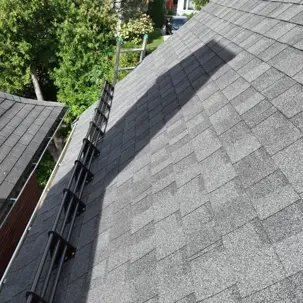
In one Providence project, we specified a fence-style snow retention system (such as the Drift III by Rocky Mountain Snow Guards) to help catch and hold sliding snow.
Why fence-style rails are different from small pad-style guards
Small, surface-mounted guards can be appropriate in some designs, but they may not be the best fit for large sheet releases from solar panels.
Fence-style rails:
- Provide continuous resistance across the roof plane
- Can be paired with accessories that help reduce ice slip-through
- Are designed to be mechanically attached (not glued)
Note: System selection depends on roof geometry, panel layout, and manufacturer requirements.
Building science: attachment and flashing are non-negotiable
A snow retention system is only as strong as its attachment.
When heavy, wet snow loads push against a rail, the force transfers into the mounting brackets. If brackets are not anchored into structural framing members (rafters or trusses) per manufacturer requirements and site conditions, the system can fail.
Why decking-only attachment is risky
Fastening into roof decking alone may not provide the structural holding power required for a snow rail system under load.
What a proper installation should include
A professional scope should specify:
- How framing locations will be verified
- Fastener type and spacing per manufacturer requirements
- Flashing method for all penetrations
- Sealant and underlayment integration where applicable
When installed and flashed correctly, the goal is a secure, watertight attachment that performs through freeze-thaw cycles.
Is your Providence home at risk? Quick checklist
You may be at higher risk for sheet snow release if:
- Your solar panels sit above a front door, walkway, or driveway
- You have a moderate-to-steep roof pitch on the solar side
- Your gutters are already bent, pulling away, or frequently clogged with ice
- You see icicles forming at panel edges
- You have seen snow slide off in sheets after sunny breaks
Rhode Island Service Locations:
Ashaway, Barrington, Bradford, Bristol, Carolina, Central Falls, Charlestown, Chepachet, Clayville, Coventry, Cranston, Cumberland, East Greenwich, East Providence, Exeter, Forestdale, Foster, Glendale, Greene, Greenville, Harrisville,Hope,Hope Valley, Hopkinton, Jamestown, Johnston, Kenyon, Kingston, Lincoln, Little Compton, Manville, Mapleville, Middletown, Narragansett, Newport, North Kingstown, North Providence, North Scituate, North Smithfield, Oakland, Pascoag, Pawtucket, Portsmouth, Providence, Riverside, Rockville, Rumford, Saunderstown, Shannock, Scituate, Slatersville, Smithfield, Tiverton, Wakefield, Warren, Warwick, West Greenwich, West Kingston, West Warwick, Westerly, Wood River Junction, Woonsocket, Wyoming
Frequently Asked Questions
Why do I need snow guards if I have solar panels?
Solar panels can reduce friction compared to shingles, which can allow snowpack to release in larger sheets. Snow rails can help interrupt that movement and reduce the risk of damage below.
Can snow rails be installed on an existing roof?
In many cases, yes. The key is that the system must be designed and attached according to manufacturer requirements, typically anchoring into structural framing and flashing every penetration correctly.
Will snow rails stop all snow from sliding?
No system can eliminate all risk. The goal is to reduce large sheet releases and help snow shed in smaller, more controlled amounts.
Schedule a roof safety inspection for your solar snow-slide risk
If you have rooftop solar in Providence and you are worried about snow sliding off in sheets, start with an inspection and a written scope.
We can help you understand:
- Where the hazard zones are around your home
- Whether a snow rail system is appropriate for your roof geometry
- What an attachment and flashing plan should include
Call Mighty Dog Roofing of Rhode Island: (401) 425-4108 Or book here: https://www.mightydogroofing.com/rhode-island/contact-us/