
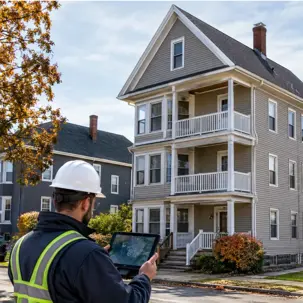
The classic New England triple-decker is an iconic part of Pawtucket’s housing stock. You see them concentrated along corridors like Power Road, Mineral Spring Avenue, and Armistice Boulevard.
If you own one as a rental property, the roof is not just a building component. It is a risk management system.
Triple-deckers stand taller than surrounding single-family homes, which increases wind exposure. They also tend to combine steep gables, long side slopes, rear flat-roof porches, tall chimneys, and tight knee-wall attic spaces. Those details change the scope, staging, and substrate requirements.
Quick answer: why triple-decker roofs fail faster in Pawtucket
Triple-decker roof failures are often driven by a combination of:
- Height-driven wind uplift on three-story roof planes
- Complex geometry (valleys, gables, dormers, porch transitions)
- Historic plank decking that has shrunk and separated over time
- Prior overlays that hide substrate issues and reduce fastener holding power
For investors, the takeaway is simple: treat the project like a structural and water-management upgrade, not a cosmetic re-shingle.
Wind load and height: why three stories changes everything
Because triple-deckers are taller, their roof edges and ridges can see higher wind pressures than nearby one- and two-story homes.
When shingles are brittle, poorly fastened, or nailed into weak decking, wind uplift can pull fasteners, lift tabs, and open pathways for wind-driven rain. That is how a roof problem becomes a tenant-safety problem.
Uncovering hidden substrate failure: the plank gap problem
Many Pawtucket multi-family properties were built around the turn of the 20th century using 1x6 or 1x8 pine decking planks.
After decades of heat cycles and moisture exposure, those boards can shrink, warp, and separate. It is common to find gaps that are large enough to create a major fastener problem.
Why overlays create nail-holding failures
When a previous contractor overlays (nails new shingles over old), fasteners can end up driven into empty gaps between boards.
If nails are not anchored into solid wood, pull-through resistance drops dramatically. In a high-wind event, that can contribute to widespread shingle loss and rapid leak exposure.
The substrate solution: code-appropriate plywood overlays (when needed)
For multi-family roof replacement in Pawtucket, we typically recommend a complete tear-off so the substrate can be evaluated.
When we encounter spaced plank decking, wide gaps, or compromised sheathing, we may recommend a continuous overlay using rated panels (often 1/2-inch CDX plywood or equivalent), installed to create a consistent, nail-ready substrate.
What the overlay accomplishes
- Solid nail holding power: Helps ensure roofing nails anchor into continuous decking
- Diaphragm strength: Adds rigidity across the roof plane and can improve overall assembly performance
- Better substrate consistency: Reduces the chance of fasteners landing in voids between planks
Note: Panel selection and thickness should match the property needs and applicable code requirements.
Managing flashing, flat transitions, and chimneys
Triple-deckers frequently include transitions where steep-slope shingles meet low-slope porch roofs (often EPDM or TPO). They also commonly have tall brick chimneys that require careful step flashing and counterflashing.
These details matter because most multi-family leaks do not start in the middle of a shingle field. They start at:
- Chimneys
- Sidewalls
- Valleys
- Porch transitions
- Penetrations
A written scope should specify how these details will be rebuilt.
Materials: high-wind architectural shingles and low-slope systems
We do not install 3-tab shingles.
For Pawtucket triple-deckers, we typically recommend high-wind architectural lines such as Owens Corning TruDefinition Duration or IKO Dynasty, selected based on roof design, color goals, and system requirements.
If the property has low-slope areas, those sections often require a dedicated waterproofing system rather than shingles.
Investor focus: staging, safety, and controlling CAPEX surprises
A three-story multi-family roof is not a standard staging plan.
A professional scope should include:
- Fall protection and safe access plan
- Debris containment and tenant safety measures
- Disposal plan (including volume assumptions)
- Clear decking inspection process and pricing for re-decking per sheet
This is how investors reduce change orders and protect operating cash flow.
Financing note (compliance-safe)
For qualified buyers, financing options may be available to help spread project cost over time. Terms, approvals, and offers vary.
Rhode Island Service Locations:
Ashaway, Barrington, Bradford, Bristol, Carolina, Central Falls, Charlestown, Chepachet, Clayville, Coventry, Cranston, Cumberland, East Greenwich, East Providence, Exeter, Forestdale, Foster, Glendale, Greene, Greenville, Harrisville,Hope,Hope Valley, Hopkinton, Jamestown, Johnston, Kenyon, Kingston, Lincoln, Little Compton, Manville, Mapleville, Middletown, Narragansett, Newport, North Kingstown, North Providence, North Scituate, North Smithfield, Oakland, Pascoag, Pawtucket, Portsmouth, Providence, Riverside, Rockville, Rumford, Saunderstown, Shannock, Scituate, Slatersville, Smithfield, Tiverton, Wakefield, Warren, Warwick, West Greenwich, West Kingston, West Warwick, Westerly, Wood River Junction, Woonsocket, Wyoming
FAQ
How many layers of shingles are allowed on a Pawtucket triple-decker?
Rhode Island building code commonly limits re-roofing layers in many cases (often no more than two). For three-story multi-family properties, a full tear-off is frequently recommended so the decking can be inspected and the roof system can be rebuilt correctly.
What happens if new shingles are nailed into gapped plank decking?
If fasteners land in gaps between planks, they may not anchor into solid wood. That reduces holding power and can increase the risk of shingle loss and leak exposure during high-wind events.
How do you inspect a three-story roof safely in Pawtucket?
We use drone-based inspections to document steep slopes, chimney flashing, and flat-roof transitions with detailed imagery, while reducing technician risk and minimizing foot-traffic on brittle shingles.
Schedule a documented drone inspection for your Pawtucket triple-decker
If you own a triple-decker and want a scope you can trust, start with documentation.
You get:
- Drone photo documentation of key risk areas
- A written scope that calls out substrate needs and transition details
- A clear recommendation for repair vs replacement and whether an overlay is appropriate
Call Mighty Dog Roofing of Rhode Island: (401) 425-4108 Or book here: https://www.mightydogroofing.com/rhode-island/contact-us/