
Living in Smithfield: Why Trees Create a Roof Microclimate
Living in Smithfield offers a perfect blend of suburban convenience and rural, wooded charm. Neighborhoods surrounding Stump Pond, Greenville, and the northern stretches of town are defined by their beautiful, mature tree canopies.
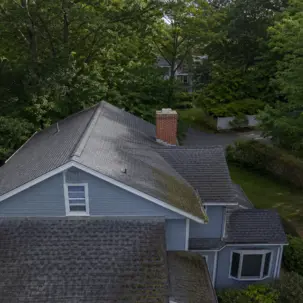
However, from a roofing and building science perspective, those trees create a localized hazard. Heavy shade and reduced airflow produce a damp microclimate on your roof. This constant moisture exposure is the perfect breeding ground for algae, lichen, and destructive roof moss.
If you own a home in a wooded area of Smithfield, understanding how this microclimate attacks your roofing system is critical to preventing thousands of dollars in structural damage.
The Difference Between Algae and Moss
Not all green or black growth on your roof operates the same way.
Gloeocapsa magma (black algae)
This bacteria causes the dark, unsightly streaks running down your shingles. While it feeds on the limestone filler in older shingles and reduces curb appeal, it is primarily a cosmetic issue in the short term.
Roof moss
Moss is a structural threat. It thrives in shaded, damp conditions. Unlike algae, moss has a shallow root-like system that anchors into the shingle granules.
How Moss Destroys Your Roof Deck
Moss acts like a thick, organic sponge. After a Rhode Island rainstorm, the moss absorbs water and holds it directly against the leading edges of your shingle tabs.
As the moss grows, it physically lifts the shingles. Once the factory seal is broken, capillary action pulls that trapped moisture backward and underneath the shingle layers. The water bypasses the underlayment and soaks directly into your wood roof deck.
Because the roof is heavily shaded, the wood never gets enough solar heat to dry out. The trapped moisture leads directly to wood rot, delamination, and mold growth inside your attic.
The 1/2-Inch CDX Plywood Standard
Many older homes in Smithfield were built with spaced plank decking or thinner sheets of OSB (oriented strand board). When OSB gets repeatedly soaked from moss-driven moisture, it can swell and lose structural integrity.
At Mighty Dog Roofing of Rhode Island, we refuse to nail premium shingles into soft, compromised wood. During a tear-off, if we discover rot from shaded microclimates, we execute a full deck remediation.
Our standard for structural integrity is 1/2-inch CDX plywood.
Unlike standard OSB, CDX plywood provides superior moisture resistance and creates a rigid, continuous roof deck. This helps ensure consistent nail holding power, which is critical for maintaining high-wind manufacturer warranty eligibility.
Upgrading the System in Wooded Smithfield Neighborhoods
When replacing a roof in a wooded Smithfield neighborhood, the replacement system must be engineered to fight back against the environment.
- Algae-resistant shingles: Many premium architectural shingles use algae-resistant granules designed to inhibit black algae staining.
- Targeted tree trimming: Trimming branches back allows sunlight to hit the roof planes and improves airflow needed to keep shingles dry.
- Drone diagnostics: Before we ever pull a shingle, we use our Drone Super Scan to document organic growth patterns and potential deck sagging from above.
Rhode Island Service Locations:
Ashaway, Barrington, Bradford, Bristol, Carolina, Central Falls, Charlestown, Chepachet, Clayville, Coventry, Cranston, Cumberland, East Greenwich, East Providence, Exeter, Forestdale, Foster, Glendale, Greene, Greenville, Harrisville,Hope,Hope Valley, Hopkinton, Jamestown, Johnston, Kenyon, Kingston, Lincoln, Little Compton, Manville, Mapleville, Middletown, Narragansett, Newport, North Kingstown, North Providence, North Scituate, North Smithfield, Oakland, Pascoag, Pawtucket, Portsmouth, Providence, Riverside, Rockville, Rumford, Saunderstown, Shannock, Scituate, Slatersville, Smithfield, Tiverton, Wakefield, Warren, Warwick, West Greenwich, West Kingston, West Warwick, Westerly, Wood River Junction, Woonsocket, Wyoming
FAQ
Can I pressure wash the moss off my Smithfield roof?
Never use a high-pressure washer on an asphalt shingle roof. The water pressure can strip protective granules off the shingle surface and may void the manufacturer’s warranty.
Will homeowner’s insurance cover roof damage caused by moss and rot?
Generally, no. Insurance companies often classify moss growth and resulting deck rot as long-term maintenance-related damage, which commonly falls under wear-and-tear exclusions.
Why is 1/2-inch CDX plywood better than OSB for a roof deck?
CDX plywood handles incidental moisture better than OSB. When OSB gets wet, the edges can swell permanently, which can telegraph through shingles and create a wavy roofline. CDX plywood maintains better rigidity and provides stronger nail holding power.