
A masonry chimney is one of the most attractive architectural features of a classic New England home. However, from a structural waterproofing perspective, a wide chimney is a giant obstacle standing directly in the flow path of heavy rainwater and winter snowmelt.
When a roof plane slopes down toward a wide chimney, fast-moving water hits the back wall of the masonry structure. Without proper drainage geometry, that area becomes a dead valley where standing water, heavy snowpacks, and wet pine needles accumulate.
Over time, standing water breaks down standard caulking, saturates the mortar joints, and leaks beneath surrounding shingles. The primary line of defense against this failure mechanism is a custom-engineered roof cricket (also known as a chimney saddle).
What Is a Roof Cricket?
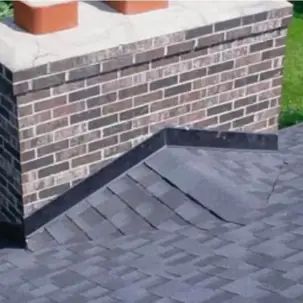
A roof cricket is a small, elevated, ridge-shaped structure built on the high side of a chimney. Its primary purpose is to divert water and debris away from the back wall of the chimney and direct it down the main slopes of the roof plane.
Under the International Residential Code (IRC) and the Rhode Island State Building Code, a cricket or saddle is required on many pitched-roof chimneys that are wider than 30 inches (measured parallel to the ridge), unless the chimney penetrates directly through the ridge.
The Fluid Mechanics of Cricket Design
When rain hits an uninterrupted roof, it flows straight toward the gutters. When a 36-inch or 48-inch brick chimney interrupts that path, a large volume of runoff can collect behind it.
- Pitched diverters: The cricket features two small sloping planes that meet at a center ridge, creating an inverted V shape. This split pushes runoff around both sides of the brickwork.
- Custom metal detailing: While the underlying frame of a cricket is typically constructed from structural plywood, the exterior should be protected with long-life metalwork. For historic or luxury properties in Rhode Island, custom-soldered copper or heavy-gauge standing seam metal is often the gold standard.
- Step and counter flashing integration: The cricket metal must integrate with step flashing along the sides and be counterflashed into the masonry in a reglet or mortar joint so water cannot track behind the metal.
Why Patching Behind Wide Chimneys Always Fails
Low-bid contractors often try to seal dead valleys behind wide chimneys using thick applications of roofing cement (mastic) or polyurethane caulking. In Rhode Island’s freeze-thaw climate, sealants can expand, split, and dry out over time. Once the sealant fails, water can enter the roof system unchecked.
At Mighty Dog Roofing of Rhode Island, we build custom, code-compliant crickets clad in premium metals to help wide chimneys stay dry for the life of the roof.
Rhode Island Service Locations:
Ashaway, Barrington, Bradford, Bristol, Carolina, Central Falls, Charlestown, Chepachet, Clayville, Coventry, Cranston, Cumberland, East Greenwich, East Providence, Exeter, Forestdale, Foster, Glendale, Greene, Greenville, Harrisville,Hope,Hope Valley, Hopkinton, Jamestown, Johnston, Kenyon, Kingston, Lincoln, Little Compton, Manville, Mapleville, Middletown, Narragansett, Newport, North Kingstown, North Providence, North Scituate, North Smithfield, Oakland, Pascoag, Pawtucket, Portsmouth, Providence, Riverside, Rockville, Rumford, Saunderstown, Shannock, Scituate, Slatersville, Smithfield, Tiverton, Wakefield, Warren, Warwick, West Greenwich, West Kingston, West Warwick, Westerly, Wood River Junction, Woonsocket, Wyoming
FAQ
When is a chimney cricket required by building code in Rhode Island?
On many pitched roofs, building code requires a chimney cricket (saddle) on the high side of chimneys wider than 30 inches (measured parallel to the ridge), unless the chimney penetrates through the ridge.
What happens if you do not have a cricket behind a wide chimney?
Without a cricket, water, snow, and ice can pool behind the flat rear wall of the chimney. Over time, that can lead to moss growth, saturated mortar joints, deck rot, and interior ceiling leaks.
What metal is best for cladding a chimney cricket?
For long-term durability, many contractors use 16-ounce copper or heavy-gauge, Kynar-finished metal cladding. The best choice depends on the roof type, chimney geometry, and the flashing system being installed.