
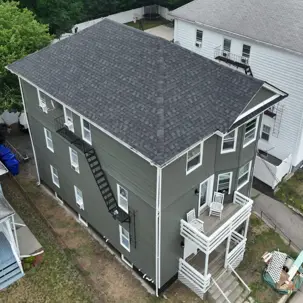
Multi-story residential properties across Pawtucket - from historic triple-deckers off Mineral Spring Avenue to 3-story homes along Power Road - present unique structural and wind exposure challenges. Because of their height, 3-story roof planes take the brunt of severe New England wind uplift and driving rain.
When property owners try to save money by executing partial repairs or half-roof replacements on these tall structures, the long-term results are almost always severe.
We recently completed a full structural roof remediation for a 3-story home on Power Road in Pawtucket. Below is a breakdown of how we identified hidden substrate issues, remediated the deck, streamlined roof penetrations, and built a high-wind roofing system.
The Problem: The Half-Roof Trap and 2-Inch Decking Gaps
When our team inspected the 3-story property on Power Road, we discovered that the previous owner had replaced only half of the roof several years prior.
While partial roof replacements may seem cost-effective on paper, they create systemic risks:
- The seam vulnerability: Joining new shingles directly to an aged, weathered half-roof can create a long-term leak risk along the ridge or valley plane.
- Hidden substrate violations: During tear-off, we uncovered dimensional wood roof planks that had dried out and shifted, leaving open gaps between boards ranging from 1/2 inch to 2 inches wide.
Why 2-Inch Plank Gaps Can Void Shingle Warranties
Building codes and manufacturers’ installation requirements generally assume shingles are fastened into a solid, continuous, nailable wood substrate.
When a roofing nail lands in an open gap between planks, the fastener can have little to no holding power. In high-wind events, uplift can pull shingles loose because the nails were driven into empty space.
Wide gaps can also allow shingle mats to sag, which increases the risk of cracking under winter snow loads.
Step 1: Complete Decking Remediation (Full Plywood Overlay)
Rather than trying to patch individual boards, our crew executed a full substrate remediation. We installed new CDX plywood sheathing across the entire 3-story roof deck.
This created a continuous, flat surface designed to improve nail retention and restore the roof deck to a more uniform structural plane.
Step 2: Streamlining Roof Penetrations and Flashing Geometry
Every penetration through a roof plane - whether a chimney, pipe boot, or exhaust vent - is a potential leak point. Tall 3-story roofs are also more difficult to service if a penetration flashing fails years down the road.
During pre-construction planning, we audited existing penetrations on the Power Road property:
- Unused chimney removal: We removed an obsolete masonry chimney below the roofline so we could sheath over the opening and eliminate a dead-valley leak risk.
- Obsolete exhaust pipe removal: An abandoned exhaust pipe was cut back, capped, and framed over.
- Exhaust pipe extension: An active plumbing vent was extended to improve clearance above the roof surface for better long-term performance and flashing integration.
Step 3: The High-Wind Waterproofing System
With the substrate remediated and penetrations streamlined, we installed a multi-layer waterproofing stack designed for multi-story wind exposure.
- Layer 1: CDX plywood sheathing overlay (solid, continuous substrate)
- Layers 2 and 3: High-temp ice and water barrier + synthetic underlayment (critical zones protected, field covered with tear-resistant membrane)
- Layer 4: IKO Dynasty Class 3 architectural shingles (ArmourZone)
Premium ice and water protection and synthetic membrane
We applied self-adhered ice and water protection at critical leak zones, including eaves, valleys, and around penetrations. Over the remaining field, we installed high-performance synthetic underlayment for improved tear resistance compared to standard felt.
Black metal drip edge
To protect the perimeter and reduce water wicking at the roof edge, we installed heavy-gauge black metal drip edge along eaves and rakes.
IKO Dynasty Class 3 shingles with ArmourZone technology
For the outer defense layer, the homeowner selected IKO Dynasty Class 3 architectural shingles.
These shingles include the ArmourZone nailing band, a reinforced nailing zone designed to improve nail pull-through resistance. That matters on 3-story homes in Pawtucket where wind speeds and uplift pressures are higher at upper roof elevations.
Verifying Multi-Story Integrity With Drone Diagnostics
Walking and servicing steep 3-story roofs introduces safety risks and can damage fresh shingles. Mighty Dog Roofing of Rhode Island used Drone Super Scan to capture aerial documentation of plywood installation, flashing integration, and final shingle alignment.
If you own a multi-family or multi-story property in Pawtucket, Providence, or Central Falls, do not settle for partial roof patches. Demand a fully documented, code-compliant roof system.
Rhode Island Service Locations:
Ashaway, Barrington, Bradford, Bristol, Carolina, Central Falls, Charlestown, Chepachet, Clayville, Coventry, Cranston, Cumberland, East Greenwich, East Providence, Exeter, Forestdale, Foster, Glendale, Greene, Greenville, Harrisville,Hope,Hope Valley, Hopkinton, Jamestown, Johnston, Kenyon, Kingston, Lincoln, Little Compton, Manville, Mapleville, Middletown, Narragansett, Newport, North Kingstown, North Providence, North Scituate, North Smithfield, Oakland, Pascoag, Pawtucket, Portsmouth, Providence, Riverside, Rockville, Rumford, Saunderstown, Shannock, Scituate, Slatersville, Smithfield, Tiverton, Wakefield, Warren, Warwick, West Greenwich, West Kingston, West Warwick, Westerly, Wood River Junction, Woonsocket, Wyoming
FAQ
Why is replacing only half a roof on a multi-family home a bad idea?
Replacing half a roof can create a permanent seam vulnerability where old and new materials meet. It can also leave aged underlayment and hidden deck issues unaddressed on the unreplaced side.
What is the maximum allowable gap between roof deck planks in Rhode Island?
Allowable plank gaps depend on the roof covering and the manufacturers’ requirements. When gaps exceed 1/4 inch, a full plywood overlay is required to create a solid, continuous nailable surface and maintain manufacturer warranties.
Why are Class 3 shingles recommended for 3-story homes in Pawtucket?
Multi-story buildings experience higher wind-uplift pressures than single-story structures. Class 3 shingles offer enhanced impact resistance, and products like IKO Dynasty include reinforced nailing zones designed to perform better in higher-wind conditions.