
Replacing a roof in Rhode Island is not merely a cosmetic update. It is a structural project governed by statewide building standards and local enforcement.
As of 2026, Rhode Island uses the International Residential Code (IRC) framework with Rhode Island Building Code Commission amendments, and municipalities enforce permitting and inspection requirements. These rules set minimum expectations for wind resistance, weather-resistant underlayments, roof decking integrity, and attic ventilation.
Understanding the basics matters for homeowners in Providence County and Kent County. A contractor who skips code-aligned steps to present a lower estimate can leave your home more vulnerable to winter ice dams, manufacturer warranty limitations, and inspection issues during resale.
This guide breaks down the practical code concepts that most directly affect roof performance in Rhode Island: ice dam protection, substrate rules, ventilation math, and how insurance code supplements may apply after storm damage.
The science of ice dams: how Rhode Island winters damage roofs
Ice dams are among the most destructive winter forces facing New England homes. Understanding how they form explains why codes and manufacturers emphasize ice barrier protection at roof edges.
How ice dams form
Ice dams often start in the attic.
When heat escapes from the living space into an under-insulated or poorly ventilated attic, it can warm sections of the roof deck. Snow on the upper roof melts, then runs down toward the eaves.
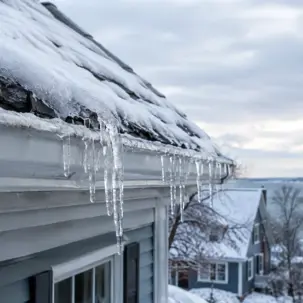
The eave edge extends beyond the exterior wall and stays colder. When meltwater reaches that colder edge, it can refreeze and form a ridge of ice. As the cycle repeats, the ridge grows and blocks drainage.
The back-up mechanism
When water is trapped behind an ice ridge, it can pool and work its way under shingle courses.
Asphalt shingles are designed to shed water moving downslope, not resist standing water. Backed-up meltwater can find pathways at laps and penetrations, wet the deck, and lead to interior staining or damage.
Ice barrier coverage: what the code concept is trying to achieve
Rhode Island follows the IRC approach to ice barrier protection in areas subject to ice damming.
In practical terms, the concept is:
- Install a self-adhering ice barrier membrane at roof edges (eaves)
- Extend coverage far enough upslope so the membrane reaches beyond the interior warm wall line
The 24-inch interior wall line concept (how to think about it)
A common rule of thumb in cold-climate codes is that the ice barrier should extend to a point at least 24 inches inside the interior warm wall line.
That means the required upslope distance depends on your overhang depth and roof pitch. On some homes, a single 36-inch course may not be enough, and additional coverage may be needed.
Other common vulnerability zones
Even beyond eaves, many roof assemblies require enhanced membrane and flashing detailing at:
- Valleys
- Chimneys and sidewalls
- Roof-to-wall intersections
- Penetrations (plumbing vents, skylights)
Note: Exact requirements vary by roof design, municipality enforcement, and manufacturer specifications.
Substrate regulations: decking integrity and plywood standards
A code-aligned roof requires a sound structural substrate. Roofing fasteners must bite into solid wood to resist wind uplift.
The problem with spaced plank decking
Many older Rhode Island homes (including parts of Providence County and Kent County) have plank decking. Over time, boards can shrink, warp, and separate.
When fasteners land in gaps, holding power drops. That can increase the risk of shingle movement or blow-offs during high winds.
The plywood overlay solution (when needed)
When we uncover spaced plank decking, wide gaps, or compromised sheathing during a tear-off, we typically recommend a continuous overlay using code-appropriate rated panels (often 1/2-inch CDX plywood or equivalent).
Benefits can include:
- More consistent nail bite
- A flatter surface for underlayment and self-adhered membranes
- Reduced risk of telegraphing (board lines showing through)
Balanced ventilation math: stopping heat and moisture build-up
Attic ventilation is a major factor in both winter and summer roof performance.
Codes commonly reference minimum net free ventilating area (NFVA) ratios such as 1:150, with allowances to reduce to 1:300 when specific conditions are met.
Why balance matters
Ventilation should be balanced between:
- Intake (lower roof edge, often soffits)
- Exhaust (high roof, often ridge)
If a contractor adds ridge exhaust without confirming adequate intake, the attic can pull air from unintended places, increasing heat loss and moisture movement.
A proper plan looks at the whole system: intake, exhaust, baffles, insulation contact, and air sealing.
Navigating insurance code supplements (law and ordinance)
If your roof replacement is triggered by storm damage, your policy may include law and ordinance coverage that helps pay for required upgrades to meet current code.
A common issue is that initial insurance estimates may be written for like-kind replacement and miss code-driven items such as:
- Expanded ice barrier coverage based on overhang geometry
- Required flashing details or underlayment upgrades
- Decking replacement or overlay when substrate is not suitable
Mighty Dog Roofing can provide line-itemed estimates with clear scope language to support documentation with your carrier.
Capital protection: financing options for qualified buyers
Upgrading your roof to meet current code concepts and reduce ice dam risk is an investment in your home.
Financing may be available for qualified buyers, including zero-down options (terms vary). Approvals and terms depend on the lender and the applicant.
Start with documentation (before you sign an estimate)
Before writing a deposit, schedule a drone-based inspection.
A documented inspection can help clarify:
- Roof geometry and slope transitions
- Eave overhang depth (which affects ice barrier coverage)
- Valleys, penetrations, and flashing zones
- Areas where decking may need closer evaluation during tear-off
Rhode Island Service Locations:
Ashaway, Barrington, Bradford, Bristol, Carolina, Central Falls, Charlestown, Chepachet, Clayville, Coventry, Cranston, Cumberland, East Greenwich, East Providence, Exeter, Forestdale, Foster, Glendale, Greene, Greenville, Harrisville,Hope,Hope Valley, Hopkinton, Jamestown, Johnston, Kenyon, Kingston, Lincoln, Little Compton, Manville, Mapleville, Middletown, Narragansett, Newport, North Kingstown, North Providence, North Scituate, North Smithfield, Oakland, Pascoag, Pawtucket, Portsmouth, Providence, Riverside, Rockville, Rumford, Saunderstown, Shannock, Scituate, Slatersville, Smithfield, Tiverton, Wakefield, Warren, Warwick, West Greenwich, West Kingston, West Warwick, Westerly, Wood River Junction, Woonsocket, Wyoming
Frequently Asked Questions
What is the ice and water shield code requirement in Rhode Island for 2026?
Rhode Island follows the IRC framework with state amendments and local enforcement. In practice, ice barrier membrane is typically required at eaves in areas subject to ice damming, and coverage is commonly designed to extend upslope beyond the interior warm wall line. Exact requirements depend on roof geometry and local enforcement.
How does attic ventilation help reduce ice dams in New England?
Balanced ventilation helps keep attic temperatures more consistent by exhausting warm, moist air and supporting intake airflow at the eaves. Combined with insulation and air sealing, this can reduce uneven roof-deck warming that contributes to ice dam formation.
Can I install new shingles over gapped plank decking in Rhode Island?
If decking has wide gaps or compromised boards, fasteners may not achieve reliable holding power. When spaced planking is uncovered, a continuous overlay using rated panels (such as 1/2-inch CDX plywood or equivalent) is commonly recommended to create a consistent nailing surface.
Are zero-down financing options available for code-aligned roof replacements?
Financing may be available for qualified buyers, including zero-down options (terms vary). Ask what programs are currently available at the time of your estimate.
Schedule a code-aligned roof evaluation
If you are in Providence County or Kent County and want a roof system designed around ice dam risk, wind exposure, and documentation, we can help.
Call Mighty Dog Roofing of Rhode Island: (401) 425-4108 Or book here