
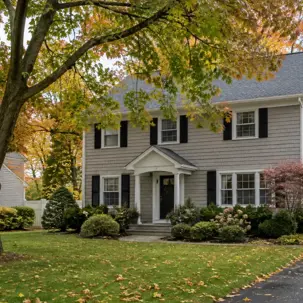
Living in Lincoln, Rhode Island - whether in historic Lime Rock, near the Blackstone Valley, or bordering Lincoln Woods State Park - offers a picturesque landscape dominated by mature hardwoods and white pines.
That same tree cover can create a demanding microclimate for residential roofing systems. Shade, trapped organic debris, and persistent moisture can accelerate aging and increase the odds of leaks if the roof system is already near end-of-life.
This guide explains what happens to roofs under heavy canopy cover in Lincoln, what warning signs to look for, and what a long-term repair or replacement plan should include.
Why tree cover changes how a roof ages
Tree-covered roofs often experience a different set of stressors than open-sun roofs.
Common canopy-driven issues include:
- Pine needles and leaves collecting in valleys, behind chimneys, and at gutter lines
- Organic debris holding moisture against shingle edges
- Increased moss and lichen growth in shaded zones
- More frequent clogged gutters and overflow at corners
Over time, moisture retention can contribute to granule loss, edge deterioration, and localized deck damage.
Debris impact and “micro-damage” (what is realistic)
In fall and during wind events, twigs, acorns, and small branches can strike roof surfaces.
On newer, healthy shingles, minor impacts are often cosmetic. On older shingles that are already brittle or losing granules, repeated impacts can contribute to:
- Granule displacement
- Small creases or bruising
- Faster aging in already weak areas
Practical takeaway: If your roof is older and heavily shaded, impact plus moisture retention can speed up failure.
Uncovering substrate failure under tree cover
Many classic homes in Lincoln built prior to the 1970s feature dimensional plank decking rather than continuous modern plywood sheathing.
Under heavy shade and persistent moisture, boards can shrink and separate over decades.
Why plank decking can become a leak and wind risk
When moisture penetrates through aged shingles over spaced plank decking, water can find pathways into attic spaces or contribute to rot along board edges.
Fastening new shingles into gapped or softened plank decking can also reduce holding power, increasing the risk of shingle movement during high winds.
The plywood overlay solution (when needed)
When we uncover spaced plank decking, wide gaps, or compromised sheathing during a tear-off in Lincoln, we typically recommend a continuous overlay using code-appropriate rated panels (often 1/2-inch CDX plywood or equivalent).
Benefits can include:
- A flatter, more consistent nailing surface
- Better underlayment adhesion and membrane performance
- Improved overall roof stability
Note: The right approach depends on what is found during tear-off and what manufacturer and local requirements apply.
Engineered defense: algae resistance and airflow
A shaded roof is more likely to show dark streaking and biological growth.
Shingle selection for shaded, tree-covered homes
For heavily shaded homes, we often specify architectural shingles with algae-resistant granules from lines such as:
- IKO Dynasty
- Owens Corning TruDefinition Duration
Color choice is mostly aesthetic. If you want to target color-based searches, we can include a short section that references popular blends (such as Driftwood or Teak) without making performance claims tied to color.
Ventilation and moisture control
A shaded roof also needs proper attic ventilation to help purge trapped humidity.
We often pair ridge exhaust ventilation with intake strategies. When soffits are blocked or narrow, deck-level intake vents (such as Smart Vents) can be an option depending on roof design.
Important: Ventilation should be planned as a system (intake plus exhaust). Adding exhaust without adequate intake can create unintended airflow patterns.
Financing options for qualified buyers (terms vary)
Protecting your property against canopy-driven roof damage should be straightforward.
Financing may be available for qualified buyers, including zero-down options (terms vary). Ask what programs are available at the time of your estimate.
Rhode Island Service Locations:
Ashaway, Barrington, Bradford, Bristol, Carolina, Central Falls, Charlestown, Chepachet, Clayville, Coventry, Cranston, Cumberland, East Greenwich, East Providence, Exeter, Forestdale, Foster, Glendale, Greene, Greenville, Harrisville,Hope,Hope Valley, Hopkinton, Jamestown, Johnston, Kenyon, Kingston, Lincoln, Little Compton, Manville, Mapleville, Middletown, Narragansett, Newport, North Kingstown, North Providence, North Scituate, North Smithfield, Oakland, Pascoag, Pawtucket, Portsmouth, Providence, Riverside, Rockville, Rumford, Saunderstown, Shannock, Scituate, Slatersville, Smithfield, Tiverton, Wakefield, Warren, Warwick, West Greenwich, West Kingston, West Warwick, Westerly, Wood River Junction, Woonsocket, Wyoming
Frequently Asked Questions
Can falling acorns and tree branches really damage my Lincoln roof?
They can contribute to damage, especially on older shingles that are already brittle or losing granules. Impacts can displace granules and create localized weak spots. If your roof is heavily shaded, moisture retention and debris buildup can accelerate aging.
What should be done if my Lincoln roof deck has spaced wooden planks?
If spaced plank decking or wide gaps are uncovered during tear-off, a continuous overlay using code-appropriate rated panels (often 1/2-inch CDX plywood or equivalent) is commonly recommended to create a consistent nailing surface.
Are zero-down financing options available for roof replacements in Lincoln?
Financing may be available for qualified buyers, including zero-down options (terms vary). Ask what programs are available at the time of your estimate.
Schedule a Lincoln roof inspection
If your Lincoln home is under heavy tree cover and you want a roof plan built around moisture control, decking integrity, and ventilation, we can help.
Call Mighty Dog Roofing of Rhode Island: (401) 425-4108 Or book here: https://www.mightydogroofing.com/rhode-island/contact-us/