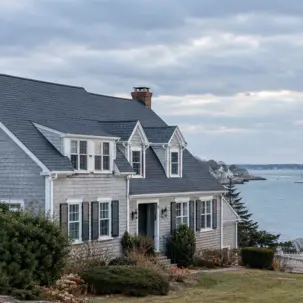
Living in East Greenwich, Rhode Island offers a vibrant downtown, rich marine history, and panoramic views of Greenwich Bay. But as late September brings seasonal Nor’easters and sharp coastal temperature shifts, local roofs can face aggressive weather pressures.
Unlike inland properties protected by dense tree cover, homes along Greenwich Cove, the Hill and Harbour district, and Cowesett often deal with more direct wind exposure off the water. When coastal storms funnel up Narragansett Bay, wind uplift forces can target the vulnerable perimeters of your roof: eaves, rakes, and ridge lines.
Quick answer: why East Greenwich roofs see higher wind risk
Coastal wind events are hard on roofs because:
- Wind hits exterior walls and accelerates over the roof plane
- Pressure differences can create uplift at edges and corners
- Small weaknesses at the perimeter can become failure points
A high-performing roof system is designed to keep the roof covering, underlayment, and decking working together as one assembly.
The pitfall of overlaying shingles in coastal zones
When trying to manage costs, some homeowners consider a roof overlay, which is installing a new layer of shingles over an existing layer.
In a coastal environment like East Greenwich, we typically do not recommend overlays in coastal zones because they can reduce performance and make it harder to verify what is happening underneath.
Inadequate fastener penetration
Roofing nails need to seat into solid wood with enough embedment to resist uplift.
When nails must pass through two shingle layers, effective penetration into the deck can be reduced. That can weaken wind resistance, especially at the perimeter where uplift forces are highest.
Trapped moisture and rot risk
Overlays can trap moisture between layers. In salt-air environments with frequent fog, wind-driven rain, and freeze-thaw cycles, trapped moisture can accelerate deck deterioration and shorten the service life of the roof system.
Warranty and system limitations
Many manufacturers place restrictions on warranties when shingles are installed over existing layers. Even when coverage is available, the roof system may be less predictable because the installer cannot fully evaluate the substrate, flashing, and underlayment conditions.
Why tear-off matters
A full tear-off is the only way to:
- Inspect decking for rot, delamination, and soft spots
- Confirm flashing details at chimneys, valleys, and walls
- Correct ventilation and intake/exhaust balance
- Build a roof assembly that is easier to document and stand behind
Substrate engineering: continuous plywood for older homes
A high-wind roof is only as reliable as the substrate it is anchored to.
Many older homes in East Greenwich have dimensional plank decking. Over decades, planks can shrink, warp, and separate.
If a roofer drives a nail into a gap between planks, that fastener has limited holding power. During a coastal gale, wind uplift can exploit those weak points.
When we uncover spaced plank decking, wide gaps, or compromised sheathing during a tear-off, we typically recommend a continuous overlay using code-appropriate rated panels (often 1/2-inch CDX plywood or equivalent). This helps create a flatter, more consistent nailing surface and can improve overall roof assembly performance.
Material aesthetics that still respect performance
A roof replacement should elevate curb appeal while protecting the building envelope.
For East Greenwich homes, dimensional architectural shingles can provide strong shadow lines that complement coastal siding. Examples include:
- IKO Dynasty in Atlantic Blue
- Owens Corning TruDefinition Duration in Estate Gray
Final product selection depends on your roof geometry, ventilation plan, and manufacturer availability.
Protecting your property with zero-down options
Protecting your home from coastal storms should not require draining your savings.
We can connect homeowners with financing options, including zero-down options for qualified buyers (terms vary). This can help you move forward with an engineered roof assembly sooner, rather than waiting until after the first major storm.
Rhode Island Service Locations:
Ashaway, Barrington, Bradford, Bristol, Carolina, Central Falls, Charlestown, Chepachet, Clayville, Coventry, Cranston, Cumberland, East Greenwich, East Providence, Exeter, Forestdale, Foster, Glendale, Greene, Greenville, Harrisville,Hope,Hope Valley, Hopkinton, Jamestown, Johnston, Kenyon, Kingston, Lincoln, Little Compton, Manville, Mapleville, Middletown, Narragansett, Newport, North Kingstown, North Providence, North Scituate, North Smithfield, Oakland, Pascoag, Pawtucket, Portsmouth, Providence, Riverside, Rockville, Rumford, Saunderstown, Shannock, Scituate, Slatersville, Smithfield, Tiverton, Wakefield, Warren, Warwick, West Greenwich, West Kingston, West Warwick, Westerly, Wood River Junction, Woonsocket, Wyoming
Frequently Asked Questions
Why are coastal wind storms especially damaging to East Greenwich roofs?
Coastal storms coming off Greenwich Bay can produce more direct wind exposure. As wind hits an exterior wall, it can accelerate upward and create uplift forces along eaves, rakes, and ridges, especially if the roof system is not well anchored at the perimeter.
What should be done if my East Greenwich home has gapped plank decking?
If we uncover spaced plank decking or wide gaps during a tear-off, we typically recommend a continuous overlay using code-appropriate rated panels (often 1/2-inch CDX plywood or equivalent). This provides a flatter, more consistent surface so fasteners have better bite.
Can I finance a coastal roof replacement without paying cash upfront?
Financing may be available for qualified buyers, including zero-down options (terms vary). Approvals and terms depend on the lender and the applicant.
Schedule an inspection before the first Nor’easter
If your roof is older, has multiple layers, or you are seeing lifted tabs, granule loss, or staining near the eaves, it is worth getting it documented before winter.
Call Mighty Dog Roofing of Rhode Island: (401) 425-4108 Or book here