
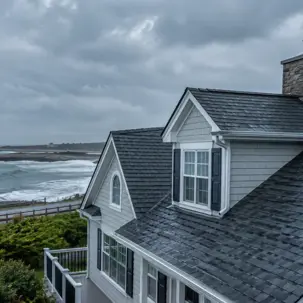
Living along the Narragansett coastline offers unmatched access to Rhode Island beaches and landmarks like The Towers. But late-season coastal storms and Nor’easters can be tough on residential building envelopes.
When a strong coastal storm moves through, wind crossing open water can accelerate and hit homes with higher exposure than inland neighborhoods. That matters because wind does not just push on a roof - it can also create negative pressure (uplift) that pulls on shingle tabs, rake edges, and valley and wall flashings.
If you are in Narragansett Pier, Bonnet Shores, Point Judith, or nearby coastal streets, use this homeowner advisory to spot common wind and water entry points and avoid the most common post-storm mistake: patching the symptom without addressing the system.
How coastal wind uplift actually damages a roof (simple physics)
Wind moving across a roof surface can create areas of suction, especially near:
- Rakes (gable edges)
- Eaves
- Corners
- Valleys
- Around chimneys and roof-to-wall intersections
Those are the same zones where small failures can turn into interior leaks during the next heavy rain.
Why quick patch work often fails on coastal roofs
After a storm, it is tempting to replace a few shingles and move on. In a high-exposure zone like Narragansett, patching over an aging or compromised roof deck is often a temporary fix.
Broken thermal seals
High gusts can lift aging shingle tabs and weaken or break the factory adhesive seal.
Once shingles are unsealed, wind-driven rain can travel upward under shingle courses. That is why some roofs leak only during storms (not during light rain).
Plank gap vulnerability (older homes)
Many older Rhode Island homes have plank decking. Over time, boards can shrink and gaps can open.
If a replacement shingle is nailed into a gap between planks, the fastener has little to no holding power. That can make the next wind event a repeat failure.
Corroded fasteners in salt air
Coastal salt air can accelerate corrosion on standard fasteners. Over time, corrosion can reduce holding strength and contribute to shingle movement and flashing failures.
Substrate integrity: why the wood matters as much as the shingles
A high-wind shingle is only as effective as the wood it anchors into.
If we uncover spaced plank decking, wide gaps, or compromised sheathing during a post-storm tear-off, we typically recommend a continuous overlay using code-appropriate rated panels (often 1/2-inch CDX plywood or equivalent).
Benefits of a continuous overlay can include:
- More consistent nail bite across the entire roof
- A flatter surface for underlayment and self-adhered membranes
- Stronger overall roof diaphragm behavior (better resistance to movement)
Note: The right approach depends on what is found during tear-off and what local enforcement and manufacturer requirements apply.
Material choices that can help in coastal wind zones
Not every shingle is built the same.
For coastal homes, we often specify architectural shingles designed for higher wind performance and better fastening consistency, such as:
- IKO Dynasty (high-wind architectural shingle line)
- Owens Corning TruDefinition Duration (reinforced nailing zone)
Do you need a specific color for performance? No. Color is mostly aesthetic. If you want to include colors for SEO or design intent, it can help match homeowner search behavior (for example, homeowners searching specific shingle colors), but it is not required for a technically strong post.
What to check after a Narragansett storm (ground-level checklist)
You do not need to climb on the roof to spot many warning signs.
Exterior signs
- Missing shingles or visible tabs out of alignment
- Creased shingles (a horizontal bend line)
- Lifted or damaged rake edge metal
- Bent or missing flashing at chimneys or sidewalls
- Granules collecting at downspout outlets (sand-like grit)
- Gutters pulling away or overflowing at corners
Interior signs
- Dark spots on ceilings or upper walls
- Damp insulation in the attic
- Musty odor after rain
- Rust stains on nail tips or fasteners visible from the attic
If you see any of these, the safest next step is a documented inspection.
Protecting your property equity with financing options (for qualified buyers)
Post-storm repairs can arrive at the same time as other unexpected expenses.
Financing may be available for qualified buyers, including zero-down options (terms vary). This can help eligible homeowners complete a full roof replacement or a properly scoped repair plan without draining emergency reserves.
When a full tear-off is the safer choice
A full tear-off is not always required, but it is often the only way to confirm:
- Decking condition (especially with plank decks)
- Hidden moisture damage
- Proper flashing integration at valleys, chimneys, and walls
If your roof is near end-of-life, has repeated leaks, or shows widespread seal failure, a full replacement may be more cost-effective than repeated patches.
Rhode Island Service Locations:
Ashaway, Barrington, Bradford, Bristol, Carolina, Central Falls, Charlestown, Chepachet, Clayville, Coventry, Cranston, Cumberland, East Greenwich, East Providence, Exeter, Forestdale, Foster, Glendale, Greene, Greenville, Harrisville,Hope,Hope Valley, Hopkinton, Jamestown, Johnston, Kenyon, Kingston, Lincoln, Little Compton, Manville, Mapleville, Middletown, Narragansett, Newport, North Kingstown, North Providence, North Scituate, North Smithfield, Oakland, Pascoag, Pawtucket, Portsmouth, Providence, Riverside, Rockville, Rumford, Saunderstown, Shannock, Scituate, Slatersville, Smithfield, Tiverton, Wakefield, Warren, Warwick, West Greenwich, West Kingston, West Warwick, Westerly, Wood River Junction, Woonsocket, Wyoming
Frequently Asked Questions
How do I know if the recent Nor’easter damaged my Narragansett roof?
Look for missing or creased shingles, lifted rake edges, or granules collecting in downspouts. Interior signs include ceiling stains or attic dampness after heavy rainfall. If you are unsure, schedule a documented inspection.
What should be done if my coastal home has spaced plank decking?
If spaced plank decking or wide gaps are uncovered during tear-off, a continuous overlay using code-appropriate rated panels (often 1/2-inch CDX plywood or equivalent) is commonly recommended to create a consistent nailing surface.
Can I finance a roof replacement after storm damage in Rhode Island?
Financing may be available for qualified buyers, including zero-down options (terms vary). Ask what programs are available at the time of your estimate.
Schedule a documented roof inspection in Narragansett
If you are in Narragansett (including Narragansett Pier, Bonnet Shores, or Point Judith) and you want a roof plan built for coastal wind exposure, we can help.
Call Mighty Dog Roofing of Rhode Island: (401) 425-4108 Or book here