
Roofing in Medford, MA
Medford sits right in the middle of the territory the Mighty Dog Roofing of North Boston team works week in and week out. We're not a referral service passing your name along, and our trucks aren't coming from two states away. We're a North Boston roofing crew, and Medford — from the three-deckers off Salem Street to the colonials up on the Hillside — is core to the ground we cover.
That local familiarity matters more here than it does in a subdivision built in 2015. Medford's housing stock is old, varied, and tightly packed, and a roof that works on a 1920s two-family near Medford Square is not the same roof that works on a renovated Victorian in West Medford. Below is how we think about roofing in this specific city, and what we'd want you to know before you spend a dollar.
Note: We serve Medford as part of our North Boston service area. We don't keep a separate Medford storefront — but Medford is a short drive, and we're in its neighborhoods constantly.
Neighborhoods and ZIP codes we serve in Medford
Medford's residential mail almost all runs through a single ZIP — 02155 — which covers the whole city, West Medford included. (You'll also see 02153, but that's a P.O. Box ZIP tied to the Tufts University area, not a separate residential zone.) Wherever your roof is in the city, we cover it:
- Medford Square and the downtown core
- West Medford (the “Ville”) and the Brooks Estate area
- South Medford and Station Landing
- Wellington and the Mystic riverfront
- Glenwood
- The Hillside (Medford Hillside, near Tufts)
- North Medford / Fulton Heights
- Lawrence Estates
- Haines / Stevens and the surrounding squares
If you're on a Medford street and you're not sure whether you're technically in one neighborhood or the next, it doesn't change anything for us — give us the address and we'll come look.
Roofing for Medford's older and historic homes
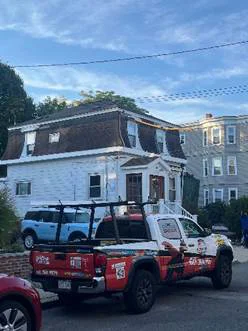
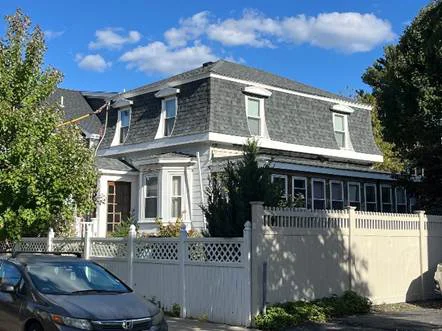
A lot of Medford was built before World War II, and it shows in the rooflines: steep-pitched Victorians, gable-and-dormer colonials, and block after block of two- and three-family homes. These houses are a pleasure to work on when you understand them, and a headache when you don't. Old framing isn't always square, decking under decades-old shingles can be a mix of plank and plywood, and flashing details around dormers, valleys, and additions were often done by hand a long time ago. We plan for that instead of being surprised by it.
A note on historic districts. Medford has two local historic districts — the Hillside Avenue Historic District and the Marm Simonds District — administered by the Medford Historic District Commission under Massachusetts General Law Chapter 40C. If your home sits inside one of them, exterior changes visible from the street can require review. The practical news for roofing is reassuring: roof color and storm- or fire-related repairs are specifically exempt from review, and a like-for-like replacement using the same materials is often handled with a certificate of non-applicability rather than a full hearing. We'll help you figure out which bucket your project falls in before any work starts. (Medford also has a separate Historical Commission that reviews demolitions of buildings over 75 years old — that's a teardown issue, not a re-roof one, but it's worth knowing the city pays attention to its old housing.)
About slate. Some of Medford's oldest homes still wear original slate. We want to be straight with you: slate is rare here, and it is not our specialty. Genuine slate work — matching salvaged tiles, replacing a slate field, or rebuilding the kind of ornamental detailing some of these roofs carry — is a craft of its own. If your roof is slate and slate is the right answer, we'll tell you so and point you toward a dedicated slate specialist rather than pretend it's in our wheelhouse. Where it makes sense, we're glad to talk through asphalt as a practical alternative — but that's a conversation, not a default.
Asphalt shingle roofs, installed as a complete system
Most Medford homes are best served by a quality asphalt shingle roof, and this is the work we do best. We're an Owens Corning Platinum Preferred Contractor, which is the top tier of their contractor network and the reason we can install — and stand behind — the complete Owens Corning roofing system rather than a pile of loose parts.
That distinction is the whole point. A roof doesn't fail because the shingles were cheap; it usually fails at the edges, the valleys, and the penetrations. Installing the full system means every layer is doing its job:
- Synthetic underlayment across the deck as a secondary water barrier
- Leak barriers (ice-and-water membrane) at the eaves and in the valleys — the exact spots where Medford's ice dams push water backward
- Starter shingles along the eaves and rakes so wind can't get under the first course
- Shingles — modern laminate/architectural shingles that lie flat and hold their line
- Hip and ridge caps finished to match
- Ventilation — balanced intake and exhaust so the attic breathes, which is what keeps the roof from cooking itself from below and feeding ice dams from above
Installed as a system, the components are also what make the manufacturer warranty coverage meaningful. Installed piecemeal, you've just got shingles.
EPDM flat roofs — the section most homeowners forget
Here's the part of the roof most Medford homeowners never think about until it leaks: the flat one.
A huge share of Medford's two- and three-family homes pair a sloped, shingled main roof with a flat rubber (EPDM) roof over a back porch, a piazza, a deck, or a dormered addition. Owners diligently watch the big shingle roof and completely ignore the small flat one — right up until the ceiling under the porch starts staining. Flat roofs are simpler in principle and less forgiving in practice, because water doesn't run off; it sits and waits for a weak point. The usual culprits:
- Seams and flashing. Where the rubber laps itself or meets a wall, a chimney, or a railing post is where most flat roofs let go first.
- Ponding. Standing water that never drains accelerates aging and finds the smallest gap.
- Foot traffic. If that flat roof doubles as a deck or balcony, every footstep, planter, and dragged chair works against the membrane.
- Age and shrinkage. EPDM shrinks as it ages, pulling at its own edges and flashings until a seam opens.
- Animals. This is New England, and the wildlife knows your attic is warm. Raccoons will claw and tear at a rubber membrane to get at a heated space underneath, and squirrels are notorious for gnawing at chimney flashing on the main roof. Animal damage is one of the most common flat-roof failures we get called about, and it's almost never on the homeowner's radar until there's a hole.
If you own a multifamily in Medford, the flat roof deserves the same attention you give the shingles. We'll inspect it as part of any look at your property.
New England weather, and what last winter did to Medford roofs
You don't need us to tell you what winter does here, but the roofing consequences are specific.
Ice dams. When snow on an upper roof melts, runs down to the cold eave, and refreezes, it builds a dam of ice that forces meltwater backward — up and under the shingles, where it finds the seams and drips into the rooms below. The leak shows up at the edge of the roof and along the gutters, which is exactly why eave leak barriers matter so much. Last winter made the point emphatically: the Blizzard of 2026 in late February capped one of the snowiest Boston-area seasons in years — well over five feet of snow on the ground across Greater Boston by season's end — and the repeated freeze-thaw that came with it was a textbook ice-dam machine.
Snow load. Heavy, wet snow stacked on an aging or under-ventilated roof is a stress test, and structures that were already tired tend to reveal it in February.
Nor'easters and wind. High-wind storms are especially hard on old 3-tab shingles: when the wind gets under a tab, it can peel whole shingles off in full pieces, leaving bare deck exposed. Modern laminate/architectural shingles are heavier, multi-layered, and far better at staying put — one of the strongest practical arguments for upgrading an old 3-tab roof rather than patching it again.
Freeze-thaw. The daily cycle of melting and refreezing works open every small gap it can find — around flashing, in aging sealant, at the edges of that forgotten flat roof — a little more each year.
Our roofing services in Medford
- Roof repair — leaks, storm damage, failed flashing, missing shingles, problem valleys.
- Roof replacement — full tear-off and a complete Owens Corning system, sized and detailed for your home.
- Roof inspection — free, drone-assisted, with a written report and photos you keep, whether or not you hire us.
- Storm and emergency response — fast tarping and stabilization after wind, ice, or a fallen branch.
- Flat and low-slope EPDM — repair and replacement of porch, deck, and addition roofs.
- Beyond the roof — siding, replacement windows, gutters, and skylight replacement, so the whole exterior works together and the water goes where it should.
Commercial and industrial roofing
We also handle commercial and industrial roofs across the North Boston area, including Medford's mixed-use blocks and light-industrial buildings:
- Membrane roof systems — EPDM and other commercial membrane systems suited to low-slope commercial roofs.
- Drainage and ponding fixes — correcting the standing-water problems that quietly destroy flat commercial roofs.
- Inspections and maintenance programs — scheduled care that catches small failures before they become interior damage and downtime.
- Emergency response — rapid stabilization to protect the building and what's inside it.
Optional extended warranty (commercial only). On a full commercial EPDM installation, the property owner can optionally add an RPI full-system warranty — 40 years on the EPDM membrane and 20 years on labor and accessories. It's an add-on, entirely the owner's call, and we'll lay out the cost and terms so you can decide. Please note this warranty applies to commercial roofs only — it is not available on one-family residential flat roofs.
From first call to final inspection
We keep the process the same every time so there are no surprises:
- Inspect. We come out and look at the whole roof — including the flat sections and penetrations — and document what we find.
- Measure. We take precise measurements so the estimate reflects your actual roof, not a guess.
- Estimate, in writing. We provide a complete written estimate and review it with you. Nothing moves forward until you've signed off on it.
- Permits. We apply for the required Medford building permits (and flag any historic-district step if your home is in a local district).
- Schedule. We set a date that works around the weather and your life.
- Install. Our crew installs the complete system, protects your property, and cleans up the site.
- Final walkthrough and city inspection. We walk the finished roof with you and file for the city's final inspection so the job is closed out properly.
Why homeowners in Medford choose us
- We're in the area constantly. Medford isn't a place we visit; it's part of our weekly territory.
- We know these houses. Older and historic homes, multifamily two- and three-deckers, and the flat-roof-plus-shingle combination that defines so much of Medford.
- Owens Corning Platinum Preferred Contractor — the top tier of Owens Corning's network, installing the complete system.
- Licensed and insured, with the documentation to prove it before we set foot on your roof.
- Free, no-pressure inspections — drone-assisted, with a written report and photos you keep.
- The Mighty Watchdog Warranty standing behind our work.
- Financing available, so a sudden roof problem doesn't have to become a financial emergency.
Frequently asked questions
How much does a new roof cost in Medford?
There's no honest flat number, because price follows the roof: its size and pitch, how many layers have to come off, the condition of the decking underneath, the number of valleys and penetrations, and whether there's a flat section in the mix. A small, simple roof and a steep three-decker with a porch roof are very different jobs. What we can tell you is that our estimate is all-in, with no surprises tacked on later. Our estimate includes: all the materials needed to complete the project, labor, all permits, dumpster and disposal to the landfill. The right way to get a real figure is a free inspection and a written estimate — and we'd rather quote your actual roof than throw out a number that changes the day we get up there.
How long does a new roof take to install?
In most cases, a roof replacement takes 1–2 days. The biggest variable is what we find once the old roof comes off: the condition of the sheathing underneath. If the decking is sound, we stay on schedule. If it needs substantial carpentry work — replacing rotted or soft sheathing before the new roof goes on — plan on about a day more. A few other things can stretch the timeline: the size and pitch of the roof, complex rooflines with lots of valleys and dormers (common on Medford's older homes), the number of chimneys and skylights to flash and seal around, and weather. We won't start a job we can't finish cleanly, so we watch the forecast and schedule around it.
How long does a roof last?
A quality architectural-shingle roof, properly installed and ventilated, can last decades. But here's the part people miss: the shingle field is rarely what fails first — the penetrations and accessories are. Rubber pipe boots around plumbing vents typically fail in roughly 15–20 years, because that exposed rubber takes direct UV that the shingles are designed to shrug off. Chimney flashing is worth checking once a roof passes 20 years. And tree-branch damage and moss or algae growth can shorten the life of any roof regardless of age. The shingles are usually fine long after the little parts need attention.
How often should I have my roof inspected?
You do not need an annual inspection — that's overkill for most homes. The sensible rhythm is: get up there (or send us up) after any major storm, and otherwise about once every two years once the roof passes 15 years old. Before 15 years, a sound roof generally doesn't need routine inspection unless a storm gives you a reason.
Should I repair my roof or replace it?
If the damage is localized — a few shingles, one bad flashing detail, a single leak — and the roof is otherwise sound and not too old, repair is the smart money. If the roof is near the end of its service life, leaking in more than one place, or you're patching the same areas repeatedly, you're spending good money to delay the inevitable, and replacement usually wins. We'll give you the honest read after we inspect, including when the answer is “this roof has years left in it.”
Can you roof over my existing shingles, or do you tear off?
We tear off. Mighty Dog Roofing of North Boston does not install new shingles over an existing roof — every replacement we do starts with a complete tear-off down to the deck. It's worth knowing where the code sits, because homeowners often ask: Massachusetts building code (780 CMR) allows a maximum of two layers of asphalt shingles, so if your home currently has a single layer, an overlay would technically be permitted. We don't do it anyway. A layover looks like it saves money on labor and disposal, but that's an illusion — you're not avoiding those costs, just pushing them down the road to whenever the roof finally comes off. And with a few years of inflation and rising material prices in between, that future tear-off almost always costs more than it would today. So there's no real saving. What a layover actually does is hide the deck — so no one can see or fix the rot, soft spots, or failed flashing that Medford's freeze-thaw winters tend to leave behind. It also adds weight to the structure, traps heat that ages the new shingles faster, and gives the new shingles an uneven surface to seal against instead of a clean, flat deck with fresh leak barrier underneath. On Medford's older homes especially, we'd rather see what's under there than roof over a surprise. Tearing off costs a bit more today and gives you a roof that actually lasts — which is the whole point.
My roof looks dull or dusty from the street — is that a problem?
It can be. That worn, dusty look is often granule loss — the protective mineral granules washing off the shingle and exposing the asphalt base underneath to direct UV. Once the asphalt is exposed, it dries out and degrades faster, so a roof that merely looks tired can be aging quicker than its years suggest. It's worth a look.
Do I need a permit to replace my roof in Medford?
Yes. A building permit is required to replace a roof in Medford, and we apply for it as part of the job. If your home is in one of the city's local historic districts, there may be an additional historic-district review step — we'll flag that early so it doesn't slow you down.
Do you work on slate roofs?
Rarely, and it's not our focus. Slate is a specialized craft, and when slate is genuinely the right answer for your home we'll point you to a dedicated slate specialist rather than overreach. If you'd like, we can also talk through whether a quality asphalt system is a sensible alternative for your situation.
My flat porch roof is leaking but my shingles look fine — what's going on?
Very common in Medford's multifamily homes. The sloped shingle roof and the flat EPDM porch or deck roof are two different roofs with two different failure modes, and the flat one almost always goes first — usually at a seam, the flashing, a ponding spot, or somewhere an animal got to it. The shingles can be in great shape while the rubber quietly fails. We inspect both.
I only get leaks in winter — why?
That's the signature of an ice dam. Snow melts on the warmer upper roof, refreezes at the cold eave, and the resulting ice forces water backward under the shingles. The fix is usually a combination of proper eave leak barriers, better attic ventilation and insulation, and addressing any spots where heat is escaping into the attic. A summer-dry, winter-wet roof is almost always an ice-dam story.
Do you do emergency roof repairs?
Yes. After wind, ice, or a fallen branch opens up your roof, we respond quickly to tarp and stabilize it so the damage stops getting worse, then come back to do the permanent repair properly.
Do you do commercial or industrial roofing?
Yes — membrane systems (EPDM and other commercial membranes), drainage and ponding corrections, scheduled inspection and maintenance programs, and emergency response for commercial and industrial buildings in the Medford area.
Which Medford neighborhoods do you serve?
All of them — Medford Square, West Medford, South Medford, Wellington, Glenwood, the Hillside, North Medford/Fulton Heights, Lawrence Estates, Station Landing, and everywhere in between, across ZIP 02155.
Book your free inspection
Call the Mighty Dog Roofing of North Boston team at (617) 934-4336, or use the form on this page to schedule a free, no-pressure, drone-assisted inspection with a written report you keep.


-
"Mighty Dig Roofing did a great job on my roof. Amar, the owner was very professional, courteous and knowledgeable. I would highly recommend Mighty Dog Roofing and would hire again for future projects."David Blessing


roof inspection
Explore Our Family Of Brands


.2408271108368.png "Groovy Hues")