
As late September brings a chill to the air, Rhode Island property owners shift focus to winter preparation. While sealing drafts and checking the furnace are standard, many overlook a major hazard right above their heads: roof avalanches.
When heavy, wet New England snow accumulates on a pitched roof, it forms a dense pack. As heat escapes from the attic or the winter sun warms the exterior, the bottom layer can melt and create a lubricated slip plane. When friction drops, the snowpack can release suddenly and slide off the eaves.
That sheet release can damage gutters, flatten foundation plantings, and create a serious safety risk for anyone walking below.
Quick answer: what causes a roof avalanche?
A roof avalanche is usually caused by three things happening together:
- A smooth or low-friction roof surface
- A warming event (sun or heat loss) that creates meltwater at the roof interface
- A roof pitch and layout that allows the snowpack to move as one mass
The goal of snow retention is not to eliminate snow. It is to interrupt the slide so snow releases in smaller, more controlled amounts.
High-risk roofs: it is not just a solar problem
Solar panels can increase sheet release because their glass surface is low-friction, but roof avalanches are not limited to solar.
Standing seam metal and slate
Standing seam metal and natural slate are designed to shed water and snow efficiently. Their smooth surfaces can allow snowpack to slide quickly, especially on steeper pitches.
If the roof plane sits above a front entry, walkway, or driveway, engineered snow retention may be appropriate.
Steep-slope asphalt and valleys
Architectural asphalt shingles have a granular surface that provides more friction than metal or glass. However, steep pitches (A-frames, steep Victorians, some Capes with additions) can still shed snow in sheets.
Valleys can also concentrate snow and ice loads and channel them toward the eave edge, increasing the chance of a sudden release.
Engineered solutions: pad-style guards vs snow rails
Stopping sheet release requires matching the retention method to the roof material, pitch, and hazard zones.
Pad-style snow guards
Pad-style guards (metal or polycarbonate) are installed in a staggered grid pattern across the lower roof area. They create friction points that help hold snowpack and encourage gradual melt.
They can be a good fit for some architectural shingle and slate applications when designed and installed correctly.
Pipe and rail systems
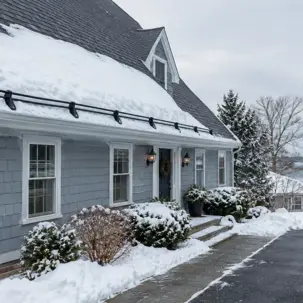
For lower-friction surfaces (such as standing seam metal or solar-adjacent zones), fence-style pipe and rail systems may be used. These create a continuous barrier designed to resist sliding snow loads.
Example systems include fence-style rails such as the Drift III by Rocky Mountain Snow Guards, selected based on roof geometry and manufacturer requirements.
Note: The correct system depends on layout, roof pitch, and attachment design.
Attachment and flashing: the part that determines success
A snow guard is only effective if it stays attached.
If a system is installed without proper structural attachment, it can fail under load and create additional roof damage.
Why decking-only attachment can be risky
Fastening into roof decking alone may not provide the holding power required for higher-load snow retention systems.
What a professional scope should include
A written scope should specify:
- How framing locations will be verified (rafters or trusses)
- Fastener type and spacing per manufacturer requirements
- Flashing method for all penetrations
- Sealant and underlayment integration where applicable
When installed and flashed correctly, the goal is a secure, watertight attachment that performs through freeze-thaw cycles.
The Mighty Dog structural assessment
Before we recommend a snow retention system, we start with documentation.
We use drone-based inspections to evaluate:
- Roof pitch and hazard zones (entries, walkways, driveways)
- Shingle or roof surface condition
- Valleys, transitions, and drainage paths
If snow retention is being combined with a full roof replacement, we also evaluate the substrate during tear-off. When we uncover spaced plank decking, wide gaps, or compromised sheathing, we may recommend a continuous overlay using code-appropriate rated panels (often 1/2-inch plywood or equivalent) to create a consistent substrate.
Financing note (compliance-safe)
For qualified buyers, financing options may be available. Terms, approvals, and offers vary.
Rhode Island Service Locations:
Ashaway, Barrington, Bradford, Bristol, Carolina, Central Falls, Charlestown, Chepachet, Clayville, Coventry, Cranston, Cumberland, East Greenwich, East Providence, Exeter, Forestdale, Foster, Glendale, Greene, Greenville, Harrisville,Hope,Hope Valley, Hopkinton, Jamestown, Johnston, Kenyon, Kingston, Lincoln, Little Compton, Manville, Mapleville, Middletown, Narragansett, Newport, North Kingstown, North Providence, North Scituate, North Smithfield, Oakland, Pascoag, Pawtucket, Portsmouth, Providence, Riverside, Rockville, Rumford, Saunderstown, Shannock, Scituate, Slatersville, Smithfield, Tiverton, Wakefield, Warren, Warwick, West Greenwich, West Kingston, West Warwick, Westerly, Wood River Junction, Woonsocket, Wyoming
Frequently Asked Questions
Do I need snow guards if I have an asphalt shingle roof?
Sometimes. Asphalt granules provide friction, but steep pitches, valleys, and certain roof layouts can still shed snow in sheets. If the roof plane is above an entry, walkway, or driveway, snow retention may be worth evaluating.
Will installing snow guards cause my roof to leak?
Not when designed and installed correctly. The key is proper attachment, flashing, and sealing methods that follow manufacturer requirements.
Can I finance the installation of a snow guard system?
Financing may be available for qualified buyers. Terms and approvals vary, and options can change.
Schedule an inspection before the first freeze
Do not wait for the first heavy storm to find out your roof sheds snow in sheets.
Call Mighty Dog Roofing of Rhode Island: (401) 425-4108 Or book here: https://www.mightydogroofing.com/rhode-island/contact-us/