

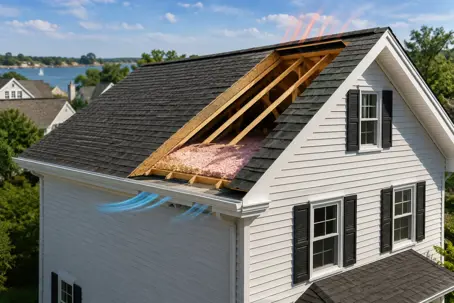
When Rhode Island homeowners evaluate a roof replacement quote, the focus is almost exclusively on the exterior shield: the shingle brand, the color profile, and the wind warranty. But building science dictates that a roof is only as healthy as the air flowing beneath it.
As we progress through 2026, the intersection of modern roofing and energy efficiency has transformed how attics perform. Rhode Island’s adoption of the 2024 International Energy Conservation Code (IECC) has changed how attic insulation is commonly specified. While thick, high-density insulation keeps your living space comfortable, it also changes the thermal physics of your roof deck.
If a contractor installs beautiful new shingles over a poorly ventilated attic, that roof can fail prematurely. This master guide breaks down the relationship between attic insulation, balanced airflow, and long-term asset protection in Providence, Cranston, Warwick, and the surrounding metro areas.
The Building Science of the Thermal Envelope
To understand roof ventilation, you need to understand the thermal envelope. The thermal envelope is the physical boundary that separates the conditioned air inside your home from the unconditioned air outdoors.
In many Rhode Island homes, the thermal boundary is the floor of the attic (the ceiling of your top-floor rooms). The attic itself is intended to behave like unconditioned outdoor space. In other words, the attic temperature should roughly track the outdoor temperature, regardless of season.
The Threat of Attic Heat Stagnation
During a humid Providence summer, the sun transfers heat through the roofing materials and into the attic. If the attic cannot breathe, that heat becomes trapped.
In a stagnant attic, temperatures can exceed 150 F. That heat stagnation creates two major problems:
- Bottom-up shingle baking: Extreme attic heat radiates back through the roof decking and cooks asphalt shingles from the underside. This can accelerate aging, contribute to curling and blistering, and create warranty risk when ventilation is inadequate.
- HVAC overload: Trapped heat presses down against ceiling insulation. Even heavy insulation can eventually allow heat to bleed into upper rooms, forcing air conditioning to run longer and driving up summer energy costs.
The 2024 IECC and the Insulation Sandwich Effect
Rhode Island has adopted the 2024 IECC, a framework designed to reduce residential energy consumption. In our climate zone, attic insulation targets are commonly specified at high R-values.
Achieving those targets often means thick layers of blown-in fiberglass or cellulose across the attic floor. That is great for comfort and efficiency, but it can also create an insulation sandwich effect.
Heavy insulation reduces heat transfer from the living space below, while the sun continues to heat the roof from above. Without sufficient continuous ventilation to flush trapped heat out of the attic, adding insulation can increase roof deck temperatures and accelerate material stress.
How Balanced Ventilation Actually Works
Proper roof ventilation is not achieved by randomly cutting holes in the roof. It requires a balanced system of intake and exhaust that uses the stack effect.
The stack effect is simple: warm air is less dense than cold air, so it naturally rises.
The Intake (Soffit Vents)
The most ignored half of the ventilation system is intake. Fresh outdoor air must be able to enter at the lowest point of the roof assembly. This is typically done through soffit vents at the eaves.
If soffit vents are painted shut, clogged with debris, or blocked from the inside by attic insulation, the entire system chokes. Baffles should be installed between rafters to keep insulation from spilling over the intake path.
The Exhaust (Ridge Vents)
As warm, humid air rises to the peak of the roof, it needs an exit. The most efficient and architecturally clean exhaust method is a continuous ridge vent.
A ridge vent is a low-profile exhaust channel installed along the roof peak and covered by matching cap shingles. As hot air exits, it creates negative pressure that pulls cooler air in through the soffits.
This creates a continuous, passive cycle of airflow that helps flush heat and moisture out of the attic without motors or switches.
The Winter Threat: Condensation and Ice Dams
Ventilation is not just a summer strategy. In Rhode Island, balanced airflow is also a primary defense against winter moisture damage.
In January and February, everyday activities like cooking, showering, laundry, and humidifiers generate moisture vapor. Warm air rises, and that vapor can migrate into the attic.
If the attic is poorly ventilated, warm vapor can hit the cold underside of the roof deck and condense into liquid water.
- Organic growth: Persistent condensation can support mold and mildew on roof sheathing and framing.
- Ice dams: If heat leaks warm the upper roof, snow can melt and refreeze at cold eaves. Ice dams can force water under shingles and into ceilings and walls.
A balanced soffit-to-ridge system helps keep the roof deck colder and more uniform, reducing condensation risk and limiting the thaw-freeze cycle that contributes to ice dams.
Verifying Your System with the Drone Super Scan
When evaluating a home for roof replacement, assessing ventilation geometry should be a mandatory step.
We use Drone Super Scan to capture high-definition imagery of the exterior envelope. This helps us document soffit intake conditions, verify ridge vent potential, and identify older static vents that may need to be removed or rebalanced.
We do not simply nail on new shingles; we engineer a complete thermal management system. If you want a roof replacement quote that includes ventilation planning, start with our Exterior Quote Widget so we can scope a code-aligned system that protects your property value and comfort year-round.
Rhode Island Service Locations:
Ashaway, Barrington, Bradford, Bristol, Carolina, Central Falls, Charlestown, Chepachet, Clayville, Coventry, Cranston, Cumberland, East Greenwich, East Providence, Exeter, Forestdale, Foster, Glendale, Greene, Greenville, Harrisville,Hope,Hope Valley, Hopkinton, Jamestown, Johnston, Kenyon, Kingston, Lincoln, Little Compton, Manville, Mapleville, Middletown, Narragansett, Newport, North Kingstown, North Providence, North Scituate, North Smithfield, Oakland, Pascoag, Pawtucket, Portsmouth, Providence, Riverside, Rockville, Rumford, Saunderstown, Shannock, Scituate, Slatersville, Smithfield, Tiverton, Wakefield, Warren, Warwick, West Greenwich, West Kingston, West Warwick, Westerly, Wood River Junction, Woonsocket, Wyoming
FAQ
How do I know if my roof has enough ventilation?
Common warning signs include hot upper-floor rooms in summer, visible mold or dark staining on attic wood, rusty nails protruding through the roof deck, and a history of severe ice dams at the gutters.
Can I have too much roof ventilation?
You cannot have too much intake, but you can have unbalanced exhaust. If exhaust capacity is higher than intake capacity, the system can pull rain or snow into the attic under certain conditions. The goal is a balanced intake-to-exhaust design.
Are powered attic fans better than continuous ridge vents?
In most modern applications, no. Powered fans use electricity and can fail over time. If a fan runs without enough intake air, it can pull conditioned air out of the home and increase energy costs. Passive ridge vents are often preferred when the system is designed and balanced correctly.
Will a new roof lower my summer air conditioning bills?
If the roof project includes a true upgrade to balanced soffit-to-ridge ventilation, it can reduce attic heat buildup and lower the thermal load on upper rooms. Many homeowners notice improved comfort and potentially lower cooling run time during Rhode Island summers.