
If you live in North Providence or Lincoln, you may have woken up this week to a scary sight: a water stain growing on your second-floor ceiling, even though it has not rained in 48 hours.
Before you panic and call for a tarp, you need to understand the Phantom Leak phenomenon that shows up in Rhode Island during February cold snaps and sudden warm-ups.
In many cases, what looks like a roof leak is actually attic condensation that froze, then melted all at once.
The science of a Rhode Island winter “sweat”
Here is the scenario we see constantly in Northern RI:
1) The freeze
Night temperatures drop into the teens. Your attic roof deck and nails get ice-cold.
2) The heat
You crank the heat up. Warm, moist air from showers, cooking, and everyday living rises. If your attic has air bypasses (like unsealed recessed lights, plumbing chases, attic hatches, or gaps around ductwork), that moisture leaks into the attic.
3) The frost
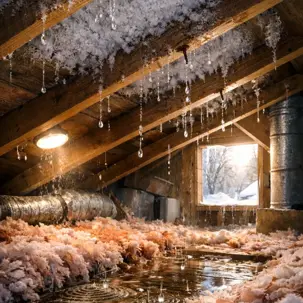
When that warm moisture hits cold nails and plywood, it condenses and freezes instantly. You can literally see frost on nail tips and roof sheathing.
4) The thaw
Then the sun comes out or the temperature jumps into the 40s. The frost melts quickly and drips. It can look and sound like it is raining in your attic.
Is it condensation or a real roof leak?
Both are possible. The key is to look at the pattern.
It is more likely condensation if:
- The staining is near the center of the room (not near an exterior wall)
- You see “rusty nails” or frost on nail tips in the attic
- Moisture appears after a cold night followed by a sunny warm-up
- The water looks clear and not dirty
It is more likely a roof leak if:
- The water is brown or dirty (it may carry roof debris)
- The stain is localized to a known roof detail (chimney, valley, skylight, wall line)
- The problem gets worse during wind-driven rain events
- You can trace a wet path to a specific penetration
The fix is usually not a new roof
If this is a Phantom Leak, the solution is usually ventilation balancing and air sealing, not a full roof replacement.
What “ventilation balancing” means
A healthy attic needs the right balance of intake ventilation (usually soffits) and exhaust ventilation (often ridge vent). If you have too little intake, the attic can pull warm, moist air from the house. If you have blocked soffits, the attic cannot dry out.
Mighty Dog Roofing specializes in calculating the intake vs exhaust ratio and identifying the bypasses that are feeding moisture into the attic.
What we typically do
- Inspect attic ventilation and look for blocked soffits
- Identify common air leaks (recessed lights, attic hatch, chases)
- Document conditions with photos
- Recommend a targeted plan that keeps the attic dry and helps protect insulation from mold
Do not ignore it
Even if it is “just condensation,” repeated wetting can lead to: - Moldy insulation - Wood rot on roof sheathing - Rusted fasteners - Reduced energy efficiency
If you are in North Providence (02904) or Lincoln and you are seeing ceiling stains with no rain, call (401) 425-4108 or use our Contact Us page. We will inspect the attic and roof system, document what is happening, and tell you whether you are dealing with a true leak or a Phantom Leak.
Rhode Island Service Locations:
Ashaway, Barrington, Bradford, Bristol, Carolina, Central Falls, Charlestown, Chepachet, Clayville, Coventry, Cranston, Cumberland, East Greenwich, East Providence, Exeter, Forestdale, Foster, Glendale, Greene, Greenville, Harrisville,Hope,Hope Valley, Hopkinton, Jamestown, Johnston, Kenyon, Kingston, Lincoln, Little Compton, Manville, Mapleville, Middletown, Narragansett, Newport, North Kingstown, North Providence, North Scituate, North Smithfield, Oakland, Pascoag, Pawtucket, Portsmouth, Providence, Riverside, Rockville, Rumford, Saunderstown, Shannock, Scituate, Slatersville, Smithfield, Tiverton, Wakefield, Warren, Warwick, West Greenwich, West Kingston, West Warwick, Westerly, Wood River Junction, Woonsocket, Wyoming
FAQ
Why is my attic wet in winter?
In Rhode Island, a wet attic in winter is often caused by warm indoor air condensing on cold roof nails and sheathing, then freezing and melting during warm-ups. It is not always a roof leak.
How do I stop attic condensation in North Providence?
The most effective approach is to improve attic ventilation and seal air leaks from the living space into the attic. A balanced intake and exhaust system helps the attic dry out.
How can I tell if I need roof repair or ventilation work?
A documented inspection can usually identify the difference. Condensation often shows frost or rusty nails and broader moisture patterns, while roof leaks are typically localized to chimneys, valleys, skylights, or penetrations.