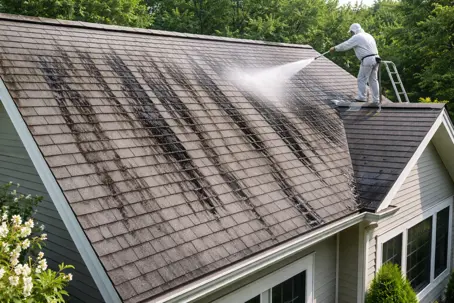
As the snow melts in Smithfield and Johnston, many homeowners look up and notice something new (and ugly): dark, vertical streaks running down the shingles.
Is it dirt? Is it soot? Usually, no.
In many cases, those streaks are caused by a living organism commonly called roof algae. The technical name you may see is Gloeocapsa magma.
The good news: it is usually fixable.
The bad news: the most common DIY “solution” can ruin your roof.
What is causing the black streaks on your roof?
Roof algae is airborne. It travels, lands on shingles, and grows over time.
On many older asphalt shingles, algae feeds on the limestone filler in the shingle. That is why the streaks often look like they are “dripping” down the roof.
Important: algae is mostly a cosmetic issue at first, but it can hold moisture on the roof surface and make shingles look prematurely aged. It also hurts curb appeal fast.
Why it is worse on the north side (the “north slope” effect)
Homeowners in Smithfield often notice the streaks first on:
- North-facing slopes
- Shaded roof sections under trees
- Areas that stay damp longer in the morning
Less sun means dew and moisture linger, and algae loves that.
The do’s and don’ts of removal
DO NOT power wash your roof
We see this every spring.
A homeowner grabs a high-pressure washer. Yes, the streaks come off.
But so do the protective granules on the shingles.
Once you blast granules off, you can:
- Shorten the roof life dramatically
- Void manufacturer warranty coverage
- Create bald spots that age faster in the sun
- Turn a cosmetic issue into a real roofing problem
DO use a professional soft wash
The safe method is typically a low-pressure chemical treatment (often called a soft wash).
The goal is to:
- Kill the algae spores
- Let weather rinse the dead growth over time
- Avoid damaging the shingle surface
This is not the same as pressure washing. It is controlled, low-pressure application with the right mix and runoff protection.
The longer-term fix: algae-resistant shingles and metal-based prevention
If you are replacing your roof this year, you can reduce the chance of streaks coming back.
Option 1: Algae-resistant (AR) shingles
Many modern shingles are available in algae-resistant (AR) versions.
These shingles use copper and/or zinc granules that help slow algae growth. When it rains, trace amounts wash down the roof and create an environment algae does not like.
If you are comparing brands, ask specifically about:
- AR shingle options
- How long the algae resistance is expected to perform in New England conditions
Option 2: Copper or zinc strips at the ridge
Another common prevention method is installing a zinc or copper strip near the ridge.
When it rains, metal ions wash down and help prevent algae and moss growth on the shingles below.
Note: This works best when installed correctly and when the roof has decent runoff paths (not blocked by heavy debris).
When black streaks are a sign you should get a roof check
Call for an inspection if you also notice:
- Granules collecting in gutters
- Curling, cracking, or missing shingles
- Soft spots or sagging areas
- Active leaks or interior staining
Sometimes algae is just algae. Other times it is showing you a roof that is aging faster than you think.
If your Smithfield or Johnston roof has black streaks, do not gamble with a pressure washer.
Mighty Dog Roofing of Rhode Island can inspect the roof, confirm what you are seeing, and recommend the safest fix (cleaning, repairs, or replacement).
Call (401) 425-4108 or visit our Contact Us page.
Rhode Island Service Locations:
Ashaway, Barrington, Bradford, Bristol, Carolina, Central Falls, Charlestown, Chepachet, Clayville, Coventry, Cranston, Cumberland, East Greenwich, East Providence, Exeter, Forestdale, Foster, Glendale, Greene, Greenville, Harrisville,Hope,Hope Valley, Hopkinton, Jamestown, Johnston, Kenyon, Kingston, Lincoln, Little Compton, Manville, Mapleville, Middletown, Narragansett, Newport, North Kingstown, North Providence, North Scituate, North Smithfield, Oakland, Pascoag, Pawtucket, Portsmouth, Providence, Riverside, Rockville, Rumford, Saunderstown, Shannock, Scituate, Slatersville, Smithfield, Tiverton, Wakefield, Warren, Warwick, West Greenwich, West Kingston, West Warwick, Westerly, Wood River Junction, Woonsocket, Wyoming
FAQ
How do I remove black streaks from my roof in Rhode Island?
Do not pressure wash a roof. The safer method is a professional soft wash that kills algae without blasting off shingle granules.
What causes black streaks on asphalt shingles?
Often it is roof algae (commonly Gloeocapsa magma) that grows on shingles, especially on shaded or north-facing slopes.
Do copper strips stop roof moss and algae?
They can help. Zinc or copper strips near the ridge release metal ions during rain that discourage moss and algae growth on the shingles below.
Are algae-resistant shingles worth it in Rhode Island?
If your roof area stays damp (shade, north slope, near trees), AR shingles can be a smart upgrade to reduce streaking and improve curb appeal.