
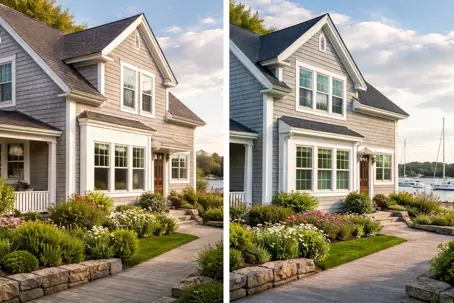
Drive through Bristol or Wickford Village and you will see it everywhere: the classic gray, weathered shingle look. It is the uniform of coastal Rhode Island.
But for many homeowners, the romance of real wood fades the first time they get a quote for staining, painting, or repairs.
In 2026, you have a real choice:
- The historic “real deal” (natural cedar)
- The high-tech alternative (polymer shingle-style siding)
Here is a clear, Rhode Island-specific comparison to help you decide.
The contenders
Option A: Real white cedar shingles (the purist’s choice)
Real cedar is historically accurate, looks incredible up close, and ages naturally.
Why homeowners love it: - Authentic texture and character - Natural aging and a true coastal patina - Often required in strictly regulated historic districts
The tradeoffs: - Can cup and crack over time - Salt air and wind-driven rain accelerate wear near the coast - Typically needs maintenance on a schedule (often every 5 to 7 years depending on exposure)
If you are in a historic district with strict rules, real cedar may be the only acceptable choice. When that is the case, we install high-quality cedar options (including Maibec shingles) and build the wall system correctly so it performs.
Option B: Polymer “Cedar Impressions” (the high-tech alternative)
Modern polymer shingle-style siding is designed to replicate cedar.
It is often molded from real wood, so you get: - Realistic grain texture - Strong shadow lines - A consistent, clean look from the street
The difference is what it is made of: durable polymer designed for long-term exterior exposure.
Why Rhode Island homeowners are switching to polymer
Coastal Rhode Island is tough on exteriors. These are the three biggest reasons we see homeowners choose polymer.
1) The salt air factor
Near the water (Narragansett, Jamestown, Bristol, Newport), salt spray and wind-driven rain punish natural materials.
Polymer does not rot. It does not absorb moisture the way wood does. That means the siding can keep its look longer with far less upkeep.
2) Woodpeckers and pests
This surprises a lot of homeowners until it happens.
Woodpeckers can damage real cedar by drilling for insects or nesting. Once they start, the damage can spread.
Polymer siding is not food and does not host insects the same way wood can, so it is far less attractive to pests.
3) Wind resistance and storm performance
Rhode Island storms are not just about rain. Wind matters.
Many modern polymer systems are rated for high wind speeds (often marketed at 160+ MPH depending on the system and installation).
Translation: when installed correctly, polymer shingle-style siding can be a strong choice for homeowners who want the coastal look but also want storm confidence.
The verdict (simple and honest)
If you live in a strictly regulated historic district, you may need real cedar to meet local guidelines. In that case, plan for maintenance and choose a contractor who understands historic details.
For most other Rhode Island homeowners, polymer Cedar Impressions-style siding delivers the “million-dollar” coastal look with:
- Less maintenance
- Better resistance to rot and salt exposure
- Strong storm performance
What matters more than the material: the wall system behind it
No matter which option you choose, the installation details determine whether the siding performs.
Ask your contractor about: - Proper water-resistive barrier (WRB) - Flashing details at windows, doors, and rooflines - Ventilation and drainage (especially on older homes)
A great-looking exterior that traps moisture is not a win.
If you are considering the classic coastal shingle look for your Rhode Island home, we can help you compare options and choose the right system for your neighborhood, exposure, and maintenance tolerance.
Call (401) 425-4108 or visit our Contact Us page.
Rhode Island Service Locations:
Ashaway, Barrington, Bradford, Bristol, Carolina, Central Falls, Charlestown, Chepachet, Clayville, Coventry, Cranston, Cumberland, East Greenwich, East Providence, Exeter, Forestdale, Foster, Glendale, Greene, Greenville, Harrisville,Hope,Hope Valley, Hopkinton, Jamestown, Johnston, Kenyon, Kingston, Lincoln, Little Compton, Manville, Mapleville, Middletown, Narragansett, Newport, North Kingstown, North Providence, North Scituate, North Smithfield, Oakland, Pascoag, Pawtucket, Portsmouth, Providence, Riverside, Rockville, Rumford, Saunderstown, Shannock, Scituate, Slatersville, Smithfield, Tiverton, Wakefield, Warren, Warwick, West Greenwich, West Kingston, West Warwick, Westerly, Wood River Junction, Woonsocket, Wyoming
FAQ
Does vinyl siding look like real wood?
Some vinyl products look better than others, but modern polymer shingle-style siding (often called Cedar Impressions) is molded from real wood textures and can look very close to real cedar from the street.
Is polymer siding better than wood for coastal Rhode Island homes?
For durability and low maintenance, polymer is often a better fit near the coast because it resists rot and salt exposure and can offer strong wind ratings when installed correctly.
Do I need real cedar in a Rhode Island historic district?
Some historic districts require wood or specific profiles. Always confirm local guidelines before choosing materials.