
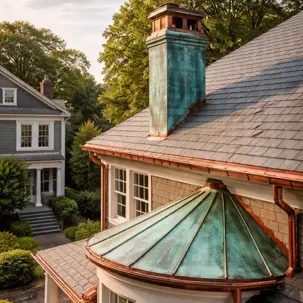
In the historic neighborhoods of Woonsocket’s North End and North Smithfield, you see it on the most distinguished homes: that distinct, sea-green patina of aged copper. You will also see it across Northern and Central Rhode Island historic districts (including Providence’s East Side and College Hill) and in high-end coastal markets like Newport, Jamestown, Barrington, East Greenwich, Bristol, and Narragansett.
Copper is not just an aesthetic choice for the wealthy. It is one of the most practical long-life engineering solutions for Rhode Island weather, especially on the roof details that fail first: chimneys, valleys, and gutters.
The “Solder” Difference
Standard aluminum flashing often relies on caulk to seal corners and transitions. In Rhode Island’s freeze-thaw cycle, caulk can dry out, crack, and fail over time, sometimes within 5-7 years depending on exposure and installation.
Copper is different because it can be soldered.
When we install copper details like a copper chimney cricket or valley, we fuse the joints with lead-tin solder. That creates a continuous seam and removes one of the most common weak points in many flashing systems: caulked corners. Workmanship still matters, but properly soldered copper is built for long-term performance.
Longevity: The 100-Year Clock
While an asphalt roof might last around 25 years (sometimes more, sometimes less), a copper detail can last 80 to 100 years. That means you can often carry copper components through multiple roof replacements instead of rebuilding the same vulnerable areas again and again.
For historic homeowners, this is a big deal. You are not just buying a roof detail. You are buying fewer future leak points, fewer repairs, and fewer disruptions.
The Patina Protection
As copper oxidizes, it changes from bright bronze to brown, and eventually to green. That “tarnish” is not a defect. It is a natural protective layer that forms over time and helps shield the metal from corrosion, including salt air and acid rain. In other words, copper does not just survive with age. It protects itself.
Common Upgrades for 2026 Renovations (No Full Copper Roof Needed)
You do not need a full copper roof to get the benefits. Most homeowners choose strategic upgrades where copper delivers the biggest ROI, especially in older neighborhoods and coastal areas.
- Chimney flashings (the #1 leak source)
- Standing seam accents (bay windows and porticos)
- Copper gutters
Where Copper Shows Up Most in Rhode Island
We most often install copper details on historic and high-value homes in: - Northern RI: Woonsocket, North Smithfield, Cumberland, Lincoln - Providence area: Providence East Side (College Hill, Fox Point), North Providence, Cranston - Coastal and high-income towns: Newport, Jamestown, Barrington, East Greenwich, Narragansett, Bristol
Common ZIPs we see for these upgrades include 02895, 02896, 02906, 02840, and 02806.
Rhode Island Service Locations:
Ashaway, Barrington, Bradford, Bristol, Carolina, Central Falls, Charlestown, Chepachet, Clayville, Coventry, Cranston, Cumberland, East Greenwich, East Providence, Exeter, Forestdale, Foster, Glendale, Greene, Greenville, Harrisville,Hope,Hope Valley, Hopkinton, Jamestown, Johnston, Kenyon, Kingston, Lincoln, Little Compton, Manville, Mapleville, Middletown, Narragansett, Newport, North Kingstown, North Providence, North Scituate, North Smithfield, Oakland, Pascoag, Pawtucket, Portsmouth, Providence, Riverside, Rockville, Rumford, Saunderstown, Shannock, Scituate, Slatersville, Smithfield, Tiverton, Wakefield, Warren, Warwick, West Greenwich, West Kingston, West Warwick, Westerly, Wood River Junction, Woonsocket, Wyoming
If you own a historic or coastal home in Rhode Island and want a long-life solution for chimney leaks or chronic flashing issues, call (401) 425-4108 to schedule an inspection.
FAQ
Is copper flashing better than aluminum?
Yes. Copper joints can be soldered for a long-life seal, while aluminum systems often rely on caulk at corners and transitions that can crack over time. Copper also typically lasts much longer.
Why does copper turn green?
The green color is called patina. It is a natural protective layer of copper carbonate that forms over time and helps shield the metal from corrosion.
How long does copper flashing last?
In many real-world installations, copper flashing can last 80 to 100 years when installed correctly and maintained, which is often longer than the roof covering itself.
Is copper worth it if I do not have a copper roof?
Often, yes. Many homeowners choose copper only at the highest-risk leak areas (chimneys, valleys, and porticos) to get the durability benefits without the cost of a full copper roof.