
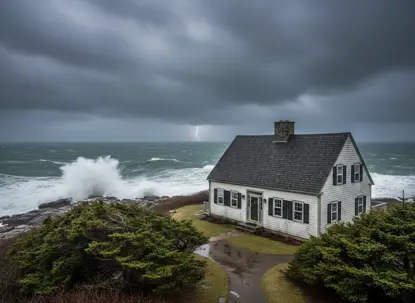
Living on Aquidneck Island comes with incredible views, but it also means your home is on the front lines of Atlantic weather. For homeowners in Newport and Middletown, wind is a constant threat, not just during hurricane season.
A typical Nor’easter can bring strong gusts and wind-driven rain that find the weak points in a roof fast. If shingles are already slightly lifted, if flashing is loose, or if roof edges are underbuilt, a storm can turn a small issue into a major leak.
Here is the homeowner guide to building and preparing a roof for real coastal conditions.
Why Nor’easters damage roofs (even at “non-hurricane” wind speeds)
Wind does not need to be extreme to cause problems. The most common failure starts at the perimeter: - Wind gets under the first row of shingles or the rake edge - Shingles lift and lose their seal - Wind-driven rain follows the lifted edge into the roof system
Salt air adds another layer of risk by accelerating corrosion on fasteners, flashing, and edges.
The 401 coastal approach: go beyond the minimum
Rhode Island building requirements can vary by site conditions, but coastal homes should be built for reality, not just the minimum.
1) The six-nail standard for asphalt shingles
On high-wind coastal roofs, we commonly use a six-nail pattern (instead of four) when the shingle manufacturer specifications allow it.
We also prefer shingles with a reinforced nailing zone (for example, GAF Timberline HDZ with LayerLock). The goal is simple: reduce blow-offs by locking the shingle down where uplift forces are highest.
Important: Wind warranty terms depend on the exact product, accessories, and installation requirements.
2) Metal roofing: the ultimate shield
For maximum wind resistance, standing seam metal is hard to beat.
Why it performs well on Aquidneck Island: - Interlocking panels resist uplift - Concealed clip fastening systems reduce exposed fastener points - Excellent durability in salt-air environments
It is also a strong long-term choice for homeowners who want fewer storm-related repairs.
3) Roof edge upgrades (the most vulnerable zone)
The perimeter is where wind gets a foothold.
We upgrade roof edges with heavy-gauge drip edge and secure fastening patterns so wind has a harder time getting underneath the first course of shingles.
This is one of the most overlooked details in coastal roofing.
The Mighty Drone pre-storm check
Do not wait for shingles to end up in your yard.
Our Drone Super Scan can identify: - Lifted or missing shingles - Loose flashing at chimneys and walls - Vulnerable roof edges
That lets you make proactive repairs before the next gale warning.
Next step: get your roof checked before the next storm
If you live in Newport or Middletown and you want a clear plan before the next Nor’easter, start with a professional inspection.
Call/text (401) 425-4108.
FAQ
What is the best roof for high winds in Newport, RI?
Standing seam metal is one of the best options for high-wind coastal areas. If you choose asphalt shingles, pick a wind-rated shingle with a reinforced nailing zone and ensure it is installed to manufacturer specifications (often including a six-nail pattern in high-wind applications).
Will homeowners insurance cover wind damage to my roof?
Many policies cover wind damage, but coverage and deductibles vary, especially in coastal zones. A professional inspection and documentation before a storm can help establish roof condition and support a claim if damage occurs.
Rhode Island Service Locations:
Ashaway, Barrington, Bradford, Bristol, Carolina, Central Falls, Charlestown, Chepachet, Clayville, Coventry, Cranston, Cumberland, East Greenwich, East Providence, Exeter, Forestdale, Foster, Glendale, Greene, Greenville, Harrisville,Hope,Hope Valley, Hopkinton, Jamestown, Johnston, Kenyon, Kingston, Lincoln, Little Compton, Manville, Mapleville, Middletown, Narragansett, Newport, North Kingstown, North Providence, North Scituate, North Smithfield, Oakland, Pascoag, Pawtucket, Portsmouth, Providence, Riverside, Rockville, Rumford, Saunderstown, Shannock, Scituate, Slatersville, Smithfield, Tiverton, Wakefield, Warren, Warwick, West Greenwich, West Kingston, West Warwick, Westerly, Wood River Junction, Woonsocket, Wyoming