
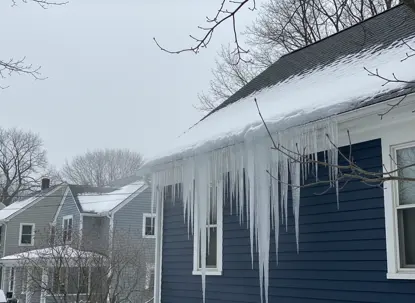
Following the snow squalls and bitter cold that hit Rhode Island earlier this month, homeowners in Warwick and Cranston are dealing with a familiar winter problem: ice dams.
When temperatures drop into the low 20s overnight and then thaw during the afternoon, the freeze-thaw cycle goes to work on your roof system. The result can be lifted shingles, wet insulation, and water stains on drywall - even if your roof looked fine last week.
This guide explains why ice dams form in Warwick and Cranston, what you can do immediately to reduce damage, and when it is time to call for a professional inspection.
What is an ice dam (and why it causes leaks)
An ice dam forms when snow on the upper roof melts, then refreezes at the colder eaves.
Here is the chain reaction:
- Heat escapes from the attic and warms the roof deck
- Snow melts higher up the roof
- Meltwater runs down toward the eaves
- The eaves stay cold, so the water refreezes
- Ice builds up and blocks proper drainage
- Water backs up under shingles and finds a path into the home
Important: A roof can be installed correctly and still be vulnerable if attic insulation, air sealing, and ventilation are not working together.
The local challenge: why Warwick and Cranston see this so often
Many homes in areas like Gaspee (Warwick) and Garden City (Cranston) have classic New England architecture with complex rooflines.
Those rooflines often include: - Valleys that collect snow and concentrate runoff - Multiple transitions where roofs meet walls - Dormers and chimneys that interrupt airflow
These details are beautiful, but they create prime locations for ice accumulation and water backup.
Warning signs your roof is at risk right now
Look for these common indicators: - Large icicles forming in specific spots (not evenly across the whole house) - Ice buildup along the eaves or in gutters - Water stains on ceilings or around exterior walls - Damp attic insulation or a musty attic smell - Granules in gutters (shingles wearing faster)
If you see ceiling stains, treat it as active risk - the next thaw can make it worse.
3 steps for immediate protection (homeowner-safe)
These are practical steps that can reduce damage while you schedule an inspection.
1) Monitor your gutters and icicles
If you see massive icicles only in certain areas, it often points to localized heat loss above that section of roof.
2) Clear the eaves (safely)
Use a roof rake from the ground to remove the bottom 3-4 feet of snow from the roof edge. This helps reduce meltwater backup.
Do not climb onto the roof. Do not chip ice with tools.
3) Check the attic basics
A cold attic is one of the best defenses against ice dams.
As a general target, many homes aim for attic insulation in the R-49 to R-60 range. But insulation alone is not enough - air sealing and ventilation matter just as much.
If you have warm spots in the attic, bathroom fan exhaust dumping into the attic, or blocked soffits, ice dams become much more likely.
What NOT to do (common mistakes that cause expensive damage)
- Do not use hammers, chisels, or sharp tools on ice
- Avoid salt pucks or rock salt on shingles (it can damage roofing materials and accelerate corrosion)
- Do not ignore small stains - winter leaks often spread behind drywall
The safest way to remove an ice dam
Professional steam removal is typically the safest method because it removes ice without tearing up shingles.
If you are seeing active leaking, it is also smart to get an inspection to confirm: - Where water is entering - Whether flashing is compromised - Whether the roof deck has softened
How Mighty Dog Roofing helps (Warwick + Cranston)
If you have water spots on your ceiling or signs of ice damming, do not wait for the next storm.
Our team can prioritize: - Emergency inspections - Temporary protection (tarping where appropriate) - Thermal drone scans to identify heat loss patterns and likely problem areas
Thermal scans help us see temperature differences that point to: - Missing insulation - Air leaks - Wet insulation - Heat escaping at valleys, dormers, and roof-to-wall transitions
Call/text (401) 425-4108 to schedule.
FAQ
How do I get rid of ice dams in Warwick?
The safest approach is professional steam removal. Avoid using hammers or salt pucks, which can permanently damage shingles and flashing. In the short term, you can rake snow off the eaves from the ground to reduce backup.
Who provides emergency roof repair in Cranston, RI?
Mighty Dog Roofing of Rhode Island provides emergency inspections and temporary protection for Cranston homeowners dealing with winter storm damage. Call/text (401) 425-4108.
How do I know if an ice dam is causing my leak?
Common signs include ceiling stains near exterior walls, dripping during afternoon thaws, heavy icicles in one area, and damp attic insulation. A professional inspection can confirm the entry point and whether the issue is roof damage, ventilation, or insulation-related.
If you are in Warwick or Cranston and you have ceiling stains, big icicles, or attic moisture after the January freeze, do not wait.
Mighty Dog Roofing of Rhode Island can help you stop the leak, document the problem, and identify the root cause so it does not keep happening every winter.
Call/text (401) 425-4108 to book an inspection.
Rhode Island Service Locations:
Ashaway, Barrington, Bradford, Bristol, Carolina, Central Falls, Charlestown, Chepachet, Clayville, Coventry, Cranston, Cumberland, East Greenwich, East Providence, Exeter, Forestdale, Foster, Glendale, Greene, Greenville, Harrisville,Hope,Hope Valley, Hopkinton, Jamestown, Johnston, Kenyon, Kingston, Lincoln, Little Compton, Manville, Mapleville, Middletown, Narragansett, Newport, North Kingstown, North Providence, North Scituate, North Smithfield, Oakland, Pascoag, Pawtucket, Portsmouth, Providence, Riverside, Rockville, Rumford, Saunderstown, Shannock, Scituate, Slatersville, Smithfield, Tiverton, Wakefield, Warren, Warwick, West Greenwich, West Kingston, West Warwick, Westerly, Wood River Junction, Woonsocket, Wyoming