
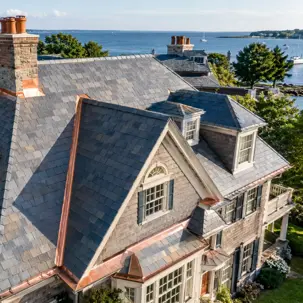
Why Slate Roofs Define Rhode Island Architecture
Rhode Island’s architectural legacy is preserved across historic coastal estates and city districts. From Benefit Street in Providence to Bellevue Avenue in Newport, natural slate roofs have delivered distinctive texture, deep shadow lines, and unfading elegance for over a century.
But as these structures age, maintaining an authentic quarried slate roof can present major financial and structural challenges. Understanding the building science, weight limitations, and material advancements between natural slate and engineered synthetic composite slate helps property owners choose the right system for long-term performance.
The Realities of Natural Quarried Slate
Natural slate is a metamorphic stone roofing product that can last 75 to 100+ years when properly installed. That performance comes with practical constraints.
Extensive Structural Weight
Natural slate commonly weighs roughly 800 to 1,500 pounds per square (100 sq. ft.). Older roof framing can sag or fail under that load, and some projects require structural engineering review and reinforcement before re-roofing.
Brittleness and Freeze-Thaw Stress
Slate is durable, but individual pieces can crack from impact or movement. In southern New England, repeated freeze-thaw cycles can accelerate failures when water works into joints, fastener penetrations, or damaged slates.
Specialized Sourcing and Repairs
Matching slates from older or discontinued quarries can be difficult. Even small repairs can become expensive when color, thickness, and texture must be matched to preserve historic appearance.
The Engineering of Class 4 Synthetic Composite Slate
Engineered synthetic slate systems are designed to replicate the hand-split texture, chiseled edges, and natural color blends of quarry slate while reducing weight and improving impact resistance.
Lightweight Structural Integration
Synthetic composite slate commonly weighs about 200 to 300 pounds per square, closer to heavy architectural asphalt shingles than stone. In many cases, it can be installed over a properly prepared 1/2-inch CDX plywood deck without major structural reinforcement.
Impact and Weather Resistance
Many premium synthetic slate products carry a Class 4 impact resistance rating (UL 2218). When installed to manufacturer specifications, systems may also carry high wind ratings, which is important for exposed coastal and elevated sites.
Fire Rating and Low Water Absorption
Many synthetic slate systems are non-porous and can reduce freeze-thaw related cracking concerns. Fire ratings vary by product and assembly; many premium systems are Class A rated when installed as specified.
Natural Slate vs Synthetic Composite Slate (Quick Comparison)
Feature | Natural Slate | Synthetic Composite Slate |
|---|---|---|
Weight per square | 800 to 1,500 lbs | 200 to 300 lbs |
Structural reinforcement | Often evaluated and may be required | Less commonly required |
Impact resistance | Can be brittle | Often Class 4 (UL 2218) |
Freeze-thaw risk | Depends on slate quality and detailing | Reduced when non-porous |
Copper flashing | Mandatory for long-life detailing | Strongly recommended |
Flashing Details Matter: Custom Copper Integration
Whether installing natural or synthetic slate, the weakest link in steep-slope roofing is often the flashing detail, not the tile itself.
Mighty Dog Roofing of Rhode Island pairs slate-style systems with long-life copper details such as:
- 16-ounce copper step flashing (custom-fit)
- Lead-coated copper valleys (where specified)
- Custom chimney crickets to divert water and debris
We verify pitch angles and key waterproofing details using our non-invasive Drone Super Scan documentation before and after installation.
Rhode Island Service Locations:
Ashaway, Barrington, Bradford, Bristol, Carolina, Central Falls, Charlestown, Chepachet, Clayville, Coventry, Cranston, Cumberland, East Greenwich, East Providence, Exeter, Forestdale, Foster, Glendale, Greene, Greenville, Harrisville,Hope,Hope Valley, Hopkinton, Jamestown, Johnston, Kenyon, Kingston, Lincoln, Little Compton, Manville, Mapleville, Middletown, Narragansett, Newport, North Kingstown, North Providence, North Scituate, North Smithfield, Oakland, Pascoag, Pawtucket, Portsmouth, Providence, Riverside, Rockville, Rumford, Saunderstown, Shannock, Scituate, Slatersville, Smithfield, Tiverton, Wakefield, Warren, Warwick, West Greenwich, West Kingston, West Warwick, Westerly, Wood River Junction, Woonsocket, Wyoming
FAQ
Does synthetic slate look realistic on historic Rhode Island homes?
Yes. Many top-tier synthetic slate tiles are molded from real slate textures and manufactured with multi-tone blends and varied exposures. The goal is a curb-appeal match that respects historic character.
Do you need to reinforce roof rafters when installing synthetic slate?
In many cases, no. Because synthetic slate is significantly lighter than natural stone, standard framing that supports architectural shingles can often support a synthetic slate system. A site-specific evaluation is still recommended.
How does synthetic slate perform during Rhode Island winter storms?
Synthetic slate can perform very well in winter conditions. Non-porous materials reduce water absorption concerns, and many premium products are Class 4 impact rated and carry strong wind ratings when installed to spec.