
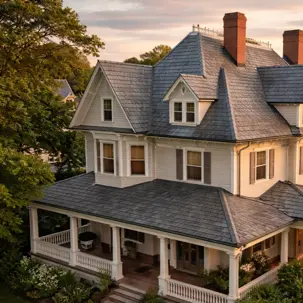
Owning a piece of history in Rhode Island is a privilege. Whether you live in a Victorian on Providence’s East Side, a historic colonial in Warwick, or a gilded-age estate in Newport, your home is a testament to classic New England architecture.
But that privilege comes with a heavy burden, especially when you look up and realize your 100-year-old original slate roof is failing.
Replacing a roof in a designated local Historic District is not a standard home improvement project. It is a regulated approval process. You cannot simply swap materials without review. In many cases, unapproved work can trigger enforcement action, delays, and costly rework.
In 2026, Rhode Island homeowners face a difficult choice: the cost and structural demands of installing real quarried slate versus the strict aesthetic expectations of local preservation boards.
Fortunately, there is a modern solution that helps bridge the gap between historic preservation and modern engineering: premium synthetic slate.
This guide explains how to navigate a historic roof replacement in Rhode Island and why products like Brava Roof Tile can help homeowners preserve architectural character without the structural burden of natural stone.
Part 1: The real slate dilemma
If your historic home currently has a slate roof, many Historic District Commissions prefer replacement materials that preserve the original appearance of the home. That often leads homeowners toward real slate, but real slate presents three major challenges.
1. The weight problem
Natural quarried slate is heavy. A standard architectural asphalt shingle roof may weigh roughly 250 to 300 pounds per square, while a natural slate roof can weigh far more.
On an older home, that difference matters. Over time, framing can settle, and past water intrusion may have weakened rafters or decking. Installing a new stone roof may require structural review and, in some cases, reinforcement.
2. The cost of scarcity
Natural slate is one of the most expensive roofing materials on the market. Material sourcing, transportation, specialized installation, and repair labor all increase total project cost.
3. The maintenance reality
Real slate can last a long time, but individual tiles can crack from impact, foot traffic, or storm damage. Once water gets beneath damaged slate, Rhode Island’s freeze-thaw cycles can accelerate surrounding deterioration.
Part 2: The bureaucracy of the HDC
Before a single piece of roofing is removed, many historic district properties require a Certificate of Appropriateness from the local Historic District Commission.
Each Rhode Island municipality has its own review standards, but the shared goal is preserving the visual character of the streetscape.
In general, HDCs focus on:
- Thickness and shadow lines
- Texture and surface realism
- Color variation appropriate to the home’s era
- Material compatibility with surrounding historic structures
If an application proposes a flat, low-profile material that changes the home’s visual character, approval may be difficult.
Part 3: The synthetic slate solution
This is where Brava Synthetic Slate changes the conversation for historic homeowners.
As a Brava Authorized Contractor, Mighty Dog Roofing of Rhode Island installs this advanced composite material because it is engineered to deliver a historically appropriate appearance with modern structural practicality.
Unmatched architectural authenticity
Brava synthetic slate is designed to replicate the texture, clefting, and variation associated with natural slate. The goal is a roof that reads correctly from the street, where historic commissions do most of their visual evaluation.
The profile that matters
One reason standard asphalt shingles often struggle in historic review is visual depth. Historic slate has thickness and shadow. Premium synthetic slate products are designed with a deeper profile to better recreate that dimensional look.
The structural advantage
This is one of the biggest benefits for historic homes. While natural slate can place major load demands on aging framing, synthetic slate is dramatically lighter.
That lower weight can reduce the likelihood of major structural reinforcement, helping preserve the home’s framing while also reducing project complexity and cost.
Part 4: Modern performance in a historic package
Historic commissions care about appearance. Homeowners also need performance.
Historic homes are often more vulnerable to wind-driven rain, ice, and moisture intrusion. A modern synthetic slate system can provide strong protection while maintaining a historically compatible look.
Potential performance benefits include:
- High wind resistance when installed to manufacturer specifications
- Strong impact resistance compared with brittle natural materials
- Low moisture absorption compared with natural stone
- Long-term color and appearance stability
Specific ratings and performance claims should always be matched to the exact product, installation method, and manufacturer documentation used on the project.
Part 5: How to improve your chances of approval
You should not walk into a historic review process with a generic quote and hope for the best.
At Mighty Dog Roofing of Rhode Island, the approval process starts with documentation and presentation.
The Drone Super Scan
We begin with a non-invasive drone inspection to document the current condition of the roof. This helps show areas of deterioration and supports the case for replacement.
Physical samples and cut sheets
Historic commissions want more than marketing language. Physical samples and manufacturer cut sheets help reviewers evaluate thickness, texture, and color.
Custom color matching
We help homeowners select a color blend that fits the architectural precedent of the house and the surrounding neighborhood.
Application support
A strong application should clearly explain the proposed material, visual compatibility, and installation details that matter in historic settings.
Do not let your roof compromise your history
Your historic home deserves modern protection without losing the architectural character that makes it special.
If your slate roof is slipping, leaking, or failing, contact Mighty Dog Roofing of Rhode Island today. Schedule your free Drone Super Scan and build a preservation plan that protects your home and supports the approval process—plus, ask about our flexible financing options to make your project more manageable.
Rhode Island Service Locations:
Ashaway, Barrington, Bradford, Bristol, Carolina, Central Falls, Charlestown, Chepachet, Clayville, Coventry, Cranston, Cumberland, East Greenwich, East Providence, Exeter, Forestdale, Foster, Glendale, Greene, Greenville, Harrisville,Hope,Hope Valley, Hopkinton, Jamestown, Johnston, Kenyon, Kingston, Lincoln, Little Compton, Manville, Mapleville, Middletown, Narragansett, Newport, North Kingstown, North Providence, North Scituate, North Smithfield, Oakland, Pascoag, Pawtucket, Portsmouth, Providence, Riverside, Rockville, Rumford, Saunderstown, Shannock, Scituate, Slatersville, Smithfield, Tiverton, Wakefield, Warren, Warwick, West Greenwich, West Kingston, West Warwick, Westerly, Wood River Junction, Woonsocket, Wyoming
FAQ
Will the Providence Historic District Commission approve synthetic slate?
Approvals are made case by case. Premium synthetic slate with realistic thickness, texture, and color variation may have a stronger chance of approval because it better preserves the historic streetscape.
Is synthetic slate lighter than real slate?
Yes. Synthetic slate is significantly lighter than natural slate, which can reduce structural concerns on older homes.
How much does a synthetic slate roof cost compared to real slate?
Synthetic slate is still a premium roofing product, but total project cost can be lower than real slate because it may reduce structural reinforcement needs and specialized installation demands.
Can you put synthetic slate over an old roof?
In most cases, a full tear-off is the better approach, especially on historic homes. It allows inspection of the decking, correction of hidden damage, and installation of modern underlayment and ventilation details.