
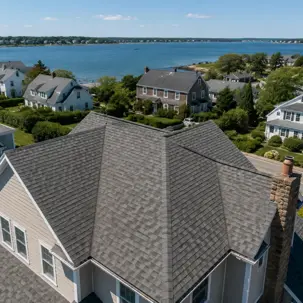
From the historic harbor streets of Wickford Village to the waterfront properties of Saunderstown and Davisville, living in North Kingstown offers incredible access to Narragansett Bay. However, that proximity to open water makes North Kingstown one of the most demanding roofing environments in southern New England.
Depending on wind direction and upwind open-water distance, many shoreline properties around Narragansett Bay can qualify for Exposure Category D under ASCE 7 wind exposure rules adopted by the Rhode Island State Building Code (RISBC). When coastal nor’easters and tropical systems sweep up the bay, wind uplift pressure concentrates at eaves, rakes, corners, and gable end zones with immense force.
In 2026, replacing a roof in North Kingstown requires strict adherence to the high-wind provisions of the Rhode Island State Building Code.
The Problem With Smooth-Shank Nails in Coastal Gusts
In standard inland installations, contractors often use smooth-shank roofing nails. While smooth nails may meet baseline requirements in lower-exposure areas, coastal wind uplift can cause wood roof decks to flex and cycle under repeated gusts.
Over time, seasonal moisture swings and thermal movement can reduce holding power in smooth-shank fasteners. Once a fastener loses its grip, a 60 to 80 MPH gust can begin lifting shingle edges and starter lines. That is how minor perimeter movement can turn into missing shingles and water intrusion during the next major storm.
The High-Wind Standard: RISBC Coastal Fastening Provisions (Appendix AA Where Applicable)
For many North Kingstown homes in higher coastal wind speed areas, the RISBC requires stricter fastening and edge-zone discipline. Depending on the home, roof geometry, and exposure, this may include:
- 8d ring-shank fasteners for roof sheathing attachment or re-nailing (when required): Ring-shank nails have annular ridges that bite into wood fibers, improving withdrawal resistance compared to smooth-shank nails.
- Perimeter edge-zone fastening discipline: Uplift pressures are highest near eaves, rakes, corners, and gable end zones. Coastal provisions often require tighter fastener spacing in these perimeter zones.
- Enhanced starter courses and perimeter sealing: Manufacturer-approved starter strips and adhesive patterns help lock down the first course at the roof edges before the main shingle field is installed.
Verification Through Aerial Diagnostics
You cannot visually confirm deck fastening patterns or edge-zone details once underlayment is installed. That is why Mighty Dog Roofing of Rhode Island uses Drone Super Scan during inspection and (when applicable) tear-off to document deck condition, perimeter details, and installation readiness before the new system goes on.
Protect your North Kingstown home with a roof built specifically for Narragansett Bay coastal exposure.
Rhode Island Service Locations:
Ashaway, Barrington, Bradford, Bristol, Carolina, Central Falls, Charlestown, Chepachet, Clayville, Coventry, Cranston, Cumberland, East Greenwich, East Providence, Exeter, Forestdale, Foster, Glendale, Greene, Greenville, Harrisville,Hope,Hope Valley, Hopkinton, Jamestown, Johnston, Kenyon, Kingston, Lincoln, Little Compton, Manville, Mapleville, Middletown, Narragansett, Newport, North Kingstown, North Providence, North Scituate, North Smithfield, Oakland, Pascoag, Pawtucket, Portsmouth, Providence, Riverside, Rockville, Rumford, Saunderstown, Shannock, Scituate, Slatersville, Smithfield, Tiverton, Wakefield, Warren, Warwick, West Greenwich, West Kingston, West Warwick, Westerly, Wood River Junction, Woonsocket, Wyoming
FAQ
What wind speed zone is North Kingstown, RI in?
North Kingstown includes higher coastal wind speed areas on the RISBC wind maps. The exact design wind speed depends on the specific address, roof height, and exposure to Narragansett Bay.
Why are ring-shank nails used for coastal roofs in Rhode Island?
Ring-shank nails feature small ridges along the nail shaft that lock into the wood grain of the roof deck. This improves withdrawal resistance against the wind-uplift pressures created by open-water exposure near Narragansett Bay.
What is the difference between Exposure Category C and D in coastal roofing?
Exposure Category C applies to open terrain with scattered obstructions. Exposure Category D applies where wind travels over large, unobstructed water surfaces upwind (common along shorelines), which increases design wind pressures on the roof system.