
When the humidity spikes in North Providence, Warwick, and Cranston during a typical July, most homeowners worry about their AC bill. But while you are cooling the living room, your roof is likely reaching temperatures upwards of 150F.
In 2026, we are moving beyond the myth that the sun just fades shingles. Under the current Rhode Island State Building Code (SBC-2) and tighter energy expectations, summer roof damage is often a failure of the entire thermal management system.
Thermal Shock: The Silent Shingle Killer
Rhode Island weather is defined by volatility. On a humid summer afternoon, shingles expand. When a sudden coastal thunderstorm rolls in and drops the temperature quickly, the roof can experience rapid contraction. That repeated expansion and contraction is what contractors often mean when they talk about thermal shock.
- The result: Lower-grade shingles can become brittle and develop micro-cracks over time.
- The defense: We install performance-focused shingles like the TruDefinition Duration(R) series. As an Owens Corning Platinum Preferred Contractor, we recommend systems designed with advanced granules and a reinforced nailing zone to handle real-world cycling better than builder-grade materials.
The Oven Effect and the 2024 IECC Standards
The biggest threat to your roof is not always the sun. It is often the attic.
If your roof lacks balanced intake and exhaust ventilation, heat can build up and stay trapped. Under modern energy expectations, Rhode Island homes commonly target higher attic insulation levels, including R-60 in many applications. That is great for comfort, but it also means the roof deck can be sandwiched between solar heat above and trapped heat below.
- The danger: Without proper ventilation, shingles can be baked from the underside, which can accelerate curling and granule loss.
Precision Detection: The Drone Super Scan
How do you know if ventilation is failing before shingles start to curl? We do not guess. We document.
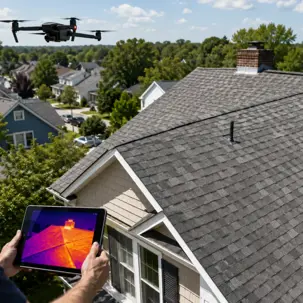
Our proprietary Drone Super Scan provides:
- Thermal mapping: Identifies hot spots where heat is stagnating, often linked to ventilation imbalance or blockage.
- Granule loss analysis: High-definition imagery can reveal early wear patterns and bald spots.
- Visual proof: A documented health report so you can see the why behind the recommendation.
The Moisture Connection: Servpro Providence Partnership
Extreme summer heat combined with Rhode Island humidity can create conditions for moisture problems in the attic. When heat is trapped, condensation risk increases, especially when ventilation is not doing its job.
If our Drone Super Scan detects moisture issues or signs of organic growth, our partnership with Servpro of Providence helps ensure the attic is dried and remediated properly while we secure the building envelope.
Choosing for Thermal Balance: Sierra Gray
If you are replacing your roof in 2026, color is not just style. It can influence thermal behavior.
We often recommend Sierra Gray because it provides a mid-tone look that fits Rhode Island architecture while offering a practical balance of reflectance and curb appeal.
Rhode Island Service Locations:
Ashaway, Barrington, Bradford, Bristol, Carolina, Central Falls, Charlestown, Chepachet, Clayville, Coventry, Cranston, Cumberland, East Greenwich, East Providence, Exeter, Forestdale, Foster, Glendale, Greene, Greenville, Harrisville,Hope,Hope Valley, Hopkinton, Jamestown, Johnston, Kenyon, Kingston, Lincoln, Little Compton, Manville, Mapleville, Middletown, Narragansett, Newport, North Kingstown, North Providence, North Scituate, North Smithfield, Oakland, Pascoag, Pawtucket, Portsmouth, Providence, Riverside, Rockville, Rumford, Saunderstown, Shannock, Scituate, Slatersville, Smithfield, Tiverton, Wakefield, Warren, Warwick, West Greenwich, West Kingston, West Warwick, Westerly, Wood River Junction, Woonsocket, Wyoming
FAQ
Does a hot attic damage shingles in RI?
Yes. Trapped heat can bake shingles from underneath, leading to premature aging, curling, and brittleness. Balanced ventilation is one of the most important factors for roof longevity.
What is the best roof color for summer heat in Rhode Island?
Lighter colors reflect more heat, but mid-tones like Sierra Gray are popular because they balance New England aesthetics with strong thermal performance.
Can I see roof heat damage with a drone?
Yes. Thermal imaging can reveal heat signatures and ventilation hot spots that are not visible from the ground.