
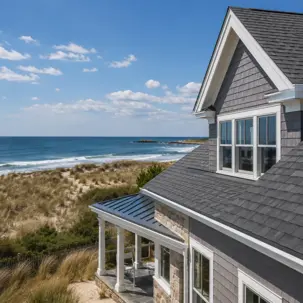
Living on the South County coast comes with incredible views and an unmatched summer lifestyle. But for a home exterior envelope, it is one of the most hostile environments in New England.
From historic estates in Watch Hill to exposed beachfront properties in Misquamicut and neighborhoods throughout downtown Westerly, local roofs take year-round punishment from wind, salt spray, and coastal nor’easters.
In 2026, protecting your property value in Westerly requires more than a baseline roof replacement. It requires a disciplined, engineered approach to fastening, edge details, and corrosion-resistant materials.
The Westerly wind reality: fastening discipline matters
Under the Rhode Island State Building Code, coastal areas like Westerly fall under stricter wind design considerations because of exposure to open water. When storms push off the Atlantic, wind uplift pressures can be extreme.
A shingle roof is only as strong as its fastening pattern and perimeter details.
The six-nail rule
In some inland applications, a four-nail pattern may meet minimum requirements. In coastal conditions, many manufacturer high-wind instructions call for a six-nail pattern, installed precisely in the engineered nail line.
Fastener placement is not optional
- Nails driven too high can miss the reinforced bond zone.
- Nails driven too deep can damage the shingle mat and reduce pull-through resistance.
The goal is consistent placement and depth so the roof performs as a system, not as a collection of individual shingles.
Enhanced starter courses and edge metal
The eaves and rakes see some of the highest uplift forces on the roof. A dedicated starter course paired with properly fastened drip edge and clean sealing at the perimeter is a core part of coastal performance.
Combating salt air corrosion
Salt air is highly corrosive to many standard metals. Near the ocean, low-grade flashing and edge metal can oxidize faster, which increases leak risk at transitions.
For Westerly homes close to open saltwater, material selection should prioritize corrosion resistance.
Marine-grade aluminum
Marine-grade aluminum is a strong baseline for drip edge and many flashing applications because it resists rust and corrosion.
Copper detailing for luxury and historic homes
For high-end and historic coastal properties, copper valleys, chimney flashing, and wall transitions can deliver extremely long service life when detailed correctly.
Choosing the right system: architectural shingles vs standing seam
Most Westerly homeowners choose between two high-performance roof systems.
Premium wind-rated architectural shingles
Modern heavy-weight architectural shingles can perform very well in coastal conditions when installed with:
- manufacturer high-wind fastening patterns
- correct starter and perimeter detailing
- compatible underlayment and accessory components
Concealed-clip standing seam metal
For maximum coastal defense, a 24-gauge standing seam metal roof is often the premium option. With concealed clips and interlocking seams, there are no exposed face fasteners for wind to work loose and no rubber washers to degrade.
Documented proof matters in coastal roofing
Before you invest in a roof replacement, make sure your contractor can document the roof geometry, perimeter details, and critical transitions.
We use our Drone Super Scan to map roof planes and capture high-definition documentation so you can see the scope clearly and verify that the roof system is engineered for Westerly coastal conditions.
Rhode Island Service Locations:
Ashaway, Barrington, Bradford, Bristol, Carolina, Central Falls, Charlestown, Chepachet, Clayville, Coventry, Cranston, Cumberland, East Greenwich, East Providence, Exeter, Forestdale, Foster, Glendale, Greene, Greenville, Harrisville,Hope,Hope Valley, Hopkinton, Jamestown, Johnston, Kenyon, Kingston, Lincoln, Little Compton, Manville, Mapleville, Middletown, Narragansett, Newport, North Kingstown, North Providence, North Scituate, North Smithfield, Oakland, Pascoag, Pawtucket, Portsmouth, Providence, Riverside, Rockville, Rumford, Saunderstown, Shannock, Scituate, Slatersville, Smithfield, Tiverton, Wakefield, Warren, Warwick, West Greenwich, West Kingston, West Warwick, Westerly, Wood River Junction, Woonsocket, Wyoming
FAQ
What is the wind rating requirement for roofs in Westerly, RI?
Westerly is in a high-wind coastal region. Roof systems are typically engineered to meet manufacturer high-wind requirements and local code expectations, which can vary based on exposure category and roof design.
Will salt air ruin a metal roof in Watch Hill?
Salt air can accelerate corrosion on low-grade metals. Using corrosion-resistant metals and premium coatings (such as PVDF finishes on metal panels) helps protect the roof system in coastal environments.
Can I file an insurance claim for wind damage on my Westerly roof?
Often, yes. If a storm causes shingle loss, lifting, or wind-driven damage, it may be covered depending on your policy. A contractor can provide photo documentation to support the claim and scope the repairs.