
After a big storm in Rhode Island, it’s common to see new trucks and unfamiliar crews knocking doors in Warwick, Cranston, Providence, Newport, Narragansett, Jamestown, Barrington, and East Greenwich.
Some are legitimate. Many are not.
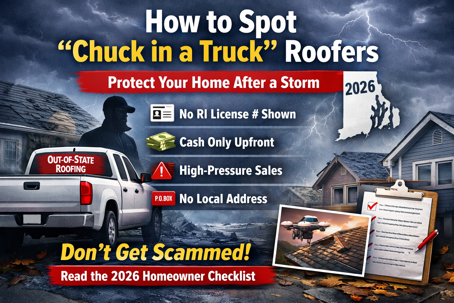
Homeowners call them “Chuck in a Truck” roofers—storm chasers who roll into town after wind or hail events, promise fast fixes, collect deposits, and then disappear when problems show up.
This 2026 update explains exactly how to protect yourself, what to ask, and how to verify a roofer is legitimate in Rhode Island.
If you want a local inspection with clear documentation (no pressure): call (401) 425-4108 or text/call 401-234-2452.
Why storm-chaser roofing is a real problem in Rhode Island
Rhode Island is a small state with a lot of coastline—and storms can create sudden demand spikes. That’s when out-of-state crews target:
- Homes with visible shingle loss
- Neighborhoods near the water (higher wind exposure)
- Older roofs in Providence/Cranston/Warwick
- Busy homeowners who need quick answers
The risk isn’t just “overpaying.” The bigger risk is bad installation that leads to leaks, mold, failed inspections and voided warranties—long after the crew is gone.
1) The biggest red flags (2026 checklist)
If you see one of these, slow down.
- High-pressure tactics: “Sign today or the price goes up.”
- Cash-only or huge deposit demands before materials are ordered.
- No Rhode Island contractor registration (or they won’t provide it).
- No local address (only a P.O. box or out-of-state address).
- No proof of insurance (liability + workers’ comp).
- Vague scope: “We’ll replace what’s needed” without line-item detail.
- They won’t discuss ventilation/flashing—they only talk shingles.
2) “Low price” usually means corners get cut
A roof can look fine for 30–90 days and still be installed wrong.
Common corner-cutting we see after storm chasers leave:
- Missing or incorrect ice & water protection
- Poor flashing at chimneys, walls, and skylights
- Incorrect nailing patterns (wind blow-offs later)
- No ventilation plan (ice dams + moisture issues)
- Messy cleanup (nails, damaged landscaping)
3) Rhode Island codes + permits: why out-of-state crews get caught
Local building departments exist for a reason. If the work isn’t compliant, you may end up paying twice.
In Rhode Island, replacement work often involves:
- Permit requirements (varies by municipality)
- Inspection requirements
- Proper disposal and site safety
A contractor who doesn’t regularly work in Rhode Island can miss local expectations and details—especially on older homes.
4) The #1 protection: verify registration + insurance before you sign
Before you sign anything, ask for:
- Rhode Island contractor registration (verify it)
- Certificate of insurance (liability + workers’ comp)
- Local references (recent jobs in your town)
5) What to ask any roofer (copy/paste questions)
Use these questions to instantly separate pros from “Chuck in a Truck” crews:
- “What’s your Rhode Island registration number, and what name is it under?”
- “Can you email a certificate of insurance today?”
- “Will you inspect flashing, ventilation, and decking—or just shingles?”
- “What’s included in the written scope (ice/water, underlayment, starter, ridge cap)?”
- “Who handles warranty issues if something shows up in 6–12 months?”
- “How will you document storm damage for insurance?”
6) Storm damage + insurance claims: avoid the most common trap
Some storm chasers push homeowners into signing documents that assign benefits or lock you into their “process.”
In 2026, the safest approach is:
- Get a professional inspection with photos (drone imagery when appropriate)
- File your claim with solid documentation
- Choose a contractor with a local reputation and follow-up support
7) Why local contractors are worth it (even when they’re not the cheapest)
A reputable local contractor is invested in:
- Your town’s reputation network
- Long-term warranty follow-through
- Code compliance and inspection pass rates
- Doing the details right (flashing, ventilation, waterproofing)
That’s what protects your home’s value.
FAQs (2026)
How do I know if a roofer is legit in Rhode Island?
Verify Rhode Island contractor registration, ask for proof of insurance, and request local references. Avoid high-pressure “sign today” tactics.
Should I pay a deposit?
A reasonable deposit can be normal, but be cautious with large upfront payments—especially if the scope is vague or they can’t show registration and insurance.
What should I do if someone knocks after a storm?
Don’t sign anything on the spot. Get a documented inspection, compare written scopes, and verify credentials first.
Need a local Rhode Island roofer you can actually reach later?
If you want clear answers without pressure, start with an inspection.
- Call: (401) 425-4108
- Text/Call: 401-234-2452
- Visit our Website
- Get an Instant quote
- Emergency Roofing
Rhode Island Service Locations:
Ashaway, Barrington, Bradford, Bristol, Carolina, Central Falls, Charlestown, Chepachet, Clayville, Coventry, Cranston, Cumberland, East Greenwich, East Providence, Exeter, Forestdale, Foster, Glendale, Greene, Greenville, Harrisville,Hope,Hope Valley, Hopkinton, Jamestown, Johnston, Kenyon, Kingston, Lincoln, Little Compton, Manville, Mapleville, Middletown, Narragansett, Newport, North Kingstown, North Providence, North Scituate, North Smithfield, Oakland, Pascoag, Pawtucket, Portsmouth, Providence, Riverside, Rockville, Rumford, Saunderstown, Shannock, Scituate, Slatersville, Smithfield, Tiverton, Wakefield, Warren, Warwick, West Greenwich, West Kingston, West Warwick, Westerly, Wood River Junction, Woonsocket, Wyoming
Last updated: 2026