
A roof replacement is one of the biggest investments you will make in your home.
Unfortunately, big-ticket projects attract bad actors.
Whether you live in Providence, Cranston, Warwick, or down in South County, knowing the red flags can save you thousands of dollars and months of headaches.
This guide covers the most common roofing scams we see in Rhode Island, what is actually happening behind the scenes, and a simple checklist you can use before you sign anything.
The rule of thumb in Rhode Island
If the deal feels rushed, confusing, or “too good to be true,” slow down.
A legitimate contractor will:
- Put the scope in writing
- Explain what is included and excluded
- Encourage you to verify registration and insurance
- Give you time to compare bids
Scammers try to do the opposite.
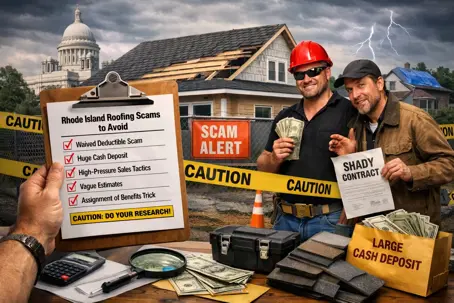
Scam #1: “We will waive your insurance deductible”
If a storm hits and a contractor offers to “eat” or “waive” your homeowner’s insurance deductible, treat it as a major red flag.
The reality
In Rhode Island, this can cross into insurance fraud territory.
To “waive” a deductible, someone typically has to make the numbers work by:
- Inflating the invoice
- Hiding costs in other line items
- Submitting paperwork that does not reflect the real transaction
That can put the homeowner at risk, not just the contractor.
What to do instead
Ask for a clear scope and a clear payment schedule. If you need help understanding what your insurance covers, work with a contractor who can document damage properly and communicate clearly - without playing games with the deductible.
Scam #2: The massive cash deposit
A reputable roofing company typically has established relationships and credit with suppliers.
So if a contractor demands a huge deposit - especially in cash - it is worth asking why.
The reality
A deposit is normal.
But when the ask jumps to 50% or more upfront, it can signal:
- They are using your money to fund another job
- They are unstable financially
- They may disappear after collecting deposits
What a normal deposit looks like
Many legitimate contractors use a smaller deposit to reserve scheduling and order materials, then collect the remainder based on progress and completion.
If you are uncomfortable, ask for:
- A written payment schedule
- Proof of insurance
- A start date window
- A detailed scope with materials listed
Scam #3: The “today only” high-pressure sale
“If you sign right now, I can knock $2,000 off because my crew is already down the street.”
The reality
Good contractors are busy.
They do not need to pressure you to sign on the spot.
High-pressure tactics are designed to stop you from:
- Researching the company
- Reading the contract carefully
- Getting a second opinion
What to do instead
Take your time.
A legitimate contractor will give you a written estimate and allow you to review it.
Scam #4: The “mystery scope” estimate
Some estimates look official but avoid specifics.
If the proposal does not clearly list what is being installed and where, you are exposed.
The reality
Vague scopes make it easy to upsell later or skip critical details like:
- Ice and water barrier locations
- Flashing at chimneys and walls
- Ventilation corrections
- Decking repair pricing
What to do instead
Ask for a scope that answers:
- What underlayment is included?
- Where is ice and water barrier installed?
- What flashing is replaced?
- How is ventilation evaluated?
- How are decking repairs priced and documented?
Scam #5: Assignment of Benefits (AOB) pressure
An “Assignment of Benefits” is a document that can transfer insurance claim rights from the homeowner to a contractor.
The reality
AOB is not automatically a scam, but it can be dangerous if you do not fully understand it.
Depending on the language, it can:
- Reduce your control over the claim
- Allow billing disputes to escalate
- Create legal and payment headaches
What to do instead
Before signing anything with the words “assignment” or “benefits”:
- Read it slowly
- Ask what rights you are giving up
- Consider legal advice if you are unsure
A trustworthy contractor should be able to work with you without taking control away from you.
How to protect yourself in Rhode Island (simple checklist)
Use this list before you sign.
- Verify registration with the Rhode Island Contractors’ Registration and Licensing Board (CRLB).
- Confirm insurance (general liability and workers’ comp) and ask for a current certificate.
- Demand a physical local address (not just a P.O. Box).
- Get the full scope in writing (materials, underlayment, flashing, ventilation).
- Make sure decking repairs are priced and documented clearly.
- Avoid “sign today” pressure.
- Avoid huge cash deposits.
- Ask about manufacturer-backed warranty options and what is required to qualify.
- Ask for photo documentation before, during, and after.
The Mighty Dog difference: documentation you can actually use
When you work with Mighty Dog Roofing of Rhode Island, we focus on clarity and documentation.
That includes:
- Drone inspection photos and measurements
- Clear scopes and contracts
- Warranty paperwork stored in your digital Mighty Pouch
The point is simple: you should be able to prove what was installed, how it was installed, and what protections you have.
If you are comparing bids or dealing with storm damage and something feels off, get a second opinion.
We can inspect your roof, document what we see, and give you a clear scope so you can make a confident decision.
Call (401) 425-4108 or visit our Contact Us page.
Rhode Island Service Locations:
Ashaway, Barrington, Bradford, Bristol, Carolina, Central Falls, Charlestown, Chepachet, Clayville, Coventry, Cranston, Cumberland, East Greenwich, East Providence, Exeter, Forestdale, Foster, Glendale, Greene, Greenville, Harrisville,Hope,Hope Valley, Hopkinton, Jamestown, Johnston, Kenyon, Kingston, Lincoln, Little Compton, Manville, Mapleville, Middletown, Narragansett, Newport, North Kingstown, North Providence, North Scituate, North Smithfield, Oakland, Pascoag, Pawtucket, Portsmouth, Providence, Riverside, Rockville, Rumford, Saunderstown, Shannock, Scituate, Slatersville, Smithfield, Tiverton, Wakefield, Warren, Warwick, West Greenwich, West Kingston, West Warwick, Westerly, Wood River Junction, Woonsocket, Wyoming
FAQ
Is it legal for a roofer to pay my insurance deductible in Rhode Island?
No. It can be considered insurance fraud for a contractor to waive, absorb, or pay a homeowner’s insurance deductible.
How much of a deposit should a roofing contractor ask for?
A deposit is common, but very large upfront payments (especially in cash) are a red flag. Many reputable contractors use a smaller deposit and a written payment schedule tied to progress.
What is an Assignment of Benefits in roofing?
An Assignment of Benefits is a document that can transfer insurance claim rights from the homeowner to a contractor. It can reduce your control over the claim, so read it carefully before signing.