
Replacing a roof in the Ocean State is a significant investment. In 2026, it is about more than just keeping the rain out. Between coastal wind exposure, changing material pricing, and better inspection technology, Rhode Island homeowners need a modern roadmap to make the right decision.
Whether you own a multi-family in Providence, a coastal cottage in Narragansett, or a modern colonial in Cranston, this guide breaks down the real cost ranges, the code items that matter, and the material choices that perform best in Rhode Island.
2026 Rhode Island roof replacement cost guide
One of the most common questions we hear is: How much does a new roof actually cost in the 401?
In 2026, many Rhode Island homeowners land between $12,500 and $20,500 for a standard 2,000 sq ft home. Your final price depends on roof size (measured in squares), pitch, number of layers, decking condition, ventilation, and detailing around chimneys, skylights, and valleys.
Typical material pricing (Rhode Island)
Material type | Typical installed cost per sq ft (RI) | Typical lifespan | Best for |
|---|---|---|---|
Architectural asphalt | $6.50 - $9.25 | 25-30 years | Best overall value for RI weather |
Standing seam metal | $14.50 - $22.00 | 50+ years | Maximum durability in high-wind zones |
Synthetic slate | $9.00 - $16.00 | 40-50 years | Historic aesthetics (Providence / Newport) |
Important: If two quotes are far apart, it is usually because the scope is different (ice and water barrier, flashing, ventilation, tear-off layers, or decking repairs).
Designing for the Rhode Island four-season challenge
Rhode Island roofs deal with four distinct stressors. Your zip code matters.
1) The coastal corridor (salt air and high winds)
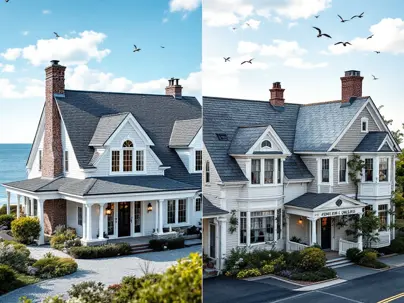
If you live in Newport, Narragansett, Bristol, Jamestown, or other exposed coastal areas, your roof has to handle wind uplift and salt-air corrosion.
What we see: Salt air accelerates corrosion on fasteners and flashing. Wind-driven rain finds weak points around chimneys, walls, and valleys.
How we build for it: - Corrosion-resistant fasteners where appropriate - Upgraded underlayment and ice and water barrier in vulnerable areas - Wind-rated shingle systems installed to manufacturer specs
Note: Wind requirements and exposure categories can vary by site conditions and code interpretation. A professional inspection and measurement is the right way to confirm what your home needs.
2) The northern snow belt (ice dams and freeze-thaw)
Homeowners in Woonsocket, Burrillville, Foster, and other northern RI towns often deal with freeze-thaw cycles.
What we see: Ice dams form when attic heat melts snow, then refreezes at the eaves. Water backs up under shingles and can damage drywall, insulation, and framing.
How we build for it: - Ice and water shield at eaves and leak-prone areas - Ventilation planning to reduce attic heat buildup - Flashing details that prevent wind-driven rain intrusion
Rhode Island roofing laws and permits (what homeowners should know)
The two-layer rule
Rhode Island generally limits asphalt shingle roofs to a maximum of two layers. If your home already has two layers, a full tear-off is typically required.
Why it matters: A tear-off allows the contractor to inspect the decking, address rot, and install modern water protection layers.
Permits and inspections
Do not skip the permit. Some municipalities can fine unpermitted work, and it can complicate resale or insurance documentation.
If you are comparing estimates, ask whether the permit is included and who is pulling it.
2026 financial incentives: up to $1,200 federal tax credit (Section 25C)
Some homeowners may qualify for a federal tax credit for certain energy-efficient home improvements.
In plain English: If you combine the roof project with qualifying attic insulation or other eligible upgrades, you may be able to offset part of the cost.
Important: Eligibility depends on the specific product and your tax situation. Talk to a tax professional for confirmation.
Why modern inspections matter (and why we use drones)
A roof can look fine from the ground and still have: - Lifted shingles - Flashing gaps - Soft decking - Moisture intrusion
Our Mighty Drone Super Scan is a non-invasive inspection approach that helps us document conditions safely and accurately, especially after storms or on steep/hard-to-access roofs.
Next step: get a clear plan for your roof
If you want a real number and a clear scope (not a guess), start with a professional inspection.
Mighty Dog Roofing of Rhode Island serves North Providence and all of Rhode Island. Call/text (401) 425-4108 to schedule a free drone inspection or visit our website.
FAQ
How much does a roof cost in Rhode Island in 2026?
In 2026, many Rhode Island homeowners spend between $12,500 and $20,500 for a standard roof replacement, but total cost can range wider based on roof size, complexity, material choice, and permit requirements.
Does RI building code allow a second layer of shingles?
Rhode Island typically allows a maximum of two layers of asphalt shingles. If your roof already has two layers, a full tear-off is usually required. Many homeowners also choose tear-off even with one layer so the decking can be inspected and modern leak barriers can be installed.
What is a Mighty Drone Super Scan?
It is a non-invasive inspection that uses drone imagery to document roof conditions safely and accurately. It is especially helpful for steep roofs, hard-to-reach areas, and post-storm inspections.
Rhode Island Service Locations:
Ashaway, Barrington, Bradford, Bristol, Carolina, Central Falls, Charlestown, Chepachet, Clayville, Coventry, Cranston, Cumberland, East Greenwich, East Providence, Exeter, Forestdale, Foster, Glendale, Greene, Greenville, Harrisville,Hope,Hope Valley, Hopkinton, Jamestown, Johnston, Kenyon, Kingston, Lincoln, Little Compton, Manville, Mapleville, Middletown, Narragansett, Newport, North Kingstown, North Providence, North Scituate, North Smithfield, Oakland, Pascoag, Pawtucket, Portsmouth, Providence, Riverside, Rockville, Rumford, Saunderstown, Shannock, Scituate, Slatersville, Smithfield, Tiverton, Wakefield, Warren, Warwick, West Greenwich, West Kingston, West Warwick, Westerly, Wood River Junction, Woonsocket, Wyoming
Last updated: 2026