
Most “roofing guides” online are written for national audiences and are often several years out of date. In Rhode Island, the landscape changed significantly in early 2026. Between stricter local enforcement of current building code requirements and a tightening insurance market, a roof replacement is no longer just about shingles. It is about structural compliance, documentation, and long-term asset protection.
If you own a home in North Providence, Warwick, Cumberland, or anywhere in the Providence metro area, this guide will help you understand what matters most in 2026 and how to avoid the most common (and expensive) surprises.
The 2026 regulatory shift: why business as usual is over
In 2026, more municipalities are treating roof replacements as a system upgrade, not a cosmetic swap. The practical impact for homeowners is that once the roof is opened up, the condition of the deck and the details of water protection matter.
Decking evaluation and tear-off reality
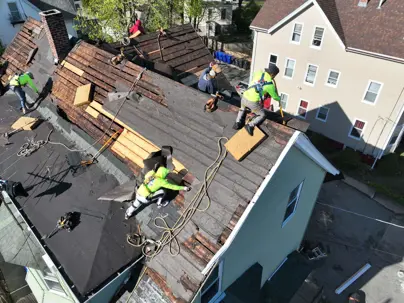
Many homeowners ask about “roof overs” (installing new shingles over existing shingles). In 2026, roof overs are less common in Rhode Island because they can limit the ability to evaluate the roof deck and can create fastening and inspection issues.
In plain terms: if the deck is not solid, nails cannot hold consistently. And if nails cannot hold, the roof system cannot perform in wind events.
What you should expect from a professional scope:
- A plan to evaluate decking condition during tear-off
- Clear documentation if decking replacement is needed
- A written process for how decking is priced (per sheet) so change orders are not a surprise
Ice and water protection is not optional
Rhode Island weather is hard on roofs: freeze-thaw cycles, ice dams, wind-driven rain, and coastal gusts. In 2026, inspectors are paying closer attention to water protection details that budget contractors often minimize.
A roof replacement should include a clear plan for:
- Ice and water barrier placement at eaves and vulnerable transitions
- Proper flashing at chimneys, walls, and valleys
- A ventilation approach that reduces moisture and ice dam risk
Important note: exact requirements can vary by municipality and roof design. The right contractor will build to the stricter interpretation and document it.
Precision over guesswork: the Drone Super Scan
Traditional roofing estimates often rely on tape measures and rough calculations. In 2026, that can lead to surprise change orders when the roof is more complex than expected.
Mighty Dog Roofing of Rhode Island uses drone-based measurement and documentation to reduce uncertainty and improve transparency.
What that supports:
- Accurate measurements of ridges, hips, valleys, dormers, and penetrations
- Better planning for material quantities and labor scope
- Clear before-and-after documentation for homeowners and, when needed, insurance carriers
If thermal imaging is used, it can help identify temperature anomalies that may indicate moisture or insulation issues. It is not a substitute for tear-off verification, but it can be a useful data point when planning the project.
Navigating the 2026 insurance pressure in Rhode Island
Many Rhode Island homeowners are receiving non-renewal notices or premium increases based on roof age and perceived risk. If you are replacing your roof to satisfy an insurance requirement, the goal is not to panic-buy. The goal is to install a system you can document.
Avoid panic decisions and low-bid shortcuts
Low-bid crews may offer fast pricing, but the risk is that corners get cut on:
- Decking evaluation and replacement
- Underlayment and ice and water protection
- Flashing details
- Ventilation balance
Those shortcuts can become expensive when the next nor’easter hits.
Document everything for your carrier
If your carrier is requesting proof of roof condition, ask your contractor for:
- Photos and documentation of tear-off and deck condition
- Product documentation for the installed system
- A clear invoice that reflects the scope and materials
Understanding the FAIR Plan risk
Some homeowners worry about being pushed toward the Rhode Island FAIR Plan if they cannot satisfy underwriting requirements. The best approach is proactive: replace the roof before the deadline, and choose a system with strong documentation and proven performance.
The good, better, best system (Rhode Island-focused)
We do not believe in one-size-fits-all roofing. Rhode Island homes vary widely: capes, colonials, raised ranches, historic homes, and coastal properties all have different risk profiles.
Standard Integrity (value tier)
A high-quality architectural shingle system designed for dependable protection when installed with proper underlayment, flashing, and ventilation.
Gold Package (performance tier)
A performance-focused architectural shingle system that emphasizes stronger fastening and wind resistance. As an Owens Corning Platinum Preferred Contractor, we feature the TruDefinition Duration® series with built-in SureNail® Technology to provide a 130-MPH wind resistance warranty when installed to manufacturer specifications.
Platinum Package (luxury and long-term tier)
For homeowners prioritizing premium aesthetics and storm defense, options can include standing seam metal roofing or premium synthetic roofing systems. For certain markets and home styles, Brava synthetic slate can be an excellent fit.
If you are in a premium or historic market, Mighty Dog Roofing of Rhode Island is an Authorized Brava Synthetic Roofing Contractor.
If you are planning a roof replacement in 2026 and want a scope built around transparency, documentation, and Rhode Island realities, contact Mighty Dog Roofing of Rhode Island to schedule an inspection.
Rhode Island Service Locations:
Ashaway, Barrington, Bradford, Bristol, Carolina, Central Falls, Charlestown, Chepachet, Clayville, Coventry, Cranston, Cumberland, East Greenwich, East Providence, Exeter, Forestdale, Foster, Glendale, Greene, Greenville, Harrisville,Hope,Hope Valley, Hopkinton, Jamestown, Johnston, Kenyon, Kingston, Lincoln, Little Compton, Manville, Mapleville, Middletown, Narragansett, Newport, North Kingstown, North Providence, North Scituate, North Smithfield, Oakland, Pascoag, Pawtucket, Portsmouth, Providence, Riverside, Rockville, Rumford, Saunderstown, Shannock, Scituate, Slatersville, Smithfield, Tiverton, Wakefield, Warren, Warwick, West Greenwich, West Kingston, West Warwick, Westerly, Wood River Junction, Woonsocket, Wyoming
FAQ
What is the best roof for Rhode Island weather?
For many homeowners, architectural asphalt shingles are the most popular balance of cost and performance. For maximum durability in nor’easters and heavy snow conditions, standing seam metal roofing is often considered a top-tier option.
How long does a roof replacement take in Rhode Island?
Many residential roof replacements in the Providence metro area can be completed in 1 to 2 days, depending on roof complexity, weather, and how much decking needs repair or replacement.
Do I need a permit for a new roof in North Providence?
In most cases, yes. Roof replacements typically require a local building permit and a final inspection. Permit requirements can vary by municipality and project scope.