
Every town in Rhode Island has a distinct geographic personality that dictates how its homes age. While coastal communities fight high winds and salt air, northern towns like Cumberland deal with a different environmental pressure.
From the historic neighborhoods near the Blackstone River to the heavily wooded pockets along Diamond Hill Road, Cumberland homes are exposed to microclimates that can shorten the lifespan of an asphalt shingle roof.
If you own a home in Cumberland, understanding how tree canopies, river valley humidity, and seasonal freeze-thaw cycles interact with your roofing system is one of the smartest ways to protect your property value in 2026.
What to do first (before cleaning or patching)
- Avoid pressure washing asphalt shingles. High pressure can strip protective granules and dramatically shorten roof life.
- Identify organic target areas. Look for moss gathering at shingle edges and valleys, and black streaking on heavily shaded roof planes.
- Inspect gutter debris. Check gutters and downspouts for an excessive buildup of dislodged shingle granules.
- Check post-winter lifting. After winter weather breaks, look for lifted tabs or exposed nail lines on the most shaded slopes.
- Secure objective proof. Get the roof documented with photos or drone scans so the fix matches the real structural cause.
The Wooded Shade Trap: Moss, Algae, and Shingle Decay
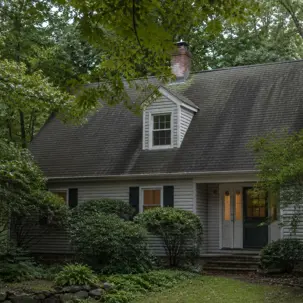
Cumberland is celebrated for its mature trees and scenic, rolling landscapes. But homes tucked under heavy tree canopies face a persistent roofing threat: prolonged shade and trapped moisture.
When a roof plane stays shaded for most of the day, rainwater and morning dew cannot evaporate efficiently. That creates a prime environment for Gloeocapsa magma, the airborne algae commonly associated with black streaks on asphalt shingles.
More destructively, prolonged dampness supports moss growth. Moss acts like a sponge, holding water directly against the shingle surface. During New England winter cycles, that retained moisture can freeze and expand. Over time, freeze-thaw can lift shingle tabs, weaken manufacturer seals, and accelerate cracking or splitting.
In Cumberland, this is especially common on:
- North-facing roof planes
- Valleys and lower roof edges
- Roof sections shaded by overhanging canopy lines
River Valley Humidity and Organic Pressures
Properties closer to the Blackstone River corridor and lower-lying areas near Valley Falls can experience higher ambient humidity during spring and summer. That moisture, combined with organic debris from trees (pollen, leaves, small branches), increases the load on your roof surface.
Here is the part many homeowners miss: roof problems are not always only on top of the shingles.
If attic ventilation is restricted, moisture vapor from inside the home can build up in the attic. When that internal moisture meets Cumberland’s external humidity and organic growth pressure, the risk of hidden wood deck deterioration increases. In other words, you can have early-stage deck damage before you see obvious shingle failure from the street.
Engineered Algae Resistance for Northern RI
To defend Cumberland homes against these microclimate pressures, a basic builder-grade shingle is often not enough.
Our team installs architectural shingle systems designed to resist algae staining and slow organic growth. Many premium shingles use algae-resistant granules (often copper-containing) that help create a less friendly surface for algae over time.
Just as important: algae resistance works best when the entire roofing system is built correctly, including:
- Balanced intake and exhaust ventilation
- Proper underlayment and flashing details
- Clean valley design and drainage
- Smart tree management around rooflines
When roof cleaning makes things worse
Cumberland homeowners often get pitched a fast solution: an aggressive chemical wash or pressure washing.
The problem is that harsh cleaning methods can remove or damage the protective granules on asphalt shingles. Those granules are not cosmetic. They help protect the shingle from UV exposure and weathering.
If your roof is already compromised by moss, lifted tabs, or granule loss, the wrong cleaning approach can accelerate the decline.
Before you invest in a spot fix, your roof should be evaluated and documented. We use our Drone Super Scan to capture clear, high-resolution images of shaded slopes, valleys, and organic growth zones so you can make a decision based on evidence, not guesswork.
Cumberland roof microclimate warning signs (quick checklist)
- Black streaks that keep spreading year over year
- Moss growth at edges, valleys, or behind chimneys
- Granules collecting heavily in gutters and downspouts
- Curling, lifting, or brittle shingle tabs on shaded slopes
- Musty attic small, staining, or damp insulation bounds
If you are seeing any of these, the next step is not a random repair. It is a documented inspection that identifies whether you are dealing with surface growth only, ventilation issues, flashing problems, or early deck deterioration.
Rhode Island Service Locations:
Ashaway, Barrington, Bradford, Bristol, Carolina, Central Falls, Charlestown, Chepachet, Clayville, Coventry, Cranston, Cumberland, East Greenwich, East Providence, Exeter, Forestdale, Foster, Glendale, Greene, Greenville, Harrisville,Hope,Hope Valley, Hopkinton, Jamestown, Johnston, Kenyon, Kingston, Lincoln, Little Compton, Manville, Mapleville, Middletown, Narragansett, Newport, North Kingstown, North Providence, North Scituate, North Smithfield, Oakland, Pascoag, Pawtucket, Portsmouth, Providence, Riverside, Rockville, Rumford, Saunderstown, Shannock, Scituate, Slatersville, Smithfield, Tiverton, Wakefield, Warren, Warwick, West Greenwich, West Kingston, West Warwick, Westerly, Wood River Junction, Woonsocket, Wyoming
FAQ
Why does my Cumberland home have black streaks on the roof?
Black streaks are commonly caused by an airborne algae called Gloeocapsa magma. It thrives in moist, shaded environments, which are common in heavily wooded parts of Cumberland.
Can roof moss cause interior leaks?
Yes. Moss holds moisture against the roof surface. Over time, freeze-thaw can lift shingle tabs and weaken seals, allowing wind-driven rain to bypass shingles and reach the roof deck.
Is roof cleaning safe for asphalt shingles?
Sometimes, but it depends on the roof condition and the method used. Aggressive cleaning can strip protective granules. A documented inspection first helps determine the safest approach.
Does moss mean I need a full roof replacement?
Not always. Moss can sometimes be addressed if the shingles are still structurally sound. But if tabs are lifting, seals are failing, or granule loss is significant, replacement may be the more cost-effective long-term solution.
How do you prevent moss from growing back after a roof replacement?
We use premium architectural shingles with algae-resistant granules and pair them with balanced attic ventilation. We also recommend practical tree management to reduce constant shade and debris buildup.
What areas of the roof are most vulnerable in Cumberland?
North-facing slopes, valleys, and roof sections under heavy canopy lines tend to stay damp longer and are more prone to algae streaking and moss growth.