
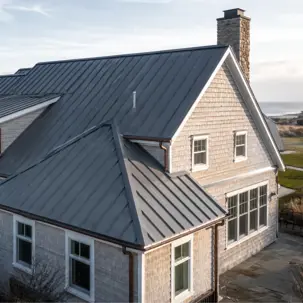
For homes along Ocean Road, Great Island, and the Point Judith peninsula in Narragansett, the Atlantic Ocean is both a primary asset and a constant structural threat.
Metal roofing has surged in popularity across Rhode Island in 2026 because it can deliver excellent wind performance and long service life. But waterfront homeowners cannot treat metal as a single, uniform category.
When your property sits within striking distance of coastal salt spray, the choice between engineered steel and marine-grade aluminum can strongly influence corrosion risk, warranty coverage, and long-term value.
The salt spray chemical reality
The primary destructive force for many coastal Narragansett homes is airborne salt mist. When saltwater vapor settles onto a metal surface, it can act as an electrolyte and accelerate corrosion mechanisms.
Steel (Galvalume or galvanized)
Steel roofing is strong and often cost-effective. To resist rust, it is typically protected by a metallic coating such as zinc (galvanized) or an aluminum-zinc alloy (often called Galvalume).
In coastal exposure, the weak points are rarely the middle of the panel. They are usually:
- Cut edges at eaves, rakes, and valleys
- Fastener penetrations and accessory details
- Scratches or abrasion from wind-driven debris
These are the areas where salt exposure can show up first if detailing and maintenance are not handled correctly.
Aluminum (marine-grade)
Aluminum does not rust the way steel does. When aluminum is exposed to oxygen, it forms a thin aluminum oxide layer that helps protect the base metal.
That does not mean aluminum is immune to every coastal issue. But for direct salt spray exposure, aluminum is often selected specifically to reduce the risk of red-rust corrosion that can occur when steel is exposed at edges and penetrations.
Coastal warranties and the common distance-to-saltwater issue
Many homeowners are surprised to learn that some metal roofing warranties include coastal proximity limitations. These limitations can be written as an exclusion zone measured in feet from saltwater.
A commonly seen threshold in warranty language is around 1,500 feet, but the exact number and the exact definition of coastline exposure vary by manufacturer, panel type, and coating system.
Before you choose a system, verify:
- The panel substrate (steel vs aluminum)
- The coating/finish system
- The warranty language for coastal exposure
- Any required maintenance or wash-down guidance
If a warranty excludes your location, that does not automatically mean the roof will fail. It means you should be extra careful about material selection, detailing, and expectations.
Wind uplift and mechanical locking in Narragansett
Narragansett nor’easters can generate straight-line winds that damage shingles and exploit weak roof edges.
Both steel and aluminum standing seam systems can deliver excellent wind performance when they are:
- Properly engineered for the building
- Installed with the correct clip and fastening pattern
- Detailed correctly at edges, transitions, and penetrations
Because aluminum is more malleable than steel, thickness matters. Common residential coastal specifications are 0.032 or 0.040 aluminum, depending on panel profile and project engineering. The goal is a system that stays anchored during extreme coastal wind events while also matching the corrosion risk profile of the site.
How to choose based on distance to saltwater (simple decision guide)
Every property is different, but this framework helps homeowners think clearly:
1) Direct waterfront or heavy salt spray exposure
If your home is directly exposed to salt mist and wind-driven spray, aluminum is often considered the technically safer choice for corrosion resistance.
2) Near-coast but partially sheltered
If you are close to the water but have some shelter (terrain, trees, neighboring structures), steel may still be viable depending on coating system, detailing, and warranty terms.
3) Inland Narragansett
If you are farther inland with reduced salt exposure, steel systems can be a strong value option when installed with correct detailing and ventilation.
How a drone inspection helps you plan a coastal metal roof
Coastal metal roofing decisions should be based on real conditions, not guesswork.
Our Drone Super Scan can help document:
- Early edge corrosion or coating wear patterns
- Paint chalking or finish breakdown indicators
- Panel alignment concerns and transition details
- Clip movement indicators that may show up as subtle seam or panel irregularities
From there, we can build a repair or replacement plan based on your exposure, roof geometry, and long-term goals.
Rhode Island Service Locations:
Ashaway, Barrington, Bradford, Bristol, Carolina, Central Falls, Charlestown, Chepachet, Clayville, Coventry, Cranston, Cumberland, East Greenwich, East Providence, Exeter, Forestdale, Foster, Glendale, Greene, Greenville, Harrisville,Hope,Hope Valley, Hopkinton, Jamestown, Johnston, Kenyon, Kingston, Lincoln, Little Compton, Manville, Mapleville, Middletown, Narragansett, Newport, North Kingstown, North Providence, North Scituate, North Smithfield, Oakland, Pascoag, Pawtucket, Portsmouth, Providence, Riverside, Rockville, Rumford, Saunderstown, Shannock, Scituate, Slatersville, Smithfield, Tiverton, Wakefield, Warren, Warwick, West Greenwich, West Kingston, West Warwick, Westerly, Wood River Junction, Woonsocket, Wyoming
FAQ
Will a steel roof rust if I live near Narragansett Town Beach?
If the property is in direct salt spray exposure, steel systems can face higher corrosion risk at cut edges, penetrations, and scratched areas. Material selection, coating choice, detailing, and warranty terms matter. Aluminum is often chosen for direct waterfront exposure to reduce red-rust risk.
Is an aluminum roof louder in the rain than a steel roof?
Usually not. Sound transmission is driven more by the roof assembly (solid decking, underlayment, attic insulation, and ventilation) than by whether the panel is steel or aluminum.
Can you see coastal metal roof damage with a drone?
Yes. High-resolution aerial imagery can help identify early corrosion patterns, finish wear, and visible detail issues without walking a steep or wind-exposed roof.
What should I ask a contractor before installing a coastal metal roof in Narragansett?
Ask what substrate and coating system is being proposed, what the coastal warranty language says, how edges and penetrations will be detailed, and what maintenance is recommended for salt exposure.