
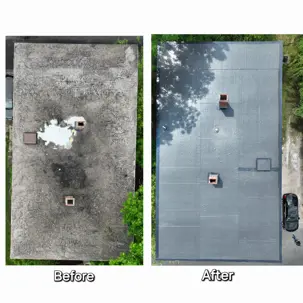
When Rhode Island homeowners think of a roof replacement, they usually picture architectural asphalt shingles or steep-slope metal systems. But thousands of homes in Providence, Cranston, and Warwick have low-slope or flat roof sections - often over sunrooms, garages, large dormers, or modern additions.
Here is the most important rule of residential roofing:
You cannot install standard asphalt shingles on a flat or low-slope roof.
Shingles are designed for steep pitches and rely on gravity to shed water quickly. On low-slope roofs, water can move slowly, pool, and push back under shingle overlaps. That is how you end up with hidden rot in the roof deck.
For low-slope applications, the roof has to transition from a water-shedding system to a waterproofing system. In 2026, one of the premier materials for residential and light-commercial flat roofing in New England is EPDM (Ethylene Propylene Diene Monomer) - a durable synthetic rubber membrane.
This guide breaks down the building science, material specs, and installation details that separate a long-lasting EPDM roof from a short-term patch.
Understanding EPDM synthetic rubber
EPDM is a resilient synthetic rubber compound that has been used in roofing for decades because of its physical properties.
Exceptional elongation
Rhode Island sees big temperature swings. EPDM can stretch significantly without tearing, which helps it tolerate seasonal movement in framing and roof assemblies.
UV and ozone resistance
EPDM is known for resisting UV and ozone degradation better than many materials, helping it stay flexible instead of becoming brittle.
Thermal behavior (black EPDM)
Most residential EPDM systems use black membrane. In a northern climate, that surface can absorb solar heat, which can help melt snow faster. (It does not replace proper insulation and ventilation, but it can be a practical benefit.)
The thickness debate: 45 mil vs 60 mil vs 90 mil
EPDM comes in large rolls and multiple thicknesses, measured in mils (one mil equals one-thousandth of an inch). Thickness is a major driver of puncture resistance and long-term durability.
Many low-bid quotes use 45 mil because it is cheaper. While it can be code-acceptable, it is the minimum and is more vulnerable to punctures.
For most residential flat roofs in Rhode Island, 60 mil is a strong baseline because it balances durability and cost.
EPDM thickness | Ideal application | Performance notes |
|---|---|---|
45 mil | Budget retrofits, low-risk areas | Thin profile; more vulnerable to punctures from debris |
60 mil | Residential additions and RI weather | Strong balance of cost and durability |
90 mil | Heavy commercial, rooftop decks | Maximum puncture defense; heavier and more expensive |
Installation methodology: fully adhered vs mechanically attached
How the membrane is secured to the roof deck affects wind performance and long-term stability.
Mechanically attached systems
A mechanically attached EPDM roof uses fasteners and plates along seams. It can be faster to install, but wind can get under the membrane between attachment rows. That can cause billowing and place stress on seams during storms.
Fully adhered systems (premium standard)
For many residential and light-commercial flat roofs in Rhode Island, a fully adhered system is the premium approach.
Adhesive is applied across the substrate and the EPDM is bonded to the deck. With fewer air pockets, the membrane is less likely to billow in high winds, and the roof tends to feel quieter and more stable during storms.
Managing water: slope and tapered insulation
A properly engineered flat roof is not perfectly level. It needs slope (commonly 1/4 inch per foot) to move water to gutters, drains, or scuppers.
If water remains on the roof for extended periods, it is considered ponding water. Ponding adds weight and can accelerate wear on details and adhesives.
If a flat roof has sagged over time, simply installing new rubber over the same low spots does not solve the root cause. Drainage has to be corrected.
Polyiso insulation and custom tapering
During replacement, many systems include Polyiso rigid insulation to improve thermal performance.
If the deck lacks slope, a tapered insulation system can be installed. Tapered Polyiso boards create a controlled slope under the membrane so water drains where it should.
The critical details: seam tapes and edge flashing
Many smaller residential flat roofs can be installed with fewer seams, but larger areas require multiple sheets.
Modern EPDM systems often use primer and peel-and-stick seam tapes. When installed correctly, these seam tapes create a durable bond designed to resist water intrusion and thermal movement.
Edge metal is just as important. EPDM must be terminated properly at roof edges with robust drip edge or perimeter metal. The membrane is bonded to the metal, and cover tape or termination details are installed so wind-driven rain cannot work under the edge.
Documenting the scope with drone diagnostics
Quoting a flat roof correctly requires accurate square footage, perimeter measurements for metalwork, and identification of low spots that hold water.
We use our Drone Super Scan to document roof geometry and conditions before tear-off. That helps reduce guesswork, supports accurate material ordering, and can prevent mid-project scope surprises.
If you are managing a flat roof addition, dormer, or light-commercial property in Rhode Island, do not settle for shortcuts. Specify the membrane thickness, the attachment method, and the drainage plan - then make sure the details are documented.
Rhode Island Service Locations:
Ashaway, Barrington, Bradford, Bristol, Carolina, Central Falls, Charlestown, Chepachet, Clayville, Coventry, Cranston, Cumberland, East Greenwich, East Providence, Exeter, Forestdale, Foster, Glendale, Greene, Greenville, Harrisville,Hope,Hope Valley, Hopkinton, Jamestown, Johnston, Kenyon, Kingston, Lincoln, Little Compton, Manville, Mapleville, Middletown, Narragansett, Newport, North Kingstown, North Providence, North Scituate, North Smithfield, Oakland, Pascoag, Pawtucket, Portsmouth, Providence, Riverside, Rockville, Rumford, Saunderstown, Shannock, Scituate, Slatersville, Smithfield, Tiverton, Wakefield, Warren, Warwick, West Greenwich, West Kingston, West Warwick, Westerly, Wood River Junction, Woonsocket, Wyoming
FAQ
How long does an EPDM rubber roof last in Rhode Island?
A professionally installed EPDM roof often lasts 20 to 30 years depending on thickness, attachment method, detailing, and maintenance. Routine inspections and prompt seam repairs can extend service life.
Can I walk on an EPDM rubber flat roof?
EPDM can handle occasional foot traffic for maintenance. It is not designed as a high-traffic deck surface. If the roof will be used regularly, protective walk pads or pavers should be installed to reduce puncture risk.
How do I clean my EPDM rubber roof?
Use mild detergent and water with a soft-bristle brush. Avoid petroleum-based products and harsh solvents, which can damage rubber.
Why is there standing water on my flat roof?
Ponding water usually means the roof does not have enough slope to drain, or the framing has sagged over time. During replacement, drainage is often corrected with tapered insulation or structural adjustments.