
When evaluating high-performance roofing systems for architectural and historic properties in Rhode Island, the discussion has to extend beyond the main field of shingles, slate, or synthetic slate. A roof rarely fails in the center of a flat plane. It fails at transitions, valleys, and wall junctions where fast-moving water is concentrated.
For historic estates on the East Side of Providence, coastal properties in Barrington, and classic structures in East Greenwich, standard aluminum flashing or temporary caulking is a liability. True architectural protection requires a long-life metallurgical solution: custom-fabricated, mechanically soldered copper detailing.
What this post covers (and why it matters)
- Why roof leaks start at transitions (chimneys, valleys, dormers, walls)
- How copper patina protects the metal for decades
- Why soldered seams outperform caulked joints in Rhode Island weather
- Compatibility rules (galvanic corrosion) that protect your investment
The Chemistry of the Copper Patina
Copper is a non-ferrous elemental metal, meaning it contains no iron and does not rust like steel.
When exposed to the New England atmosphere, copper undergoes a natural oxidation process. It shifts from a bright metallic finish to a deep nut brown, and over time can develop a classic sea-green patina.
That patina is not merely an aesthetic asset for historic properties. It is a protective layer that helps shield the underlying copper from ongoing atmospheric corrosion, coastal salt exposure, and acid rain.
In practical terms, properly fabricated copper roof detailing can deliver an operational lifespan measured in decades, often 70 to 100 years, which is why it is considered a premium material for long-term exterior protection.
Mechanical Soldering vs. Polyurethane Sealants
The defining difference between standard roof installations and elite architectural metalwork is how the joints are sealed.
Many standard flashing lines rely on aluminum or galvanized steel panels joined together with polyurethane caulking and exposed fasteners. Over a 10 to 15 year window, thermal expansion and contraction can cause movement at joints. That movement can split sealants, loosen fasteners, and create hidden leak entry points around chimneys, valleys, and sidewalls.
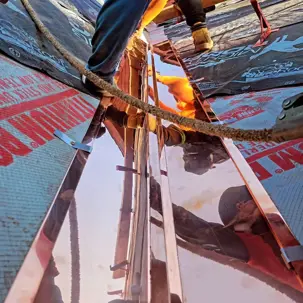
With custom copper work, critical seams are joined through mechanical soldering.
A proper soldered joint is created by cleaning the copper, applying flux, heating the seam, and melting a compatible solder alloy into the overlap. When done correctly, the seam becomes a continuous, watertight metal junction.
The result is simple: a soldered copper chimney flashing kit or valley lining is not dependent on caulk or rubber washers to stay watertight.
Where copper makes the biggest difference on RI homes
If you are prioritizing long-term performance, copper is most valuable in the places where water and movement concentrate:
- Chimney flashing kits (step, counter, and apron details)
- Valleys (especially long or complex valley runs)
- Dormer and wall transitions
- Eaves and rake edges on high-exposure rooflines
- Custom cricket flashing behind chimneys (when required)
These are the areas that typically decide whether a premium roof system stays dry for decades.
Protecting Your High-End Exterior Investment
Custom copper detailing is a significant capital investment, but it is also one of the few upgrades that can make a premium roof system truly cohesive.
When paired with high-tier materials like Brava Synthetic Slate or premium architectural shingles, copper detailing helps ensure that valleys, eaves, and dormers are built to a comparable lifespan.
To verify premium metalwork is uncompromised, we use our Drone Super Scan to document soldered joints and flashing folds from multiple high-definition aerial angles. That gives homeowners visual proof of the workmanship and helps catch issues early.
Copper compatibility matters (galvanic corrosion)
Copper is not a material you can mix casually with other metals.
If copper is connected directly to aluminum or certain steels in the presence of moisture, galvanic corrosion can occur. The less noble metal can deteriorate rapidly.
That is why professional copper work includes:
- Compatible fasteners (often copper or stainless, depending on the assembly)
- Proper isolation barriers when dissimilar metals are nearby
- Correct drainage planning so copper runoff does not constantly wash over incompatible metals
Rhode Island Service Locations:
Ashaway, Barrington, Bradford, Bristol, Carolina, Central Falls, Charlestown, Chepachet, Clayville, Coventry, Cranston, Cumberland, East Greenwich, East Providence, Exeter, Forestdale, Foster, Glendale, Greene, Greenville, Harrisville,Hope,Hope Valley, Hopkinton, Jamestown, Johnston, Kenyon, Kingston, Lincoln, Little Compton, Manville, Mapleville, Middletown, Narragansett, Newport, North Kingstown, North Providence, North Scituate, North Smithfield, Oakland, Pascoag, Pawtucket, Portsmouth, Providence, Riverside, Rockville, Rumford, Saunderstown, Shannock, Scituate, Slatersville, Smithfield, Tiverton, Wakefield, Warren, Warwick, West Greenwich, West Kingston, West Warwick, Westerly, Wood River Junction, Woonsocket, Wyoming
FAQ
Will copper flashing stain my home’s roof or siding?
As copper oxidizes, it can shed trace ions that may leave discoloration on certain light-colored surfaces directly underneath. The same copper ions can also inhibit mold, moss, and algae growth on nearby roofing materials.
Can you connect copper roofing elements directly to aluminum gutters?
No. Connecting copper directly to aluminum (or some steels) can trigger galvanic corrosion, which can rapidly damage the weaker metal. Copper should be paired with compatible materials or isolated with non-conductive barriers.
How long does a soldered copper chimney flashing last?
When properly fabricated and soldered by experienced technicians, custom copper chimney flashing can last 75 to 100 years, often outlasting multiple generations of standard roof materials.
Is copper only for historic homes?
No. Copper is common on historic properties because it matches the architecture, but it is also used on modern high-end homes because it is durable, serviceable, and designed for long-term performance.
Does copper help with moss or algae?
Indirectly, yes. Copper ions can inhibit organic growth on nearby surfaces. But the biggest benefit of copper flashing is long-life waterproofing at transitions.