
The Most Important Parts of a Roof Are the Parts You Do Not See
When homeowners plan a premium roof replacement, most of the attention goes to the visible materials: architectural shingles, synthetic slate, designer profiles, and color blends.
But the most common failure points on any sloped roof are not the wide-open roof planes. They are the junctions and transitions where roof sections meet: chimneys, dormers, valleys, sidewalls, skylights, and roof-to-wall intersections.
In Rhode Island, those details matter even more. We deal with freeze-thaw cycles, wind-driven rain, coastal salt air, and seasonal temperature swings that punish weak flashing and drainage systems.
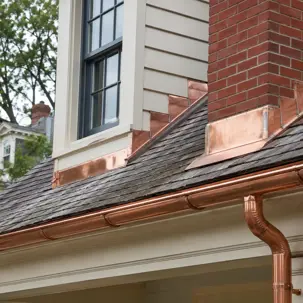
That is why many architectural homes across the East Side of Providence, East Greenwich, and Barrington demand a lifetime metallurgical solution: custom-fabricated copper flashing paired with copper gutters.
The Chemistry of Architectural Longevity (Why Copper Wins)
Flashing is the primary mechanism that redirects fast-moving water away from the most vulnerable roof areas. If the flashing fails, water can migrate behind shingles and siding, rot sheathing, and create hidden damage that may not show up until it becomes expensive.
The aluminum problem: Standard aluminum flashing often depends on sealants and exposed fasteners to stay watertight. Over time, thermal expansion and contraction can enlarge fastener holes, and UV exposure can degrade caulks. In a 10 to 20 year window, those small weaknesses can become chronic leak points - especially around chimneys and step flashing runs.
The copper advantage: Copper is a non-ferrous elemental metal. It contains no iron, so it does not rust. When exposed to the elements, copper naturally oxidizes, shifting from bright copper to brown and eventually to a classic green patina. That patina is not cosmetic only - it is a protective layer that resists atmospheric corrosion, salt air, and acid rain.
For homeowners investing in a premium roof system (especially historic and coastal properties), copper is not a trend. It is a long-term building material.
Mechanical Solder vs. Temporary Caulking (The Real Differentiator)
The biggest difference between standard contracting and true architectural metalwork is how the seams and corners are joined.
Many flashing systems rely on a bead of silicone to bridge gaps at chimney corners, roof-to-wall transitions, and other complex intersections. Caulking can be useful in the right place, but it is not a permanent structural joint. It can dry out, crack, separate, or wash away.
With copper, the premium approach is mechanical soldering.
Our technicians melt a solder alloy into properly prepared overlapping seams, fusing the copper components into a single continuous assembly. A soldered copper chimney flashing kit or copper valley lining is designed to function as a monolithic waterproof system - not a collection of parts held together by temporary sealants.
In practical terms, that means fewer failure points and a longer service life. It is one of the reasons copper detailing can remain functional for 50 to 100 years when installed correctly.
Why Bundle Copper Flashing + Copper Gutters for Premium Homes
A premium roof system is not only about keeping water out at the top. It is also about controlling water once it leaves the roof plane.
Copper gutters and downspouts are a natural match for copper flashing because:
- They create a unified architectural aesthetic for historic and high-end homes
- They resist corrosion in coastal environments
- They support long-term performance when paired with correct fastening and detailing
- They elevate curb appeal in a way aluminum systems do not
For many East Side Providence homes and coastal estates, bundling copper flashing and copper drainage is the cleanest way to build a cohesive exterior system that looks intentional and performs for decades.
High-Definition Asset Verification (Drone Super Scan)
Custom copper work is a significant investment. Verification matters.
We use our Drone Super Scan to document finished copper flashing and gutter lines from multiple aerial angles without walking on the roof or risking damage to softer metal surfaces. This helps confirm:
- Crisp folds and correct step flashing geometry
- Clean soldered seams at corners and transitions
- Proper integration with shingles or premium synthetic slate systems (including Platinum tier options like Brava Synthetic)
You get clear, unedited visual proof that the most important roof details were built correctly.
Planning a Roof Replacement in Rhode Island? Ask About Copper Detailing
If you are investing in a roof replacement because you want long-term protection, copper flashing and copper gutters can be the upgrade that separates a standard roof from a premium roof system.
If you are in Providence (East Side), Barrington, East Greenwich, or nearby Rhode Island towns, we can walk you through our Gold and Platinum tier roof system options and build a quote around full-system longevity - not short-term patchwork.
Call Mighty Dog Roofing of Rhode Island to schedule a roof replacement quote.
Rhode Island Service Locations:
Ashaway, Barrington, Bradford, Bristol, Carolina, Central Falls, Charlestown, Chepachet, Clayville, Coventry, Cranston, Cumberland, East Greenwich, East Providence, Exeter, Forestdale, Foster, Glendale, Greene, Greenville, Harrisville,Hope,Hope Valley, Hopkinton, Jamestown, Johnston, Kenyon, Kingston, Lincoln, Little Compton, Manville, Mapleville, Middletown, Narragansett, Newport, North Kingstown, North Providence, North Scituate, North Smithfield, Oakland, Pascoag, Pawtucket, Portsmouth, Providence, Riverside, Rockville, Rumford, Saunderstown, Shannock, Scituate, Slatersville, Smithfield, Tiverton, Wakefield, Warren, Warwick, West Greenwich, West Kingston, West Warwick, Westerly, Wood River Junction, Woonsocket, Wyoming
FAQ
Does copper flashing stain surrounding roof shingles?
As copper oxidizes, rainwater can carry microscopic copper ions down the roof. This natural process can discourage organic growth, which may help reduce dark algae and moss staining near the flashing lines.
How long does copper roof flashing last in Rhode Island?
When properly detailed and soldered by experienced professionals, custom copper flashing can outlast multiple generations of asphalt shingles and often remains functional for 75+ years.
Can you mix copper flashing with aluminum or steel valley metals?
No. Direct contact between dissimilar metals can trigger galvanic corrosion, which rapidly degrades the less noble metal. Copper should be installed with compatible fasteners and materials, and transitions should be detailed correctly.
Is copper worth it if I am replacing the roof anyway?
If your goal is full-system longevity (not just a new shingle surface), copper detailing can reduce long-term leak risk at the most vulnerable roof transitions and elevate the overall build quality of the roof replacement.