
1) Introduction: The Rhode Island “Slate Struggle”
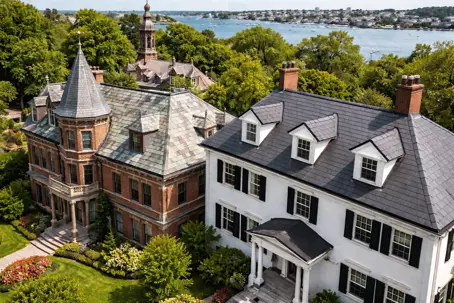
If you have ever walked the East Side of Providence or driven through Newport, you have seen it: historic homes with slate roofs that look like they belong in a magazine. Slate is not just a roofing material here. It is a status symbol. It signals craftsmanship, history, and a certain kind of Rhode Island pride.
But there is a second story that slate homeowners know too well.
Real slate is heavy, brittle, and expensive to repair. And every time a Nor’easter rolls in, many homeowners feel a very real kind of “slate anxiety.” Not just because of leaks, but because a cracked or sliding slate tile can become a liability if it falls.
The good news is you are not limited to two extremes (keep suffering with fragile slate or replace it with something that looks cheap). There is a third option that more Rhode Island homeowners are considering: composite or synthetic slate. Think of it as the technological evolution of stone, not a bargain imitation.
2) The “Real Slate” reality check (the cons)
The weight issue
Real slate is extremely heavy. Depending on the type and thickness, slate can weigh roughly 800 to 1,500 pounds per roofing square (100 square feet).
On many older Rhode Island homes, that weight is not just a roofing question. It can become a structural question. Some homes need reinforcement or repairs to framing and decking before a slate roof can be safely restored or replaced in kind.
The fragility factor
Slate is durable in the sense that it can last a long time when everything is perfect. But it is also brittle.
You generally cannot walk on slate the way you can on many asphalt roofs. A branch strike, a chimney sweep stepping in the wrong spot, or a contractor who is not trained on slate can crack tiles and create a chain reaction of repairs.
The maintenance nightmare
In 2026, finding a true slate specialist in Rhode Island can be difficult. The labor is specialized, the repair process is slow, and the cost reflects that.
If you have ever tried to schedule slate repairs after a storm, you already know: the best crews book out, and the bills can feel like a premium tax for owning a beautiful historic roof.
3) Enter synthetic slate: the “smart” luxury choice
Synthetic (composite) slate is designed to replicate the look of real slate while solving the biggest pain points.
What it is
Most premium synthetic slate products are made from engineered materials (often virgin resins with UV stabilizers and other additives) that are molded to mimic the texture and shadow lines of natural stone.
Curb appeal: from the street, you cannot tell
This is the part that surprises many homeowners. High-end synthetic slate is not flat and uniform. It is designed with chisel-like texture, varied widths, and a dimensional surface.
From curb distance, the roof reads as slate. That matters in neighborhoods where architecture and resale value are tied to historic character.
Durability you can feel
Many synthetic slate products are impact rated (often Class 4). In plain English: they are built to handle impacts that would crack real slate.
That matters in Rhode Island where winter storms, debris, and occasional hail can turn a small event into a big repair.
Wind performance for coastal towns
Wind uplift is real in Rhode Island, especially in coastal areas like Narragansett and Jamestown.
Premium synthetic slate products are often rated for high wind speeds (commonly 110+ mph when installed to specification). That does not mean “storm proof,” but it can be a meaningful upgrade in resilience compared to fragile, aging slate tiles.
4) The historic district obstacle (and why it is not always a deal-breaker)
The biggest question we hear is simple:
“Will the Historic District Commission approve synthetic slate?”
Often, yes.
Historic districts care about visual authenticity, proportions, and architectural character. Because premium synthetic slate can closely match the look of real slate, it is increasingly considered in historic zones when the alternative is a failing roof or a patchwork of mismatched repairs.
The key is to approach it the right way: - Choose a product that matches the existing slate look (color blend, thickness, exposure) - Prepare clear documentation - Provide samples and photos - Be ready to explain why the change protects the home while preserving the appearance
This is where homeowners get stuck, and where a contractor can either help or disappear.
If you live in a historic district, we can help you understand the approval process and prepare the documentation needed for a smoother review.
5) Cost comparison: the “Cranston to Newport” math
Real slate is typically the most expensive path because you are paying for: - Premium material - Specialized labor - Slower install and repair timelines - Potential structural reinforcement
Synthetic slate is still a premium roof, but the math is often different: - Premium material - Standard roofing labor (with proper training and manufacturer specs) - Less fragility during service work
The ROI is not just about the roof lasting longer. It is also about reducing the risk of constant specialty repairs and improving buyer confidence.
A crumbling slate roof can flag a home inspection fast. A slate-look roof that is documented, durable, and properly installed can be a strong selling point.
6) Conclusion: do not re-roof for 10 years, re-roof for 50
If you love the old world look of slate, you do not have to give it up to get modern performance.
Synthetic slate can deliver the curb appeal that fits Providence and Newport architecture, with better impact resistance, strong wind performance, and less maintenance stress.
If you live in a historic home and you are tired of temporary fixes, start with clarity.
Call/text (401) 425-4108 to schedule a drone inspection of your slate roof. We will document what is happening now and talk through whether repair, restoration, or a slate-look upgrade makes the most sense.
Rhode Island Service Locations:
Ashaway, Barrington, Bradford, Bristol, Carolina, Central Falls, Charlestown, Chepachet, Clayville, Coventry, Cranston, Cumberland, East Greenwich, East Providence, Exeter, Forestdale, Foster, Glendale, Greene, Greenville, Harrisville,Hope,Hope Valley, Hopkinton, Jamestown, Johnston, Kenyon, Kingston, Lincoln, Little Compton, Manville, Mapleville, Middletown, Narragansett, Newport, North Kingstown, North Providence, North Scituate, North Smithfield, Oakland, Pascoag, Pawtucket, Portsmouth, Providence, Riverside, Rockville, Rumford, Saunderstown, Shannock, Scituate, Slatersville, Smithfield, Tiverton, Wakefield, Warren, Warwick, West Greenwich, West Kingston, West Warwick, Westerly, Wood River Junction, Woonsocket, Wyomin
FAQ
Can you replace a slate roof with synthetic slate in Rhode Island?
In many cases, yes. The right choice depends on the home, roof structure, and whether the property is in a historic district. A professional inspection and documentation are the best first step.
Will a historic district approve synthetic slate?
Often, yes, when the product closely matches the look of slate and the application is documented properly. Approval depends on the specific district and review process.
Is synthetic slate worth it compared to asphalt?
Synthetic slate is typically more expensive than asphalt, but it can deliver a higher-end look, better impact resistance, and stronger long-term resale appeal for historic-style homes.
Can you walk on a slate roof?
Walking on slate is risky and can crack tiles. Many slate roofs should only be accessed by trained professionals using proper methods.